Full Text (PDF)
Indian Journal of Emergency Medicine 9(2):p 69-74, April-June 2023. | DOI: 10.21088/ijem.2395.311X.9223.3
Original Article
Comparative Evaluation of Levobupivacaine and Levobupivacaine with Dexmedetomidine in Infraumbilical Surgeries
Madhav Navlekar, Harshil Mehta1
Author Information
Licence:
Attribution-Non-commercial 4.0 International (CC BY-NC 4.0)This license enables reusers to distribute, remix, adapt, and build upon the material in any medium or format for noncommercial purposes only, and only so long as attribution is given to the creator.
Indian Journal of Emergency Medicine 9(2):p 69-74, April-June 2023. | DOI: 10.21088/ijem.2395.311X.9223.3
How Cite This Article:
Mehta H, Navlekar M. Comparative Evaluation of Levobupivacaine and Levobupivacaine with Dexmedetomidine in Infraumbilical Surgeries. Indian J Emerg Med. 2023;9(2):69–74.Timeline
Received : January 24, 2023
Accepted : February 25, 2023
Published : March 09, 2023
Abstract
Background and Aim: Spinal anesthesia is a widely used technique providing faster onset with effective and uniformly distributed sensory and motor block. Due to decreased cardiovascular and central nervous system toxicity, levobupivacaine is a good alternative for spinal anesthesia. Present study was done to compare the effects of adding of dexmedetomidine to levobupivacaine in prolonging the analgesia produced by epidural levobupivacaine alone in patients undergoing infraumbilical surgeries.
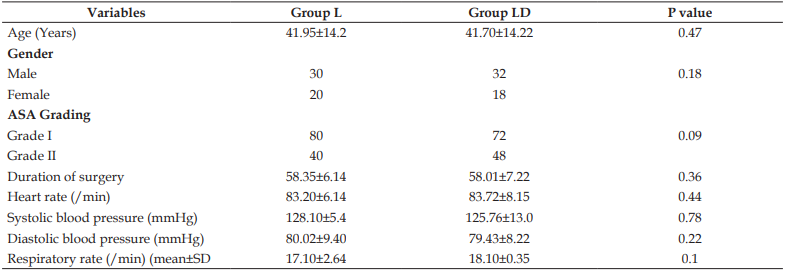
Material and Methods: A prospective study was carried out which included 100 adult patients between the age group of 20 and 65 years of physical status American Society of Anesthesiologists Classes I and II who underwent infraumbilical surgeries. Group L patients received 3 ml (15 mg) of 0.5% isobaric levobupivacaine + 0.3 ml normal saline while Group LD patients received 3 ml (15 mg) of 0.5% isobaric levobupivacaine + 0.3 ml (3 μg) dexmedetomidine. The two groups were compared with respect to the onset and duration of sensory and motor block and hemodynamic stability.
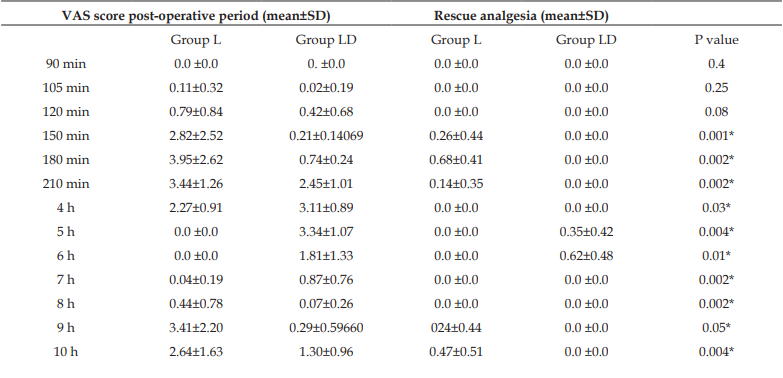
Results: In Group LD, increase in VAS was observed at 210 min and the first dose of rescue analgesia was given at 5th h postoperatively. The second dose of recue analgesia was given at 12th h and the third dose was given at 21st h. Postoperative VAS scores at different time intervals were significantly lower in Group LD than Group L, thus indicating superior analgesia. The time of request of the first dose of rescue analgesia was delayed in Group LD and the difference in the two groups was highly significant (P < 0.001).
Conclusion: Epidural administration of dexmedetomidine with levobupivacaine hydrochloride 0.5% results in faster onset of sensory and motor blockade compared to levobupivacaine hydrochloride 0.5% alone. Dexmedetomidine as an adjuvant to levobupivacaine hydrochloride 0.5% provides superior quality of analgesia without any significant hemodynamic instability.
References
- 1. Elliot JM. Regional anaesthesia in trauma. Trauma. 2001;3(3):161-74.
- 2. Sinha R, Gurwara AK, Gupta SC. Laparoscopic cholecystectomy under spinal anesthesia: A study of 3492 patients. J Laparoendosc Adv Surg Tech A. 2009;19(3):323-7.
- 3. Sinha R, Gurwara AK, Gupta SC. Laparoscopic cholecystectomy under spinal anesthesia: A study of 3492 patients. J Laparoendosc Adv Surg Tech A. 2009;19(3):323-7.
- 4. Merskey H, Fessard DG, Bonica JJ. Pain terms: A list with definition and terms of usage. J Pain. 1979;6(4):249-52.
- 5. Rodgers A, Walker N, Schug S, McKee A, Kehlet H, van Zundert A, et al. Reduction of postoperative mortality and morbidity with epidural or spinal anaesthesia: Results from overview of randomised trials. BMJ. 2000;321(7275):1493.
- 6. Brown DL, Carpenter RL, Thompson GE. Comparison of 0.5% ropivacaine and 0.5% bupivacaine for epidural anesthesia in patients undergoing lower extremity surgery. Anesthesiology. 1990;72(4):633-6.
- 7. Kambiyashi T, Maze M. Clinical uses of alpha-2-adrenergic agonists. Anesthesiology. 2000;93(5):1345-9.
- 8. Scafati A. Anaesthesia and alpha agonist 2. Medens Rev. 2004;4(1):7.
- 9. Gabriel JS, Gordin V. Alpha 2 agonist in regional anaesthesia and analgesia. Curr Opin Anaesthesiol. 2001;14(6):751-3.
- 10. Hall JE, Uhrich TD, Ebert TJ. Sedative, analgesic and cognitive effects of clonidine infusions in humans. Br J Anaesth. 2001;86(1):5-11.
- 11. Raghavendra TR, Yoganarasimha N, Radha MK, Mahdu R. A clinical study to compare the ease of intubation with combination of sevoflurane and propofol alone. Innov J Med Health Sci. 2013;3(1):143-8.
- 12. Ghanem SM, Massad IM, Mustafa MM, Zaben KR, Quadaist IY, Qatawneh AM, et al. Effect of adding dexmedetomidine versus fentanyl to intrathecal bupivacaine on spinal block characteristics in gynecological procedures: A double blind controlled study. Am J Appl Sci. 2009;6(5):882-7.
- 13. Kim JE, Kim NY, Lee HS, Kil HK. Effects of intrathecal dexmedetomidine on low dose bupivacaine spinal anesthesia in elderly patients undergoing transurethral prostatectomy. Biol Pharm Bull. 2013;36(6):959-65.
- 14. Kaur S, Attri JP, Kaur G, Singh TP. Comparative evaluation of ropivacaine versus dexmedetomidine and ropivacaine in epidural anesthesia in lower limb orthopedic surgeries. Saudi J Anaesth. 2014;8(4):463-9.
- 15. Soto RG, Fu ES. Acute pain management for patients undergoing thoracotomy. Ann Thorac Surg. 2003;75(4):1349-57.
- 16. Burmeister MA, Gottschalk A, Wilhelm S, Schroeder F, Becker C, Standl T. Ropivacaine 0.2% versus Bupivacaine 0.125% plus sufentanil for continuous peridural analgesia following extended abdominal operations. Anaesthesiol Intensivmed Notfallmed Schmerzther. 2001;36(4):219-23.
- 17. Lo WC, Harris J, Clarke RW. Endogenous opioids support the spinal inhibitory action of an alpha 2- adrenoceptor agonist in the decerebrated spinalised rabbit. Neurosci Lett. 2003;340(2):95-8.
- 18. Talke P, Xu M, Paloheimo M, Kalso E. Effects of intrathecally administered dexmedetomidine, MPV2426 and tizanidine on EMG in rats. Acta Anaesthesiol Scand. 2003;47(3):347-54.
- 19. Xu M, Kontinen VK, Kalso E. Effects of radolmidine, a novel alpha 2-adrenergic agonist compared with dexmedetomidine in different pain models in the rat. Anesthesiology. 2000;93(2):473-81.
- 20. Horvath G, Joo G, Dobos I, Klimscha W, Toth G, Benedek G. The synergistic antinociceptive interactions of endomorphin-1 with dexmedetomidine and/or S(+)- ketamine in rats. Anesth Analg. 2001;93(4):1018-24.
- 21. Shimode N, Fukuoka T, Tanimoto M, Tashiro C, Tokunaga A, Noguchi K. The effects of dexmedetomidine and halothane on the Fos expression in the spinal dorsal horn using a rat postoperative pain model. Neurosci Lett. 2003;343(1):45-8.
- 22. Onttonen T, Pertovaara A. The mechanical antihyperalgesic effect of intrathecally administered MPV-2426, a novel alpha2-adrenoceptor agonist, in a rat model of postoperative pain. Anesthesiology. 2000;92(6):1740-5.
- 23. Esmaoğlu A, Türk S, Bayram A, Akın A, Uğur F, Ulgey A, et al. The effects of dexmedetomidine added to spinal levobupivacaine for transurethral endoscopic surgery. Balkan Med J. 2013;30(2):186-90.
- 24. Basuni AS, Ezz HA. Dexmedetomidine as supplement to low dose levobupivacaine spinal anesthesia for knee arthroscopy. Egypt J Anaesth. 2014;30(2):149-53.
- 25. Kim JE, Kim NY, Lee HS, Kil HK. Effects of intrathecal dexmedetomidine on low dose bupivacaine spinal anesthesia in elderly patients undergoing transurethral prostatectomy. Biol Pharm Bull. 2013;36(6):959-65.
- 26. Eid HE, Mohamed AS, Youssef H. Dose related prolongation of hyperbaric bupivacaine spinal anaesthesia by dexmedetomidine. Ain Shams J Anesthesiol. 2011;2(2):83-95.
- 27. Amer MM, Rashwan DA, Shaker MA. Comparative study of two doses of intrathecal dexmedetomidine versus fentanyl as adjuvant to hyperbaric bupivacaine spinal anaesthesia. Med Sci (Basel). 2015;4(3):2450-64.
Data Sharing Statement
There are no additional data available. All raw data and code are available upon request.
Funding
There are no additional data available. All raw data and code are available upon request.
Author Contributions
All authors contributed significantly to the work and approve its publication.
Ethics Declaration
This article does not involve any human or animal subjects, and therefore does not require ethics approval.
Acknowledgements
Information not provided.
Conflicts of Interest
The authors report no conflicts of interest in this work.
About this article

Cite this article
Mehta H, Navlekar M. Comparative Evaluation of Levobupivacaine and Levobupivacaine with Dexmedetomidine in Infraumbilical Surgeries. Indian J Emerg Med. 2023;9(2):69–74.
Licence:
Attribution-Non-commercial 4.0 International (CC BY-NC 4.0)This license enables reusers to distribute, remix, adapt, and build upon the material in any medium or format for noncommercial purposes only, and only so long as attribution is given to the creator.
| Received | Accepted | Published |
|---|---|---|
| January 24, 2023 | February 25, 2023 | March 09, 2023 |
DOI: 10.21088/ijem.2395.311X.9223.3
Keywords
DexmedetomidineInfraumbilical SurgeryLevobupivacaineSpinal anesthesiaSearch for Similar Articles
Similar Articles
- Covid 19 Vaccine: Associated Henoch Schonlein Purpura in Young Adult Female
- A Rare Case of Intolerance to Medically Approved Dose of Sildenafil Citrate in a...
- Acute Mesenteric Ischemia: An Unusual Cause of Hematemesis in a 48 Year Old Man
- Brachial Artery Pseudoaneurysm Related Causally to Iatrogenic Coagulopathy in a...
- Combination Therapy for Acute Management of Yellow Oleander Poisoning: A Case Re...
Article Level Metrics
Last UpdatedSaturday 05 September 2026, 22:04:30 (IST)
4074
Accesses
9
922
00
Citations
NA
NA
NA
Download citation
Article Keywords
Keyword Highlighting
Highlight selected keywords in the article text.
Timeline
| Received | January 24, 2023 |
| Accepted | February 25, 2023 |
| Published | March 09, 2023 |
licence
Attribution-Non-commercial 4.0 International (CC BY-NC 4.0)
This license enables reusers to distribute, remix, adapt, and build upon the material in any medium or format for noncommercial purposes only, and only so long as attribution is given to the creator.