Full Text (PDF)
Indian Journal of Anesthesia and Analgesia 9(3):p 119-123, May-June 2022. | DOI: https://doi.org/10.21088/ijaa.2349.8471.9322.10
Original Article
Comparative Evaluation of Effect, Onset & Duration of Intranasal Dexmedetomidine Vs Midazolam for Paediatric Sedation During Diagnostic CT Scan
Ashwin Sonkamble null, Somiya Gautam 1 null, Ashwin Sonkamble 2 null, Poornima Sonkamble 3 null, Usha Badole 4 null
Author Information
Licence:
Attribution-Non-commercial 4.0 International (CC BY-NC 4.0)This license enables reusers to
distribute, remix, adapt, and build upon the material in any medium or format
for noncommercial purposes only, and only so long as attribution is given to
the creator.
Indian Journal of Anesthesia and Analgesia 9(3):p 119-123, May-June 2022. | DOI: https://doi.org/10.21088/ijaa.2349.8471.9322.10
How Cite This Article:
Somiya Gautam, Ashwin Sonkamble, Poornima Sonkamble, et al./Comparative Evaluation of Effect, Onset & Duration of Intranasal Dexmedetomidine Vs Midazolam for Paediatrics Sedation During Diagnostic CT Scan/ Indian J Anesth Analg. 2022;9(3)119-123
Timeline
Received : April 25, 2022
Accepted : May 26, 2022
Published : June 20, 2022
Abstract
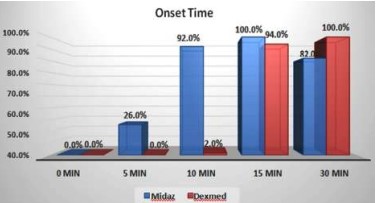
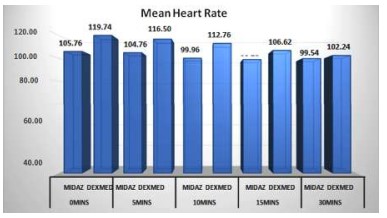
Background: Separation anxiety among children is common and normal.Children undergoing radiological imaging studies often require sedation to avoid panic episodes & severe anxiety for induction of Anaesthesia. It is important for the child to lie still during the scanning procedure & mostly we find it difficult for the children to keep still during a CT scan, which is usually about 10–15 minutes. This study aimed at comparing and evaluating the efficacy of use of intranasally administered Dexmedetomidine Vs intranasal midazolam for paediatric sedation undergoing diagnostic CT scan studies.
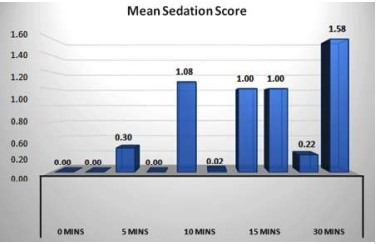
Methods: 100 paediatric patients within age group 1-10 years were divided into 2 groups of 50 patients each, Group I & II respectively, were given either intranasal Dexmedetomidine or Intranasal Midazolam. The depth of sedation was assessed by using University of Michigan sedation scale.
Results: This study concluded that Intranasal Dexmedetomidine is superior & more effective than Midazolam for pediatric sedation.
References
- 1. Mason KP, Zgleszewski SE, Dearden JL, Dumont RS, Pirich MA, Stark CD, D'Angelo P, Macpherson S, Fontaine PJ, Connor L, Zurakowski D. Dexmedetomidine for pediatric sedation for computed tomography imaging studies. AnesthAnalg. 2006 Jul;103(1):57-62.
- 2. Jun JH, Kim KN, Kim JY, Song SM: The effects of intranasal dexmedetomidine premedication in children:a systematic review and metaanalysis;2017Sep;64(9):947-961.doi:10.1007/s12630-017-0917-x.Epub 2017 Jun21.
- 3. Akin A, Bayram A, Esmaoglu A, Tosun Z, Aksu R, Altuntas R, Boyaci A: Dexmedetomidinevs midazolam for premedication of pediatric patients undergoing anesthesia; PaediatricAnaesth. 2012 Sep;22(9):871-6. doi: 10.1111/j.1460-9592.2012.03802.x. Epub 2012 Jan23
- 4. Pasin L, Febres D, Testa V, Frati E, Borghi G, LandoniG, Zangrillo A: Dexmedetomidinevs midazolam as preanesthetic medication in children: a meta- analysis of randomized controlled trials;PaediatrAnaesth. 2015 May;25(5):468-76. doi: 10.1111/pan.12587. Epub 2015Jan 6.
- 5. Dr.Pradipta Bhakta, Dr. B. R. Ghosh, Dr. Manjushree Roy, Dr.Gouri Mukherjee. Evaluation of intranasal
- 6. Peng K, Wu SR, Ji FH, Li J. Premedication with dexmedetomidine in pediatric patients: a systematic review and meta-analysis. Clinics. 2014;69(11):777-786.
- 7. Talon MD, Woodson LC, Sherwood ER, Aarsland A, McRae L, Benham T. Intranasal dexmedetomidine
- 8. Sheta SA, Al-Sarheed MA, Abdelhalim AA. Intranasal dexmedetomidinevs midazolam for premedication in children undergoing complete dental rehabilitation: A double-blinded randomized controlled trial. Paediatric Anaesth 2014;24:181-9.
- 9. Malineni N, Patil MC. “Comparative evaluation of intranasal dexmedetomidine and intranasal
- 10. Davis PJ, Tome JA, McGowan FX Jr., Cohen IT, Latta K, Felder H. Preanesthetic medication with
- 11. Dr. ShwetaNitturi, Dr. OlvynaD’souza. A Comparative Evaluation of Intranasal Dexmedetomidine and Intranasal Midazolam for Premedication in Pediatric Surgery. IAIM, 2018; 5(1): 82-94.
- 12. Malviya S, Voepel-Lewis T, Tait AR, Merkel S, Tremper K, Naughton N. Depth of sedation in children undergoing computed tomography: validity and reliability of the University of Michigan Sedation Scale (UMSS).Br J Anaesth. 2002 Feb;88(2):241-5.
Data Sharing Statement
There are no additional data available. All raw data and code are available upon request.
Funding
This research received no funding.
Author Contributions
All authors contributed significantly to the work and approve its publication.
Ethics Declaration
Provide information related to the Ethics Committee approval with approval number OR write, This article does not involve any human or animal subjects, and therefore does not require ethics approval.
Acknowledgements
We would like to express our gratitude to the patients, their families, and all those who have contributed to this study.
Conflicts of Interest
The authors report no conflicts of interest in this work.
About this article

Cite this article
Somiya Gautam, Ashwin Sonkamble, Poornima Sonkamble, et al./Comparative Evaluation of Effect, Onset & Duration of Intranasal Dexmedetomidine Vs Midazolam for Paediatrics Sedation During Diagnostic CT Scan/ Indian J Anesth Analg. 2022;9(3)119-123
Licence:
Attribution-Non-commercial 4.0 International (CC BY-NC 4.0)This license enables reusers to
distribute, remix, adapt, and build upon the material in any medium or format
for noncommercial purposes only, and only so long as attribution is given to
the creator.
| Received | Accepted | Published |
|---|---|---|
| April 25, 2022 | May 26, 2022 | June 20, 2022 |
DOI: https://doi.org/10.21088/ijaa.2349.8471.9322.10
Keywords
:Intranasal;Dexmedetomidine;Midaolam;Pediatrics;Children;Sedation;CScanSearch for Similar Articles
Similar Articles
- Awake Fibreoptic Intubation for Airway Management in Massive Thyroid Enlargement...
- A Case of Thoracotomy with One Lung Ventilation for Carcinoma Oesophagus
- A Case of Empyema for Thoracotomy and Decortication-Anaesthesia Management
- Full Mouth Rehabilitation in a 3-Year-Old Female Child with Repaired Tetralogy o...
- Do Gel Manicures Affect SpO2 Readings ? A Clinical Investigation
Article Level Metrics
Last UpdatedMonday 13 July 2026, 12:32:15 (IST)
5653
Accesses
6
678
00
Citations
NA
NA
NA
Download citation
Article Keywords
Keyword Highlighting
Highlight selected keywords in the article text.
Timeline
| Received | April 25, 2022 |
| Accepted | May 26, 2022 |
| Published | June 20, 2022 |
licence
Attribution-Non-commercial 4.0 International (CC BY-NC 4.0)
This license enables reusers to
distribute, remix, adapt, and build upon the material in any medium or format
for noncommercial purposes only, and only so long as attribution is given to
the creator.