Full Text (PDF)
Indian Journal of Emergency Medicine 11(4):p 215-219, Oct - Dec. 2025. | DOI: https://doi.org/10.21088/ijem.2395.311X.11425.1
Case Report
Comparative Evaluation of Bain Circuit Versus Non-invasive Ventilation for Preoxygenation in Preventing Peri-Intubation Hypoxemia
Anup Kumar Roy A. Roy A., Varun Byrappa, Arun A. Mohanan, Shreyas Satish, Kishore null, Kushanth P, Sangamesh Mustare
Author Information
Licence:
Attribution-Non-commercial 4.0 International (CC BY-NC 4.0)This license enables reusers to distribute, remix, adapt, and build upon the material in any medium or format for noncommercial purposes only, and only so long as attribution is given to the creator.
Indian Journal of Emergency Medicine 11(4):p 215-219, Oct - Dec. 2025. | DOI: https://doi.org/10.21088/ijem.2395.311X.11425.1
How Cite This Article:
Byrappa V, Mohanan AA, Satish S, et al. Comparative Evaluation of Bain Circuit Versus Noninvasive Ventilation for Preoxygenation in Preventing Peri-Intubation Hypoxemia. Ind J Emerg Med. 2025;11(4):215-9.Timeline
Received : June 12, 2025
Accepted : July 21, 2025
Published : December 30, 2025
Abstract
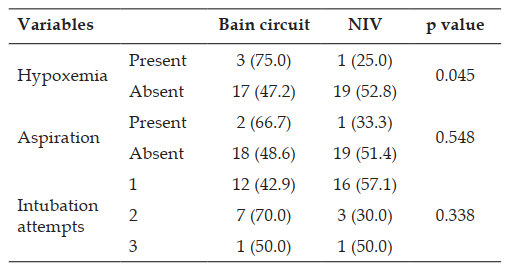
Introduction: Preoxygenation is a cornerstone of safe airway management, aiming to prevent hypoxemia during the apnoea associated with intubation. Efforts to optimize preoxygenation have led to the exploration of alternative techniques, such as non-invasive ventilation (NIV). The Bain circuit, a low-resistance modification of the Mapleson D system, is commonly utilized for its effcient gas delivery to support both spontaneous and controlled ventilation. Settings and Design: Prospective observational study. Methods and Materials: The aim was to compare the effectiveness of the Bain circuit versus NIV in preoxygenation to prevent peri-intubation hypoxemia. A prospective study was conducted among 40 subjects (20 in each of the NIV and Bain circuit groups) who were 18 years of age or older. Pregnant patients and those with diffculty in the airways, hemodynamic instability, and facial trauma were excluded. The lowest SpO2 level achieved, the time to desaturation (SpO2 < 90%), and the incidence of hypoxemia and adverse outcomes were noted in both groups and compared. Results: The lowest SpO2 level achieved was 88.0% and 83.0% in NIV and Bain circuit groups respectively (p <0.049). Incidence of hypoxemia was higher in the Bain circuit group than the NIV group (15.0% v 5.0%; p <0.049). Time to desaturation during intubation was found to be higher in the Bain circuit group. Two patients (10.0%) in the Bain circuit group and one patient (5.0%) in the NIV group developed aspiration pneumonitis during intubation. Conclusions: Among adults undergoing tracheal intubation, preoxygenation with NIV resulted in a lower incidence of hypoxemia during intubation than preoxygenation with the Bain circuit.
References
- 1. A.P., Lm W., C.S. Most Frequent Procedures Performed in U.S. Hospitals, 2011 [Internet].
- 2. PubMed. 2006 [cited 2025 Jun 8]. Available from: https://pubmed.ncbi.nlm.nih.gov/24354027/
- 3. National Hospital Ambulatory Medical Care Survey: 2018 Emergency Department Summary Tables
- 4. Prekker M.E., Driver B.E., Trent S.A., ResnickAult D., Seitz K.P., Russell D.W., et al. Video versus Direct Laryngoscopy for Tracheal Intubation of Critically Ill Adults. N Engl J Med [Internet]. 2023 [cited 2025 Jun 6]; Available from: https://www.nejm.org/doi/ full/10.1056/NEJMoa2301601
- 5. Nj S, Ak K., E B, Le M, Ur O, Da K, et al. Risk Factors for and Outcomes Associated With Peri-Intubation Hypoxemia: A Multicenter Prospective Cohort Study. J Intensive Care Med [Internet]. 2021 [cited 2025 Jun 8]; 36. Available from: https://pubmed.ncbi.nlm.nih. gov/33000661/
- 6. 7. Md B. Routine pre-oxygenation - a new ‘minimum standard’ of care? Anaesthesia [Internet]. 2004 [cited 2025 Jun 8]; 59. Available from: https://pubmed.ncbi.nlm.nih. gov/15488049/
- 7. Md B. Routine pre-oxygenation - a new ‘minimum standard’ of care? Anaesthesia [Internet]. 2004 [cited 2025 Jun 8]; 59. Available from: https://pubmed.ncbi.nlm.nih. gov/15488049/
- 8. Nd C, M O, Jr W, R H, Jc S. Use of End Tidal Oxygen Monitoring to Assess Preoxygenation During Rapid Sequence Intubation in the Emergency Department. Ann Emerg Med [Internet]. 2019 [cited 2025 Jun 8]; 74. Available from: https://pubmed.ncbi.nlm.nih. gov/30879700/
- 9. O L, L R, O B. Analysis of non-invasive ventilation effects on gastric inflation using a non-linear mathematical model. Resuscitation [Internet]. 2006 [cited 2025 Jun 8]; 71. Available from: https://pubmed.ncbi.nlm.nih. gov/17069955/
- 10. M C, U F, As B, D D, F G, R C, et al. Complications of non-invasive ventilation techniques: a comprehensive qualitative review of randomized trials. Br J Anaesth [Internet]. 2013 [cited 2025 Jun 8];110. Available from: https:// pubmed.ncbi.nlm.nih.gov/23562934/
- 11. C B, Jp F, M S, G C, F V, P C, et al. Noninvasive ventilation improves preoxygenation before intubation of hypoxic patients. Am J Respir Crit Care Med [Internet]. 2006 [cited 2025 Jun 8]; 174. Available from: https://pubmed.ncbi. nlm.nih.gov/16627862/
- 12. C B, G P, B J, E F, Jy L, F V, et al. Effect of preoxygenation using non-invasive ventilation before intubation on subsequent organ failures in hypoxaemic patients: A randomised clinical trial. Br J Anaesth [Internet]. 2018 [cited 2025 Jun 8]; 120. Available from: https://pubmed. ncbi.nlm.nih.gov/29406184/
- 13. Kaul TK, Mittal G. Mapleson’s Breathing Systems. Indian J Anaesth. 2013; 57: 507.
- 14. Arrive F., Pape S.L., Bruhn A., Lehalleur A.P., Beuvon C., Tuffet S., et al. Physiological comparison of noninvasive ventilation and highflow nasal oxygen on inspiratory efforts and tidal volumes after extubation: a randomized crossover trial. Crit Care. 2025; 29: 185.
Data Sharing Statement
There are no additional data available. All raw data and code are available upon request.
Funding
This research received no funding.
Author Contributions
All authors contributed significantly to the work and approve its publication.
Ethics Declaration
This article does not involve any human or animal subjects, and therefore does not require ethics approval.
Acknowledgements
We would like to express our gratitude to the patients, their families, and all those who have contributed to this study.
Conflicts of Interest
No conflicts of interest.
About this article

Cite this article
Byrappa V, Mohanan AA, Satish S, et al. Comparative Evaluation of Bain Circuit Versus Noninvasive Ventilation for Preoxygenation in Preventing Peri-Intubation Hypoxemia. Ind J Emerg Med. 2025;11(4):215-9.
Licence:
Attribution-Non-commercial 4.0 International (CC BY-NC 4.0)This license enables reusers to distribute, remix, adapt, and build upon the material in any medium or format for noncommercial purposes only, and only so long as attribution is given to the creator.
| Received | Accepted | Published |
|---|---|---|
| June 12, 2025 | July 21, 2025 | December 30, 2025 |
DOI: https://doi.org/10.21088/ijem.2395.311X.11425.1
Keywords
Non invasive ventilationBains circuitProspective studyObservational studyEmergency medicineSearch for Similar Articles
Similar Articles
- Inherited Thrombophilia as a Cause of Post-Partum Massive Pulmonary Embolism: A...
- ATAK Complex Presenting as Hypertensive Pulmonary Edema Following Meropenem-Indu...
- When Infection Triggers Thrombosis: A Case of Extensive DVT in a Young Male
- Case Report: Diagnostic Dilemma in 69-Year-Old Male with Radiating Right Shoulde...
- The Silent Gallbladder, The Slowing Heart: Cope’s Sign in Acute Calculous Cholec...
Article Level Metrics
Last UpdatedTuesday 20 October 2026, 22:38:41 (IST)
6088
Accesses
41
1017
00
Citations
NA
NA
NA
Download citation
Article Keywords
Keyword Highlighting
Highlight selected keywords in the article text.
Timeline
| Received | June 12, 2025 |
| Accepted | July 21, 2025 |
| Published | December 30, 2025 |
licence
Attribution-Non-commercial 4.0 International (CC BY-NC 4.0)
This license enables reusers to distribute, remix, adapt, and build upon the material in any medium or format for noncommercial purposes only, and only so long as attribution is given to the creator.