Full Text (PDF)
Indian Journal of Trauma and Emergency Pediatrics 15(3):p 77-80, July-September 2023. | DOI: https://doi.org/10.21088/ijtep.2348.9987.15323.1
Original Article
Clinico-Etiological Profile and Short Term Outcomes in Pediatric Head Injury Cases: Our Institutional Experience
Prajakta Sharad Ghatage, Karansinh Raosaheb Parve Patil, Sharad Tatyasaheb Ghatage, Dilip Pandurang Karmarkar
Author Information
Licence:
Attribution-Non-commercial 4.0 International (CC BY-NC 4.0)This license enables reusers to distribute, remix, adapt, and build upon the material in any medium or format for noncommercial purposes only, and only so long as attribution is given to the creator.
Indian Journal of Trauma and Emergency Pediatrics 15(3):p 77-80, July-September 2023. | DOI: https://doi.org/10.21088/ijtep.2348.9987.15323.1
How Cite This Article:
Karansinh Raosaheb Parve Patil, Prajakta Sharad Ghatage, Sharad Tatyasaheb Ghatage et al./Clinico- Etiological Profile and Short Term Outcomes in Pediatric Head Injury Cases: Our Institutional Experience/Indian J Trauma Emerg Pediatr.2023;15(3):77–80.Timeline
Received : July 26, 2023
Accepted : August 30, 2023
Published : September 30, 2023
Abstract
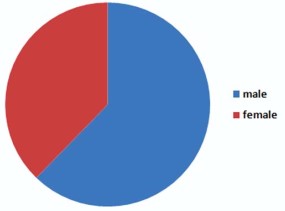
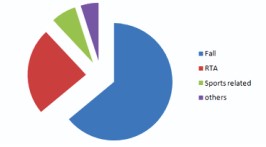
Introduction: In developing countries like India, the incidence of TBI is very high. The pathophysiology, clinical presentations and management are different as compared to adults. Hence the need to have a focused study to evaluate etiology and outcomes in Pediatric traumatic head injury. Material and Method: We retrospectively studied 45 cases of pediatric traumatic head injury upto age 14 years presenting to our institute. The study period was of 1 year from june 2022 to june 2023. Demographic data and clinical features were noted and severity was assessed by GCS scale on admission. CT scan was done in all cases. Result: The number of males were 62.2% while 37.7% were females. The mean age of presentation was 5.7 years. The most common etiology in our study was fall (64%) followed by RTA (24%) and sports and others constituting the least (7%). The most common presenting feature was headache (66.6%), vomitting (63.4%) followed seizures (26.4) and loss of consciousness (6%). On basis of GCS, 90% cases were mild in severity and 8% moderate and 2% severe. CT was normal in 32% cases and abnormal in 68% cases with Fractures being more common finding. The short term outcome was good in 95.6% and 4.4% had neurodeficit. Anti convulsants were prescribed to 26% case. Conclusion: There is a urgent need to have studies focused on pediatric head injury cases. In present study we try to contribute to the current literature available in Indian settings. We also want to increase awareness about preventable cases as most of the head injury cases can be avoided by vigilance and care by the parents.
References
- 1. Centers for Disease Control and Prevention WISCARS. Leading Causes of Death Reports, National and Regional, 1999–2013, 2015.
- 2. Shekhar C, Gupta LN, Premsagar IC, et al. An epidemiological study of traumatic brain injury cases in a trauma centre of New Delhi (India). J Emerg Trauma Shock. 2015;8:131-139.
- 3. Agrawal A, Kakani A, Baisakhiya N, et al. Developing traumatic brain injury data bank: prospective study to understand the pattern of documentation and presentation. Ind J Neurotrauma. 2012;9: 87-92.
- 4. Silen ML, Kokoska ER, Fendya DG, Kurkchubasche AG, Weber TR, Tracy TF: Rollover injuries in residential drive ways: agerelated patterns of injury. Pediatrics 104: e7, 1999.
- 5. Langlois JA, Rutland-Brown W, Wald MM. The epidemiology and impact of traumatic brain injury: a brief overview. J Head Trauma Rehabil. 2006;21(5):375-378
- 6. Thurman DJ. The epidemiology of traumatic brain injury in children and youths: a review of research since 1990. J Child Neurol. 2016;31:20- 27.
- 7. Roy JM, Balasubramaniam S, Barve PS, Nadkarni TD. Clinical profile, evaluation of imaging guidelines, and management of pediatric traumatic brain injury at a tertiary care centre in India :A review of 269 patients. J Pediatr Neurosci.
- 8. Sharma M, Lahoti BK, Khandelwal G, Mathur RK, Sharma SS, Laddha A. Epidemiological trends of pediatric trauma: a single-center study of 791 patients. J Indian Assoc Pediatr Surg. 2011;16(3):88–92.
- 9. Satapathy M, Dash D, Mishra S, Tripathy S, Nath P, Jena S (2016) Spectrum and outcome of traumatic brain injury in children.
- 10. Kuppermann N, Holmes J, Dayan P, Hoyle J, Atabaki S, Holubkov R et al. (2009) Identification of children at very low risk of clinically-important brain injuries after head trauma: a prospective cohort study. Lancet 374(9696):1160–1170
- 11. Gururaj G. Epidemiology of traumatic brain injuries: Indian scenario. Neurol Res. 2002;24(1):24–28.
- 12. Osmond MH, Brennan-Barnes MW, Shephard AL. A 4-year review of severe pediatric trauma in Eastern Ontario: a descriptive analysis. J Trauma. 2002;52(1):8–12.
- 13. Chaitanya K, Addanki A, Karambelkar R, Ranjan R. Traumatic brain injury in Indian children. Childs Nerv Syst. 2018;34(6):1119–1123.
- 14. Nath HD, Tandon V, Mahapatra AK, Kumar R. Outcome of pediatric head injury patients admitted as unknown at a level-I apex trauma centre. Asian J Neurosurg. 2015;10(3):149–152.
Data Sharing Statement
There are no additional data available. All raw data and code are available upon request.
Funding
This research received no funding.
Author Contributions
All authors contributed significantly to the work and approve its publication.
Ethics Declaration
This article does not involve any human or animal subjects, and therefore does not require ethics approval.
Acknowledgements
We would like to express our gratitude to the patients, their families, and all those who have contributed to this study.
Conflicts of Interest
No conflicts of interest in this work.
About this article

Cite this article
Karansinh Raosaheb Parve Patil, Prajakta Sharad Ghatage, Sharad Tatyasaheb Ghatage et al./Clinico- Etiological Profile and Short Term Outcomes in Pediatric Head Injury Cases: Our Institutional Experience/Indian J Trauma Emerg Pediatr.2023;15(3):77–80.
Licence:
Attribution-Non-commercial 4.0 International (CC BY-NC 4.0)This license enables reusers to distribute, remix, adapt, and build upon the material in any medium or format for noncommercial purposes only, and only so long as attribution is given to the creator.
| Received | Accepted | Published |
|---|---|---|
| July 26, 2023 | August 30, 2023 | September 30, 2023 |
DOI: https://doi.org/10.21088/ijtep.2348.9987.15323.1
Keywords
PediatricTraumatic Head InjuryComputed TomographyArticle Level Metrics
Last UpdatedSaturday 24 October 2026, 13:54:43 (IST)
1810
Accesses
87
249
00
Citations
NA
NA
NA
Download citation
Article Keywords
Keyword Highlighting
Highlight selected keywords in the article text.
Timeline
| Received | July 26, 2023 |
| Accepted | August 30, 2023 |
| Published | September 30, 2023 |
licence
Attribution-Non-commercial 4.0 International (CC BY-NC 4.0)
This license enables reusers to distribute, remix, adapt, and build upon the material in any medium or format for noncommercial purposes only, and only so long as attribution is given to the creator.