Full Text (PDF)
Indian Journal of Anesthesia and Analgesia 11(4):p 198-203, Oct - Dec. 2024. | DOI: https://doi.org/10.21088/ijaa.2349.8471.11424.4
Original Article
Clinical Utility of Epidural Volume Extension Following Reduced Intrathecal Doses: A Randomized Controlled Trial
Miral G. Joshi, Bipin M Patel, Parth M. Shah, Dipal Kharsadiya, Brijesh Bhayani
Author Information
Licence:
Attribution-Non-commercial 4.0 International (CC BY-NC 4.0)This license enables reusers to distribute, remix, adapt, and build upon the material in any medium or format for noncommercial purposes only, and only so long as attribution is given to the creator.
Indian Journal of Anesthesia and Analgesia 11(4):p 198-203, Oct - Dec. 2024. | DOI: https://doi.org/10.21088/ijaa.2349.8471.11424.4
How Cite This Article:
Joshi MG, Shah PM, Patel BM, et al. Clinical utility of epidural volume extension following reduced intrathecal doses: a randomized controlled trial. Ind J Anesth Analg. 2024;11(4):198-203.Timeline
Received : March 29, 2024
Accepted : May 31, 2024
Published : December 20, 2024
Abstract
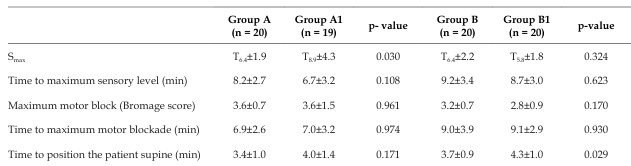
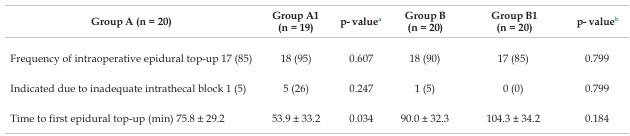
Overview The study aimed to investigate the impact of Epidural Volume Extension (EVE) on sensory block height following intrathecal injections with reduced doses of bupivacaine. It was designed as a randomized, controlled, double-blind trial involving 80 adult male patients with ASA status I or II scheduled for orthopedic lower limb surgery under combined spinal epidural anaesthesia. Patients were randomly assigned to receive either a reduced intrathecal dose of bupivacaine (5 or 8 mg) with or without EVE, based on group allocation. The study aimed to compare the maximum sensory level (Smax) achieved with and without EVE application across the two different intrathecal doses. Further research is warranted to better understand the relationship between intrathecal dose and EVE efficacy, considering various factors such as instillation technique, timing, and patient characteristics. Results: The study revealed that applying Epidural Volume Extension (EVE) alongside a 5 mg intrathecal bupivacaine dose significantly decreased the maximum sensory block height (Smax) compared to not using EVE However, there was no significant difference in Smax when EVE was applied alongside an 8 mg intrathecal bupivacaine dose compared to without it. Conclusion: Avoiding the application of Epidural Volume Extension (EVE) to 5 mg plain bupivacaine during a combined spinal epidural block in patients undergoing lower limb orthopedic surgery is advisable. This caution stems from the observation that implementing EVE alongside this particular dosage of bupivacaine could lead to a reduction in the maximum sensory level.
References
- 1. McNaught AF, Stocks GM. Epidural volume extension and lowdose sequential combined spinal-epidural blockade: two ways to reduce spinal dose requirement for caesarean section. Int J Obstet Anesth. 2007;16:346-53.
- 2. Heesen M, Weibel S, Klimek M, Rossaint R, Arends LR, Kranke P. Effects of epidural volume extension by saline injection on the efficacy and safety of intrathecal local anaesthetics: systematic review with meta-analysis, meta-regression and trial sequential analysis. Anaesthesia. 2017;72:1398-411.
- 3. Tyagi A, Sharma CS, Kumar S, Sharma DK, Jain AK, Sethi AK. Epidural volume extension: a review. Anaesth Intensive Care. 2012;40:604-13.
- 4. Mohan A, Singh PM, Malviya D, Arya SK, Singh DK. Reinforcement of subarachnoid block by epidural volume effect in lower abdominal surgery: A comparison between fentanyl and tramadol for efficacy and block properties. Anesth essays Res. 2012;6:189-94.
- 5. Tyagi A, Kumar A, Girotra G, Sethi Ak. Combined spinal epidural and epidural volume extension: Interaction of patient position and hyperbaric bupivacaine. J Anaesthesiol Clin Pharmacol. 2011;27:459-64.
- 6. Tyagi A, Kumar S, Salhotra R, Sethi AK. Minimum effective volume of normal saline for epidural volume extension. J Anaesthesiol Clin Pharmacol. 2014;30:228-32.
- 7. Choi DH, Park NK, Cho HS, Hahm TS, Chung IS. Effects of epidural injection on spinal block during combined spinal and epidural anesthesia for cesarean delivery. Reg Anesth Pain Med. 2000;25:591-5.
- 8. Blumgart CH, Ryall D, Dennison B, ThompsonHill LM. Mechanism of extension of spinal anaesthesia by extradural injection of local anaesthetic. Br J Anaesth. 1992;69:457-60.
- 9. Stienstra R, Dilrosun Alhadi BZ, Dahan A, van Kleef JW, Veering BT, Burm AG. The epidural top-up in combined spinal epidural anesthesia: the effect of volume versus dose. Anesth Analg. 1999;88:810-4.
- 10. Stienstra R, Dahan A, Alhadi BZ, van Kleef JW, Burm AG. Mechanism of action of an epidural top-up in combined spinal epidural anesthesia. Anesth Analg. 1996;83:382-6.
- 11. Doganci N, Apan A, Tekin O, Kaymak C¸. Epidural volume expansion: is there a ceiling effect? Minerva Anestesiol. 2010;76:334-9.
- 12. Zaphiratos V, George RB, Macaulay B, Bolleddula P, McKeen DM. Epidural Volume Extension During Combined Spinal-Epidural Labor Analgesia Does Not Increase Sensory Block. Anesth Analg. 2016; 123:684-9.
- 13. Loubert C, O’Brien PJ, Fernando R, Walton N, Philip S, Addei T, et al. Epidural volume extension in combined spinal epidural anaesthesia for elective caesarean section: a randomised controlled trial. Anaesthesia. 2011;66:341-7.
- 14. Hamlyn EL, Douglass CA, Plaat F, Crowhurst JA, Stocks GM. Low-dose sequential combined spinal-epidural: an anaesthetic technique for caesarean section in patients with significant cardiac disease. Int J Obstet Anesth. 2005;14:355- 61.
- 15. Richardson P, Whittaker S, Rajesh U, Bonduelle M, Morgan J, Garry M, et al. Caesarean delivery in a parturient with a femorofemoral crossover graft and congenital aortic stenosis repaired by the Ross procedure. Int J Obstet Anesth. 2009;18:387-91.
- 16. Tiwari AK, Singh RR, Anupam RP, Ganguly S, Tomar GS. Epidural volume extension: A novel technique and its efficacy in high risk cases. Anesth essays Res. 2012;6:233-5.
- 17. Tyagi A, Kumar A, Sethi AK, Mohta M. Epidural volume extension and intrathecal dose requirement: plain versus hyperbaric bupivacaine. Anesth Analg. 2008;107:333-8.
- 18. Breen TW, Shapiro T, Glass B, Foster-Payne D, Oriol NE. Epidural anesthesia for labor in an ambulatory patient. Anesth Analg. 1993;77:919- 24.
- 19. Chen M, Chen C, Ke Q. The effect of age on the median effective dose (ED50) of intrathecally administered plain bupivacaine for motor block. Anesth Analg. 2014;118:863-8.
- 20. Tiwari AK, Agrawal J, Tayal S, Chadha M, Singla A, Valson G, et al. Anaesthetic management of peripartum cardiomyopathy using epidural volume extension technique: a case series. Ann Card Anaesth. 2012;15:44-6.
- 21. Guasch E, Alsina E, Domínguez A, Diaz J, Gilsanz F. Epidural volume extension with low dose spinal anesthesia for cesarean section. Eur J Anaesthesiol. 2007;24:143-4.
- 22. Hamlyn EL, Douglass CA, Plaat F, Crowhurst JA, Stocks GM. Low-dose sequential combined spinal-epidural: an anaesthetic technique for caesarean section in patients with significant cardiac disease. Int J Obstet Anesth. 2005;14:355- 61.
- 23. Lew E, Yeo S-W, Thomas E. Combined spinalepidural anesthesia using epidural volume extension leads to faster motor recovery after elective cesarean delivery: a prospective, randomized, double-blind study. Anesth Analg. 2004; 98:810-4.
- 24. Yun MJ, Kwon MY, Kim DH, Lee JW. Combined spinal-epidural anesthesia using a reduced-dose of spinal bupivacaine and epidural top up leads to faster motor recovery after lower extremity surgeries. Korean J Anesthesiol. 2014; 66:28-33.
- 25. Choi D-H, Ahn H-J, Kim J-A. Combined lowdose spinal-epidural anesthesia versus singleshot spinal anesthesia for elective cesarean delivery. Int J Obstet Anesth. 2006; 15(1):13-7.
- 26. Mohamed Sherin A. Epidural volume expansion and single shot spinal anesthesia, for elective caesarean section. Al-Azhar Assiut Med JAAMJ. 2003;10.
- 27. Kucukguclu S, Unlugenc H, Gunenc F, Kuvaki B, Gokmen N, Gunasti S, et al. The influence of epidural volume extension on spinal block with hyperbaric or plain bupivacaine for Caesarean delivery. Eur J Anaesthesiol. 2008; 25:307-13.
Data Sharing Statement
There are no additional data available.
Funding
This research received no funding.
Author Contributions
All authors contributed significantly to the work and approve its publication.
Ethics Declaration
This article does not involve any human or animal subjects, and therefore does not require ethics approval.
Acknowledgements
Information not provided.
Conflicts of Interest
The authors report no conflicts of interest in this work.
About this article

Cite this article
Joshi MG, Shah PM, Patel BM, et al. Clinical utility of epidural volume extension following reduced intrathecal doses: a randomized controlled trial. Ind J Anesth Analg. 2024;11(4):198-203.
Licence:
Attribution-Non-commercial 4.0 International (CC BY-NC 4.0)This license enables reusers to distribute, remix, adapt, and build upon the material in any medium or format for noncommercial purposes only, and only so long as attribution is given to the creator.
| Received | Accepted | Published |
|---|---|---|
| March 29, 2024 | May 31, 2024 | December 20, 2024 |
DOI: https://doi.org/10.21088/ijaa.2349.8471.11424.4
Keywords
Epidural Volume Extension (EVE)SensoryOximetry(Smax)Search for Similar Articles
Similar Articles
- Awake Fibreoptic Intubation for Airway Management in Massive Thyroid Enlargement...
- A Case of Thoracotomy with One Lung Ventilation for Carcinoma Oesophagus
- A Case of Empyema for Thoracotomy and Decortication-Anaesthesia Management
- Full Mouth Rehabilitation in a 3-Year-Old Female Child with Repaired Tetralogy o...
- Do Gel Manicures Affect SpO2 Readings ? A Clinical Investigation
Article Level Metrics
Last UpdatedMonday 13 July 2026, 10:35:58 (IST)
5650
Accesses
12
678
00
Citations
NA
NA
NA
Download citation
Article Keywords
Keyword Highlighting
Highlight selected keywords in the article text.
Timeline
| Received | March 29, 2024 |
| Accepted | May 31, 2024 |
| Published | December 20, 2024 |
licence
Attribution-Non-commercial 4.0 International (CC BY-NC 4.0)
This license enables reusers to distribute, remix, adapt, and build upon the material in any medium or format for noncommercial purposes only, and only so long as attribution is given to the creator.