Full Text (PDF)
New Indian Journal of Surgery 15(3):p 101-105, July-September 2024. | DOI: https://doi.org/10.21088/nijs.0976.4747.15324.2
Original Article
Clinical Presentation and Outcome of Adult Groin Hernia
Avinash Surwade, Sumit Salve, Anitha Kandi, Sarojini Jadhav
Author Information
Licence:
Attribution-Non-commercial 4.0 International (CC BY-NC 4.0)This license enables reusers to distribute, remix, adapt, and build upon the material in any medium or format for noncommercial purposes only, and only so long as attribution is given to the creator.
New Indian Journal of Surgery 15(3):p 101-105, July-September 2024. | DOI: https://doi.org/10.21088/nijs.0976.4747.15324.2
How Cite This Article:
Sumit Salve, Anitha Kandi, Avinash Surwade, et al. Clinical Presentation and Outcome of Adult Groin Hernia. New Indian J Surg. 2024; 15(3):101-105Timeline
Received : June 29, 2024
Accepted : August 16, 2024
Published : September 30, 2024
Abstract
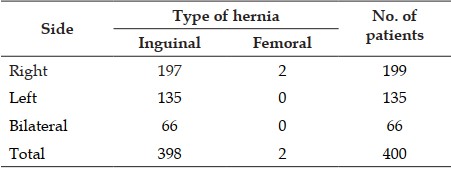
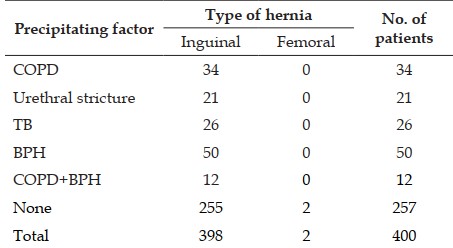
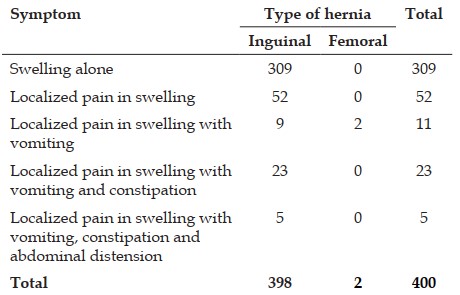
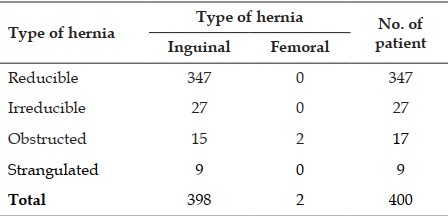
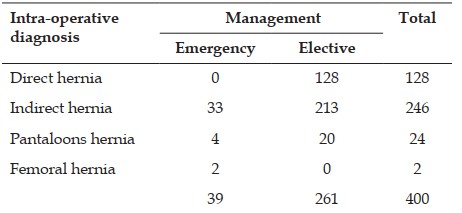
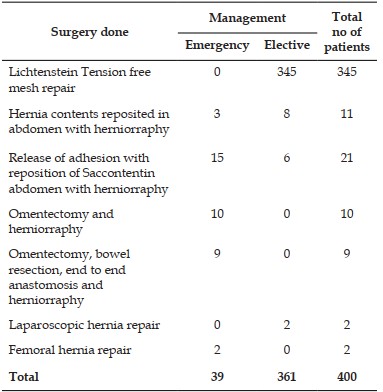
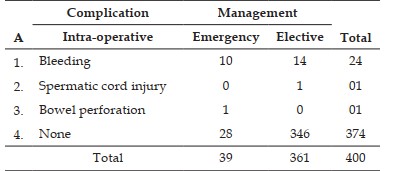
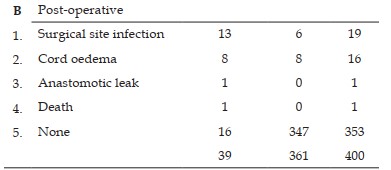
Aims & Objectives: To study the groin hernias in adult and its outcome in terms of clinical presentation, precipitating factors, intra-operative findings & complications. Materials and Methods: This prospective clinical observational study was carried out in 400 patients with complaints related to the groin region to the department of general surgery in a tertiary care center over a period of 2 years after ethical committee approval. Observation & Results: In this study inguinal swelling was the most common presentation in (77.25%), followed by localized pain in swelling (12%), localized pain in swelling with vomiting (2.25%) localized pain, vomiting And constipation in (5.75%) and distention in (1.25%) patients.The male-to-female ratio of groin hernia was 13.3, indicating a male preponderance. Unilateral groin hernias (83.5%) with right sided preponderance (49.75%) were more common than bilateral cases (16.5%) Uncomplicated groin hernias were seen in 86.75% patients while complications were seen in 12.25% patients as irreducible (6.75%), obstructed (4.25%) and strangulated (2.25%) In emergency operated case 1 patient had anastomostic leak in post-operative period and patient later succumbed. In 2.25% emergency and 1.5% elective patients had surgical site infection. Conclusion: In this study we found an association between groin hernias&various precipitating factors, comorbidities and occupation .Both complicated and uncomplicated groin hernias are most common in males. Uncomplicated groin hernias are more prevalent than complicated ones. Uncomplicated groin hernias are posted for elective hernia repair &are managed by Lichtenstein’s tension free mesh repair while incidence of complicated groin hernias is low and requires emergency surgical management &is associated with high morbidity and mortality.
References
- 1. Malangoni MA, Gagliardi RJ (2004) Hernias: Townsend CM, Beauchamp RD, Evers BM, Mattox KL editors. Sabiston’s Textbook of Surgery. (17th edn.), Elsevier-Saunders, Philadelphia, London, 1199-1218.
- 2. Fitzgibbons RJ, Jr; Forse, RA(19 February, 2015).”Clinicalpractice. Groinherniasin adults”. The New England Journal of Medicine.372(8):756–63.
- 3. Primatesta P, Goldacre MJ. Inguinalherniarepair: Incidenceofelective and emergency surgery, readmission and mortality. Int J Epidemiol 1996; 25:835-9.
- 4. Mabula JB, Chalya PL. Surgical management of inguinal hernias at Bugando Medical Centre in Northwestern Tanzania: Our experiences in a resource-limited setting. BMC Res Notes 2012; 5:585.
- 5. QuinnTH. Anatomy of the Groin: A view from the Anatomist. Chapter In: Fitzgibbons R, Greenberg G, editors. Nyhus and Condon’s Hernia: Philadelphia USA: Lippincott Williams and Wilkins, 2002, 55.
- 6. Kingsnorth AN, LeBlanc KA. Management of Abdominal Hernias. 3rd ed. London, New York: Edward Arnold; 2003. p. 40-7.
- 7. Vincent PJ, Singh Y (2000) Modern Management of Inguinal Hernia. Med J Armed Forces India 56:323- 327.
- 8. Susanta Tripathy & Raj Ratan. Presentation & Clinical Outcome of Inguinal Hernia in Elderly Adults in 5th Decade or Later: A Prospective Descriptive Study! New Indian J Surg. 2018; 9(6):771-80.
- 9. Agrawal SN. A Study of the Demography, Clinical Features and Management of Inguinal Hernia in a Tertiary Care Hospital. J Surgery. 2018; 6(2):5.
- 10. Rao SS, Singh P, Gupta D, Narang R. Clinicoepidemiologic profile of inguinal hernia in rural medical college in central India. J Mahatma Gandhi Inst Med Sci 2016; 21:116-21.
- 11. Singh S, Prakash R, Singh V. A clinical study of inguinal hernia with special reference to laparoscopictrans-abdominal preperitoneal repair. Int Surg J 2017; 4:282-90.
- 12. Dr. Vinaykumar Teradal, Dr. Bharat Kumar Bidinahal and Dr. Jyoti Karegoudar. Clinical profile of patients with inguinal hernia. International Journal of Surgery Science 2019; 3(1): 197-200.
Data Sharing Statement
There are no additional data available. All raw data and code are available upon request.
Funding
This research received no funding.
Author Contributions
All authors contributed significantly to the work and approve its publication.
Ethics Declaration
This article does not involve any human or animal subjects, and therefore does not require ethics approval.
Acknowledgements
We would like to express our gratitude to the patients, their families, and all those who have contributed to this study.
Conflicts of Interest
No conflicts of interest in this work.
About this article

Cite this article
Sumit Salve, Anitha Kandi, Avinash Surwade, et al. Clinical Presentation and Outcome of Adult Groin Hernia. New Indian J Surg. 2024; 15(3):101-105
Licence:
Attribution-Non-commercial 4.0 International (CC BY-NC 4.0)This license enables reusers to distribute, remix, adapt, and build upon the material in any medium or format for noncommercial purposes only, and only so long as attribution is given to the creator.
| Received | Accepted | Published |
|---|---|---|
| June 29, 2024 | August 16, 2024 | September 30, 2024 |
DOI: https://doi.org/10.21088/nijs.0976.4747.15324.2
Keywords
Groin herniashernia repairSearch for Similar Articles
Similar Articles
- Role of Bates-Jenson Wound Assessment Tool (BJWAT) in Wound Management
- Role of New Antimicrobial Solution in the Management of a Chronic Left Foot Woun...
- Laparoscopic Excision of a Giant Retroperitoneal Benign Mesenteric Cyst Encasing...
- Endoscopic-Assisted Sural Nerve and Biceps Femoris Muscle Biopsy in a Young Woma...
- Amniotic Membrane in Wound Healing: Biological Basis, Clinical Evidence and Futu...
Article Level Metrics
Last UpdatedWednesday 25 November 2026, 00:42:18 (IST)
9703
Accesses
13
883
00
Citations
NA
NA
NA
Download citation
Article Keywords
Keyword Highlighting
Highlight selected keywords in the article text.
Timeline
| Received | June 29, 2024 |
| Accepted | August 16, 2024 |
| Published | September 30, 2024 |
licence
Attribution-Non-commercial 4.0 International (CC BY-NC 4.0)
This license enables reusers to distribute, remix, adapt, and build upon the material in any medium or format for noncommercial purposes only, and only so long as attribution is given to the creator.