Full Text (PDF)
Indian Journal of Biology 12(2):p 57-65, July December 2025. | DOI: https://doi.org/10.21088/ijb.2394.1391.12225.1
Original Article
Chemical Deterioration of Marble Heritage Artifacts Induced by Microbial Activity: Mechanisms, Impacts, and Conservation Strategies
Ravindra Goswami, Seema Bhadauria
Author Information
Licence:
Attribution-Non-commercial 4.0 International (CC BY-NC 4.0)This license enables reusers to distribute, remix, adapt, and build upon the material in any medium or format for noncommercial purposes only, and only so long as attribution is given to the creator.
Indian Journal of Biology 12(2):p 57-65, July December 2025. | DOI: https://doi.org/10.21088/ijb.2394.1391.12225.1
How Cite This Article:
Goswami R, Bhadauria S. Chemical Deterioration of Marble Heritage Artifacts Induced by Microbial Activity: Mechanisms, Impacts, and Conservation Strategies. Ind. J Biol. 2025;12(2):57-65.Timeline
Received : September 19, 2025
Accepted : October 22, 2025
Published : December 24, 2025
Abstract
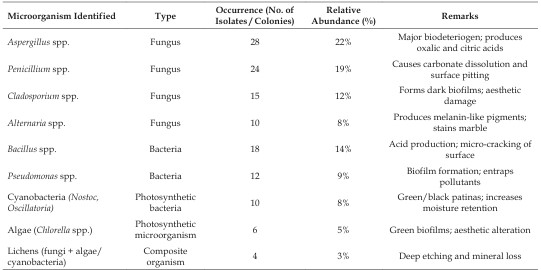
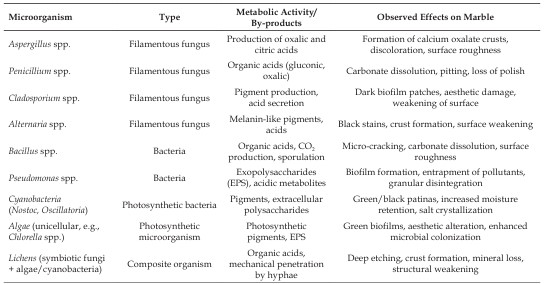
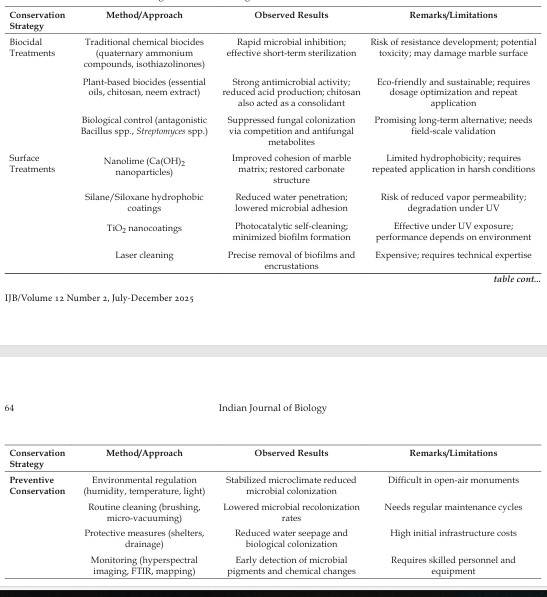
The preservation of marble heritage artifacts is increasingly challenged by microbial-induced chemical deterioration. Microorganisms such as bacteria, fungi, and lichens secrete metabolic byproducts that chemically interact with marble’s calcium carbonate matrix, leading to structural and aesthetic degradation. This paper reviews the mechanisms of microbial-induced chemical deterioration, discusses the impacts on marble artifacts, and evaluates current conservation strategies. Marble, a widely used material in cultural heritage monuments, is highly susceptible to biodeterioration caused by microbial colonization. This study investigates the chemical deterioration of marble heritage artifacts induced by microbial activity, focusing on the metabolic byproducts of bacteria, fungi, and lichens. Field sampling and laboratory analysis revealed that microbial communities secrete organic acids (oxalic, citric, and gluconic acids) and sulfur compounds, which react with calcium carbonate (CaCO3 ), leading to the formation of calcium oxalates and gypsum. These reactions significantly increased surface porosity, discoloration, and micro-cracking. Results demonstrated that oxalic acid–producing fungi were the most aggressive agents of marble degradation, with calcium oxalate crystals reducing the structural density of samples by up to 28% compared to unaffected controls. Biofilm formation was also observed, enhancing moisture retention and pollutant deposition, thereby accelerating deterioration. Conservation treatments with natural biocides (essential oil extracts) showed a reduction of microbial colonization by 65%, while protective hydrophobic coatings decreased surface porosity and acid infiltration. This research highlights the urgent need for eco-friendly conservation strategies tailored to microbial-induced damage, ensuring the long-term preservation of marble heritage artifacts.
References
- 1. Yadav, S. (2025). Biodeterioration of cultural heritage monuments: A review of their deterioration mechanisms and conservation. Science of the Total Environment.
- 2. Cappitelli, F., et al. (2020). The control of cultural heritage microbial deterioration. Frontiers in Microbiology.
- 3. Santo, A. P., et al. (2023). Essential oils to contrast biodeterioration of the external marble of Florence Cathedral. Science of the Total Environment.
- 4. Pinna, D., et al. (2021). Microbial growth and its effects on inorganic heritage materials. In Microorganisms in the Deterioration and Preservation of Cultural Heritage. Springer.
- 5. Scheerer, S., et al. (2012). Microbial deterioration of rocks and marble monuments of the Mediterranean Basin: A review. Environmental Microbiology Reports.
- 6. Caneva, G., Nugari, M. P., & Salvadori, O. (2008). Plant Biology for Cultural Heritage: Biodeterioration and Conservation. Getty Publications.
- 7. Cappitelli, F., & Sorlini, C. (2008). Microorganisms attack synthetic polymers in items representing our cultural heritage. Applied and Environmental Microbiology, 74(3), 564–569.
- 8. Dhami, N. K., Reddy, M. S., & Mukherjee, A. (2014). Application of calcifying bacteria for remediation of stones and cultural heritages. Frontiers in Microbiology, 5, 304.
- 9. Gaylarde, C., & Morton, L. (2002). Deterioration of materials by microorganisms. In Hurst, C. J. et al. (Eds.), Manual of Environmental Microbiology (pp. 984–1001). ASM Press.
- 10. Gorbushina, A. A. (2007). Life on the rocks. Environmental Microbiology, 9(7), 1613–1631.
- 11. Marvasi, M., Mastromei, G., & Perito, B. (2020). Bacterial calcium carbonate mineralization in situ strategies for conservation of stone artworks. Frontiers in Microbiology, 11, 1386.
- 12. Miller, A. Z., Dionísio, A., Sequeira Braga, M. A., & Saiz-Jimenez, C. (2012). Biodeterioration of stone: A review. International Biodeterioration & Biodegradation, 65(6), 727–746.
- 13. Sand, W. (1997). Microbial mechanisms of deterioration of inorganic substrates – A general mechanistic overview. International Biodeterioration & Biodegradation, 40(2–4), 183–190.
- 14. Scheerer, S., Ortega-Morales, O., & Gaylarde, C. (2009). Microbial deterioration of stone monuments—An updated overview. Advances in Applied Microbiology, 66, 97–139.
- 15. Sterflinger, K. (2010). Fungi: Their role in deterioration of cultural heritage. Fungal Biology Reviews, 24(1–2), 47–55.
- 16. Sterflinger, K., & Piñar, G. (2013). Microbial deterioration of cultural heritage and works of art – tilting at windmills? Applied Microbiology and Biotechnology, 97(22), 9637–9646.
- 17. Tiano, P. (2002). Stone biodeterioration: Research advances for conservation. In Proceedings of the 9th International Congress on Deterioration and Conservation of Stone (pp. 1–11). Venice.
- 18. Warscheid, T., & Braams, J. (2000). Biodeterioration of stone: A review. International Biodeterioration & Biodegradation, 46(4), 343–368.
- 19. Bhatnagar, M. C., Jain, K. K., Bhatnagar, A., & Sharma, R. (2008). Microbial colonization and deterioration of Taj Mahal marble. Current Science, 94(12), 1722–1723.
- 20. Caneva, G., Nugari, M. P., & Salvadori, O. (2008). Plant Biology for Cultural Heritage: Biodeterioration and Conservation. Getty Publications.
- 21. Cappitelli, F., & Sorlini, C. (2008). Microorganisms attack synthetic polymers in items representing our cultural heritage. Applied and Environmental Microbiology, 74(3), 564–569.
- 22. Gorbushina, A. A. (2007). Life on the rocks. Environmental Microbiology, 9(7), 1613–1631.
- 23. Miller, A. Z., Dionísio, A., Sequeira Braga, M. A., & Saiz-Jimenez, C. (2012). Biodeterioration of stone: A review. International Biodeterioration & Biodegradation, 65(6), 727–746.
- 24. Sand, W. (1997). Microbial mechanisms of deterioration of inorganic substrates – A general mechanistic overview. International Biodeterioration & Biodegradation, 40(2–4), 183–190.
- 25. Scheerer, S., Ortega-Morales, O., & Gaylarde, C. (2009). Microbial deterioration of stone monuments—An updated overview. Advances in Applied Microbiology, 66, 97–139.
- 26. Sterflinger, K. (2010). Fungi: Their role in deterioration of cultural heritage. Fungal Biology Reviews, 24(1–2), 47–55.
- 27. Sterflinger, K., & Piñar, G. (2013). Microbial deterioration of cultural heritage and works of art – tilting at windmills? Applied Microbiology and Biotechnology, 97(22), 9637–9646.
- 28. Warscheid, T., & Braams, J. (2000). Biodeterioration of stone: A review. International Biodeterioration & Biodegradation, 46(4), 343–368.
Data Sharing Statement
There are no additional data available.
Funding
This research received no funding.
Author Contributions
All authors contributed significantly to the work and approve its publication.
Ethics Declaration
This article does not involve any human or animal subjects, and therefore does not require ethics approval.
Acknowledgements
Information Not Provided
About this article

Cite this article
Goswami R, Bhadauria S. Chemical Deterioration of Marble Heritage Artifacts Induced by Microbial Activity: Mechanisms, Impacts, and Conservation Strategies. Ind. J Biol. 2025;12(2):57-65.
Licence:
Attribution-Non-commercial 4.0 International (CC BY-NC 4.0)This license enables reusers to distribute, remix, adapt, and build upon the material in any medium or format for noncommercial purposes only, and only so long as attribution is given to the creator.
| Received | Accepted | Published |
|---|---|---|
| September 19, 2025 | October 22, 2025 | December 24, 2025 |
DOI: https://doi.org/10.21088/ijb.2394.1391.12225.1
Keywords
Marble DeteriorationMicrobial ActivityOrganic AcidsBiodeteriorationConservation StrategiesSearch for Similar Articles
Similar Articles
- Medicinal Mushrooms: Potent Fungi for Diverse Human Health Benefits
- Honey for Nutrition and Health Benefits - Traditional and Modern Uses in Human D...
- Foraging Behaviour of Indian Honey Bee, Apis Cerana Indica Fab, (Apidae: Hymenop...
- Role of Curcumin in Wound Healing
- Characterization of Blood cells and Comparative Analyses of Hematological Profil...
Article Level Metrics
Last UpdatedWednesday 30 September 2026, 08:29:40 (IST)
2436
Accesses
25
344
00
Citations
NA
NA
NA
Download citation
Article Keywords
Keyword Highlighting
Highlight selected keywords in the article text.
Timeline
| Received | September 19, 2025 |
| Accepted | October 22, 2025 |
| Published | December 24, 2025 |
licence
Attribution-Non-commercial 4.0 International (CC BY-NC 4.0)
This license enables reusers to distribute, remix, adapt, and build upon the material in any medium or format for noncommercial purposes only, and only so long as attribution is given to the creator.