Full Text (PDF)
Indian Journal of Biology 12(2):p 67-78, July December 2025. | DOI: https://doi.org/10.21088/ijb.2394.1391.12225.2
Original Article
A Scoping Review on DNA Extraction Techniques in Hard Tissues
Riya Raj CA, Jeffy J Mathew, Manvi Viswanath, Suchita Rawat
Author Information
Licence:
Attribution-Non-commercial 4.0 International (CC BY-NC 4.0)This license enables reusers to distribute, remix, adapt, and build upon the material in any medium or format for noncommercial purposes only, and only so long as attribution is given to the creator.
Indian Journal of Biology 12(2):p 67-78, July December 2025. | DOI: https://doi.org/10.21088/ijb.2394.1391.12225.2
How Cite This Article:
Raj R, Mathew JJ, Viswanath M, et al. A Scoping Review on DNA Extraction Techniques in Hard Tissues. Ind. J Biol. 2025;12(2):67-78.Timeline
Received : July 14, 2025
Accepted : August 13, 2025
Published : December 24, 2025
Abstract
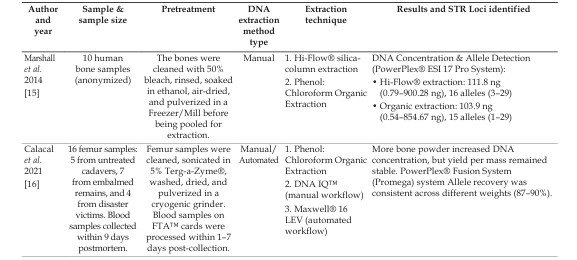
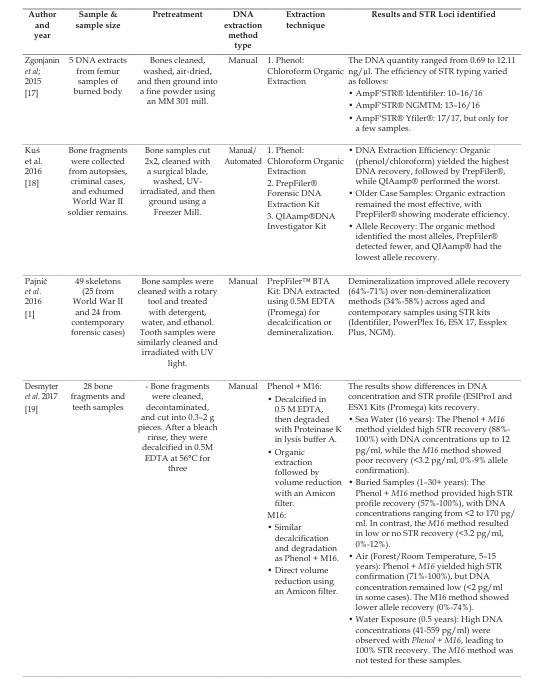
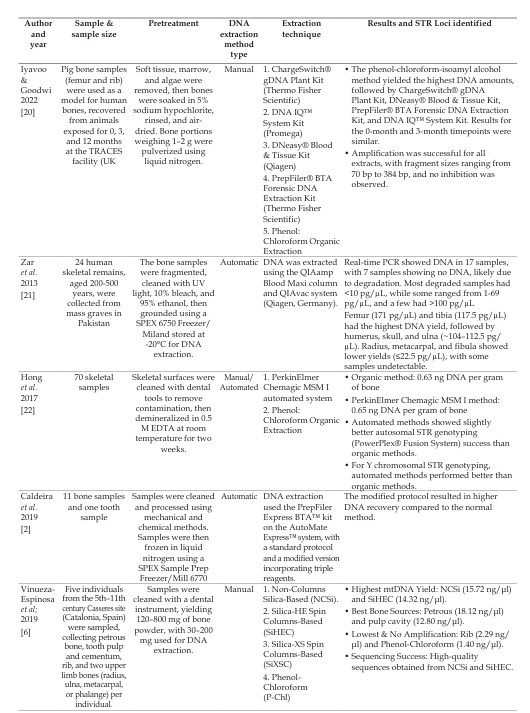
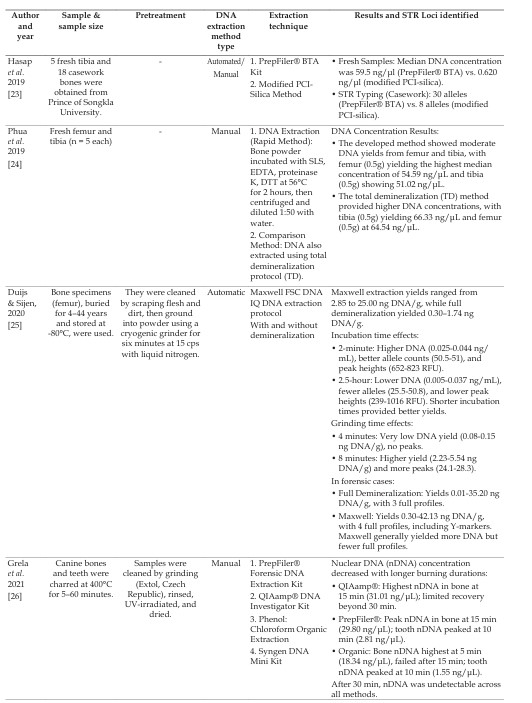
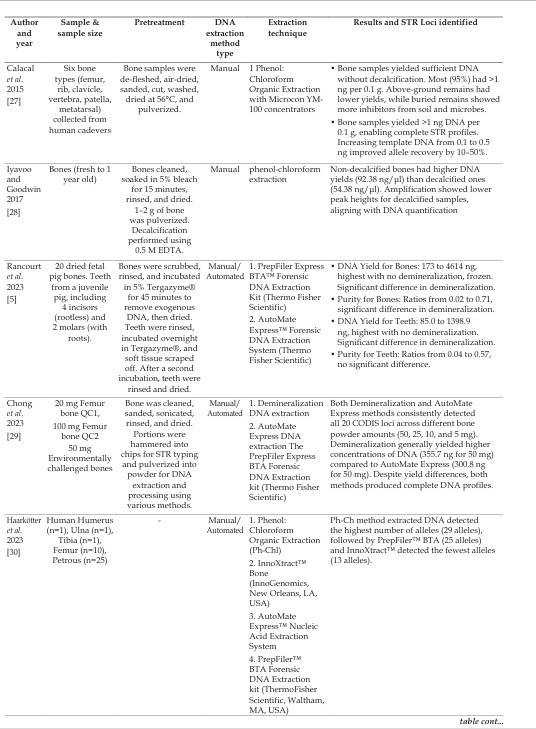
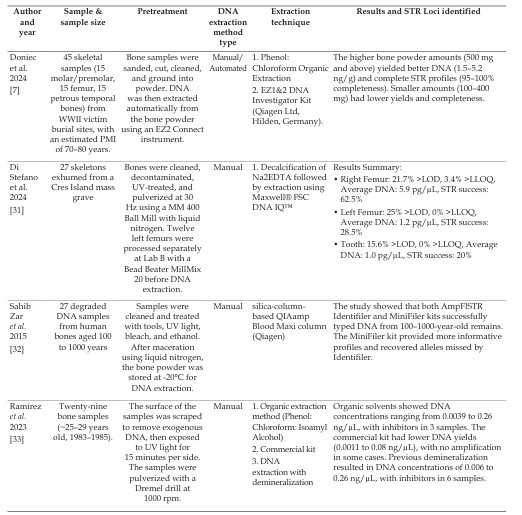
Introduction: Forensic investigations involving skeletal remains often encounter challenges related to the quality and quantity of extracted DNA. These challenges are influenced by factors such as the postmortem interval, environmental conditions, and the rate of DNA degradation. As the demand for accurate identification in forensic cases grows, researchers and forensic scientists are working to improve the efficiency of DNA extraction methods from skeletal remains to address cases involving unidentified bodies. The goal of this systematic review was to explore and evaluate DNA extraction techniques that are most effective for forensic DNA profiling from hard tissue samples. Method: The review adhered to PRISMA guidelines for its search strategy, which was implemented using the ScienceDirect database. Initially, 5,526 research articles were identified, and 20 duplicates were removed using CADIMA software. After applying the inclusion and exclusion criteria and screening titles and abstracts, 5,397 articles were excluded. Ultimately, 24 articles were included in the full-text analysis. Conclusion: This review provides a comprehensive comparison of DNA extraction methods, valuable insights into selecting the most suitable technique for specific forensic applications. It also highlights the importance of standardizing protocols to ensure consistent, reproducible, and high-quality results across different scientific fields
References
- 1. Pajnič, I. Z., Debska, M., Pogorelc, B. G., Mohorčič, K. V., Balažic, J., Zupanc, T., ... & Geršak, K. (2016). Highly efficient automated extraction of DNA from old and contemporary skeletal remains. Journal of forensic and legal medicine, 37, 78-86. https://doi.org/10.1016/j. jflm.2015.11.001.
- 2. Caldeira, M. J., Bento, A. M., Gouveia, N., Brito, P., & Porto, M. J. (2019). Evaluation of DNA levels recovered from forensic bone samples through the optimization of a semi automated extraction method. Forensic Science International: Genetics Supplement Series,
- 3. Golob, A., Kravanja, P., Concato, M., Leskovar, T., & Pajnič, I. Z. (2024). Searching for alternative high DNA-yielding bone types for DNA analysis of aged skeletal remains. Forensic science international, 362, 112184. https://doi. org/10.1016/j.forsciint.2024.112184.
- 4. Chocholova, E., Roudnicky, P., Potesil, D., Fialova, D., Krystofova, K., Drozdova, E., & Zdrahal, Z. (2023). Extraction Protocol for Parallel Analysis of Proteins and DNA from Ancient Teeth and Dental Calculus. Journal of Proteome Research, 22(10), 3311-3319. https:// doi.org/10.1021/acs.jproteome.3c00370.
- 5. Rancourt, A. C., Sainte-Marie, S., Blackmore, V., & Currie, K. A. (2023). Evaluation of low cost bone and teeth processing methods for automated DNA extraction. Forensic Science International: Reports, 8, 100328. https://doi. org/10.1016/j.fsir.2023.100328.
- 6. Vinueza-Espinosa, D. C., Santos, C., Martínez Labarga, C., & Malgosa, A. (2019). Assessing DNA recovery from highly degraded skeletal remains by using silica-based extraction methods. Forensic Science International: Genetics Supplement Series, 7(1), 810-812. https://doi.org/10.1016/j.fsigss.2019.10.204.
- 7. Doniec, A., Januła, M., Sekuła, A., Kowalczyk, M., Ba, G., & Kupiec, T. (2024). Validation process of automatic DNA extraction from bone material using a new advanced protocol for the EZ2 Connect instrument. Forensic Science International: Genetics, 71, 103054. https://doi.org/10.1016/j.fsigen.2024.103054.
- 8. Leskovar, T., & Pajnič, I. Z. (2023). Comparative analysis of DNA preservation in permanent and deciduous teeth of adults and non-adults: Implications for archaeological and forensic research. Forensic science international, 353, 111882. https://doi.org/10.1016/j. forsciint.2023.111882.
- 9. Rucinski, C., Malaver, A. L., Yunis, E. J., & Yunis, J. J. (2012). Comparison of two methods for isolating DNA from human skeletal remains for STR analysis. Journal of Forensic Sciences, 57(3), 706-712. https://doi.org/10.1111/j.1556 4029.2011.02012.x
- 10. Sutlovic, D., Boric, I., Zulim, T., & Vucinovic, A. (2015). Identification process of skeletal remains from mass graves: Our experience and proposal guidelines. Legal medicine, 17(2), 102-108. https://doi.org/10.1016/j. legalmed.2014.11.002.
- 11. Hazen, T. C., Rocha, A. M., & Techtmann, S. M. (2013). Advances in monitoring environmental microbes. Current opinion in biotechnology, 24(3), 526-533. copbio.2012.10.020. https://doi.org/10.1016/j.
- 12. Page, M. J., McKenzie, J. E., Bossuyt, P. M., Boutron, I., Hoffmann, T. C., Mulrow, C. D., ... & Moher, D. (2021). The PRISMA 2020 statement: an updated guideline for reporting systematic reviews. bmj, 372.
- 13. (n.d.). https://www.sciencedirect.com/ https://www.sciencedirect.com
- 14. (n.d.). CADIMA. https://www.cadima.info/
- 15. Marshall, P. L., Stoljarova, M., Schmedes, S. E., King, J. L., & Budowle, B. (2014). A high volume extraction and purification method for recovering DNA from human bone. Forensic Science International: Genetics, 12, 155-160. https://doi.org/10.1016/j.fsigen.2014.06.011.
- 16. Calacal, G. C., Gallardo, B. G., Apaga, D. L. T., & De Ungria, M. C. A. (2021). Improved autosomal STR typing of degraded femur samples extracted using a custom demineralization buffer and DNA IQ™. Forensic Science International: Synergy, 3, 100131. https://doi. org/10.1016/j.fsisyn.2020.100131.
- 17. Zgonjanin, D., Petković, S., Maletin, M., Vuković, R., & Drašković, D. (2015). Case report: DNA identification of burned skeletal remains. Forensic Science International: Genetics Supplement Series, 5, e444-e446. https://doi.org/10.1016/j.fsigss.2015.09.176.
- 18. Kuś, M., Ossowski, A., & Zielińska, G. (2016). Comparison of three different DNA extraction methods from a highly degraded biological material. Journal of Forensic and Legal Medicine, 40, 47-53. https://doi.org/10.1016/j. jflm.2016.03.002.
- 19. Desmyter, S., De Cock, G., Moulin, S., & Noël, F. (2017). Organic extraction of bone lysates improves DNA purification with silica beads. Forensic science international, 273, 96-101. https://doi.org/10.1016/j. forsciint.2017.02.003.
- 20. Iyavoo, S., & Goodwin, W. H. (2022). Recovery of DNA from bone without demineralization. Forensic Science International: Genetics Supplement Series, 8, 85-87. https://doi. org/10.1016/j.fsigss.2022.09.031.
- 21. Zar, M. S., Shahid, A. A., Shahzad, M. S., Shin, K. J., Lee, H. Y., Israr, M., ... & Husnain, T. (2013). Forensic DNA typing of old skeletal remains using AmpFlSTR® Identifiler® PCR amplification kit. J Forensic Res, 5(1), 211-216.
- 22. Hong, S. B., Kim, Y., & Park, J. H. (2017). High efficiency automated DNA extraction method for degraded old skeletal samples. Forensic Science International: Genetics Supplement Series, 6, e365-e367. https://doi.org/10.1016/j. fsigss.2017.09.108.
- 23. Hasap, L., Chotigeat, W., Pradutkanchana, J., Asawutmangkul, W., Kitpipit, T., & Thanakiatkrai, P. (2019). Comparison of two DNA extraction methods: PrepFiler® BTA and modified PCI-silica based for DNA analysis from bone. Forensic Science International: Genetics Supplement Series, 7(1), 669-670. https://doi.org/10.1016/j.fsigss.2019.10.132.
- 24. Grela, M., Jakubczak, A., Kowalczyk, M., Listos, P., & Gryzińska, M. (2021). Effectiveness of various methods of DNA isolation from bones and teeth of animals exposed to high temperature. Journal of forensic and legal medicine, 78, 102131.. https://doi. org/10.1016/j.jflm.2021.102131.
- 25. Calacal, G. C., Apaga, D. L. T., Salvador, J. M., Jimenez, J. A. D., Lagat, L. J., Villacorta, R. P. F., ... & De Ungria, M. C. A. (2015). Comparing different post-mortem human samples as DNA sources for downstream genotyping and identification. Forensic Science International: Genetics, 19, 212-220. https:// doi.org/10.1016/j.fsigen.2015.07.017.
- 26. Iyavoo, S., Hadi, S., & Goodwin, W. (2017). Evaluation of decalcification for recovery of DNA from bone. Forensic Science International: Genetics Supplement Series, 6, e270-e272. fsigss.2017.09.087. https://doi.org/10.1016/j.
- 27. Chong, M. D., Sheehan, S., Battaglia, J., Wescott, D. J., & Wallin, J. (2023). Comparative study of Rapid DNA versus conventional methods on compromised bones. Forensic Science International: Genetics, 63, 102825. https:// doi.org/10.1016/j.fsigen.2022.102825.
- 28. Haarkötter, C., Gálvez, X., Vinueza-Espinosa, D. C., Medina-Lozano, M. I., Saiz, M., Lorente, J. A., & Álvarez, J. C. (2023). A comparison of f ive DNA extraction methods from degraded human skeletal remains. Forensic Science International, 348, 111730. https://doi. org/10.1016/j.forsciint.2023.111730.
- 29. Di Stefano, B., Zupanič Pajnič, I., Concato, M., Bertoglio, B., Calvano, M. G., Sorçaburu Ciglieri, S., ... & Fattorini, P. (2024). Evaluation of a New DNA Extraction Method on Challenging Bone Samples Recovered from a WWII Mass Grave. Genes, 15(6), 672. https:// doi.org/10.3390/genes15060672.
- 30. Sahib Zar, M., Ali Shahid, A., Saqib Shahzad, M., Shin, K. J., Young Lee, H., Israr, M., & Husnain, T. (2015). Comparative study of STR loci for typing old skeletal remains with modified protocols of AmpFlSTR Identifiler and AmpFlSTR MiniFiler STR Kits. Australian Journal of Forensic Sciences, 47(2), 200-223. https://doi.org/10.1080/00450618.2014. 925976.
Data Sharing Statement
There are no additional data available. All raw data and code are available upon request.
Funding
This research received no funding.
Author Contributions
All authors contributed significantly to the work and approve its publication.
Ethics Declaration
This article does not involve any human or animal subjects, and therefore does not require ethics approval.
Acknowledgements
Information Not Provided
About this article

Cite this article
Raj R, Mathew JJ, Viswanath M, et al. A Scoping Review on DNA Extraction Techniques in Hard Tissues. Ind. J Biol. 2025;12(2):67-78.
Licence:
Attribution-Non-commercial 4.0 International (CC BY-NC 4.0)This license enables reusers to distribute, remix, adapt, and build upon the material in any medium or format for noncommercial purposes only, and only so long as attribution is given to the creator.
| Received | Accepted | Published |
|---|---|---|
| July 14, 2025 | August 13, 2025 | December 24, 2025 |
DOI: https://doi.org/10.21088/ijb.2394.1391.12225.2
Keywords
DNA Extraction TechniquesSystematic ReviewSTR TypingTeethBonesSearch for Similar Articles
Similar Articles
- Medicinal Mushrooms: Potent Fungi for Diverse Human Health Benefits
- Honey for Nutrition and Health Benefits - Traditional and Modern Uses in Human D...
- Foraging Behaviour of Indian Honey Bee, Apis Cerana Indica Fab, (Apidae: Hymenop...
- Role of Curcumin in Wound Healing
- Characterization of Blood cells and Comparative Analyses of Hematological Profil...
Article Level Metrics
Last UpdatedWednesday 30 September 2026, 08:28:25 (IST)
2436
Accesses
54
344
00
Citations
NA
NA
NA
Download citation
Article Keywords
Keyword Highlighting
Highlight selected keywords in the article text.
Timeline
| Received | July 14, 2025 |
| Accepted | August 13, 2025 |
| Published | December 24, 2025 |
licence
Attribution-Non-commercial 4.0 International (CC BY-NC 4.0)
This license enables reusers to distribute, remix, adapt, and build upon the material in any medium or format for noncommercial purposes only, and only so long as attribution is given to the creator.