Full Text (PDF)
International Journal of Neurology and Neurosurgery 18(2):p 73-76, May-August 2026. | DOI: https://doi.org/10.21088/ijnns.0975.0223.18226.5
Case Report
Beyond Uremic Encephalopathy: Timely Thrombolysis in Artery of Percheron Infarction Presenting as Isolated Altered Sensorium
Lakhan Parajiya, Tushar Raut, Neha Mishra, Alisha Sadarangani
Author Information
Licence:
Attribution-Non-commercial 4.0 International (CC BY-NC 4.0)This license enables reusers to distribute, remix, adapt, and build upon the material in any medium or format for noncommercial purposes only, and only so long as attribution is given to the creator.
International Journal of Neurology and Neurosurgery 18(2):p 73-76, May-August 2026. | DOI: https://doi.org/10.21088/ijnns.0975.0223.18226.5
How Cite This Article:
Lakhan Parajiya, Tushar Raut, Neha Mishra et. al, Beyond Uremic Encephalopathy: Timely Thrombolysis in Artery of Percheron Infarction Presenting as Isolated Altered Sensorium. J Surg. Nurs. 2026; 18(2): 73-76.Timeline
Received : June 11, 2026
Accepted : August 04, 2026
Published : August 30, 2026
Abstract
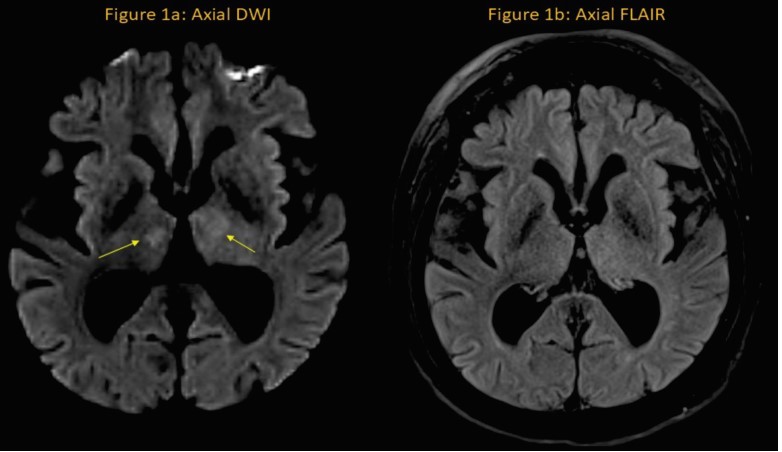
Background: Artery of Percheron (AOP) infarction is a rare ischemic stroke caused by occlusion of a solitary perforating artery supplying both paramedian thalami. It commonly presents with altered consciousness rather than focal neurological deficits, often mimicking metabolic encephalopathy and delaying diagnosis. We report a case of AOP infarction presenting as isolated altered sensorium in a patient with advanced chronic kidney disease (CKD), successfully treated with timely intravenous thrombolysis. Methods: A 70-year-old man with known stage 4 CKD, not on maintenance dialysis, presented with sudden-onset altered sensorium. Neurological examination revealed a low Glasgow Coma Scale score, drowsiness, confusion, impaired attention, and disorientation, while cranial nerve and motor examinations were largely preserved. Despite advanced CKD, the abrupt onset of symptoms and absence of significant metabolic derangements prompted activation of the acute stroke pathway. Magnetic resonance imaging was performed for definitive diagnosis, followed by intravenous thrombolysis within the therapeutic window. Results: MRI demonstrated acute bilateral paramedian thalamic infarction consistent with artery of Percheron occlusion. The patient showed progressive neurological recovery following thrombolysis. During hospitalization, hemodialysis was initiated under nephrology supervision, and he completed multidisciplinary rehabilitation. He was discharged with minimal residual disability, achieving a modified Rankin Scale score of 1. Conclusions: Acute isolated altered sensorium should prompt consideration of artery of Percheron infarction, even in patients with advanced CKD. Early clinical suspicion, prompt neuroimaging, and timely reperfusion therapy can result in excellent functional outcomes despite an initially deceptive presentation.
References
- 1. Lazzaro NA, Wright B, Castillo M, et al. Artery of Percheron infarction: imaging patterns and clinical spectrum. AJNR Am J Neuroradiol. 2010;31(7):1283–1289.
- 2. Matheus MG, Castillo M. Imaging of acute bilateral paramedian thalamic and mesencephalic infarcts. AJNR Am J Neuroradiol. 2003;24(10):2005–2008.
- 3. Schmahmann JD. Vascular syndromes of the thalamus. Stroke. 2003;34(9): 2264–2278.
- 4. Prabhakaran S, Gonzalez NR, Zachrison KS, Adeoye O, Alexandrov AW, Ansari SA, et al. 2026 Guideline for the Early Management of Patients With Acute Ischemic Stroke: A Guideline From the American Heart Association/American Stroke Association. Stroke. 2026;57(8):e316–e436.
- 5. Arauz A, Patiño-Rodríguez HM, VargasGonzález JC, et al. Clinical spectrum of artery of Percheron infarction. Stroke. 2014;45(5): 1496–1498.
- 6. Ikramuddin SS, Coburn JA, Ramezani S, Streib C. Artery of Percheron Infarction: Clinical Presentation and Outcomes. Neurol Clin Pract. 2024;14(2):e200266.
- 7. Atallah O, Almealawy YF, Alabide AS, et al. Navigating the clinical landscape of artery of Percheron infarction: A systematic review. eNeurologicalSci. 2024;37:100521.
- 8. Li J, Ge J, Yang S, et al. Clinical review and analysis of artery of Percheron infarction. IBRO Neurosci Rep. 2023;15:17-23
Data Sharing Statement
There are no additional data available. All raw data and code are available upon request.
Funding
This research received no funding.
Author Contributions
All authors contributed significantly to the work and approve its publication.
Ethics Declaration
This article does not involve any human or animal subjects, and therefore does not require ethics approval.
Acknowledgements
We would like to express our gratitude to the patients, their families, and all those who have contributed to this study.
Conflicts of Interest
No conflicts of interest in this work.
About this article

Cite this article
Lakhan Parajiya, Tushar Raut, Neha Mishra et. al, Beyond Uremic Encephalopathy: Timely Thrombolysis in Artery of Percheron Infarction Presenting as Isolated Altered Sensorium. J Surg. Nurs. 2026; 18(2): 73-76.
Licence:
Attribution-Non-commercial 4.0 International (CC BY-NC 4.0)This license enables reusers to distribute, remix, adapt, and build upon the material in any medium or format for noncommercial purposes only, and only so long as attribution is given to the creator.
| Received | Accepted | Published |
|---|---|---|
| June 11, 2026 | August 04, 2026 | August 30, 2026 |
DOI: https://doi.org/10.21088/ijnns.0975.0223.18226.5
Keywords
Artery of PercheronBilateral Thalamic InfarctionAltered SensoriumIntravenous ThrombolysisChronic Kidney DiseaseSearch for Similar Articles
Similar Articles
- Cerebellar Tuberculoma Mimicking Ganglioglioma in a Pediatric Patient: A Case Re...
- Multiscale Imaging-Based Characterization of Human Cortical Organoids Generated...
- Outcomes of Emergency Department Based Ventilatory Management of Adult Patients...
- Muscle Weakness as the Genesis of Spinal Disease: Paradigm Shift in Understandin...
- Intramedullary Capillary Hemangioma of Conus Medullaris: Case Report and Review...
Article Level Metrics
Last UpdatedWednesday 28 October 2026, 14:31:02 (IST)
2680
Accesses
7
297
00
Citations
NA
NA
NA
Download citation
Article Keywords
Keyword Highlighting
Highlight selected keywords in the article text.
Timeline
| Received | June 11, 2026 |
| Accepted | August 04, 2026 |
| Published | August 30, 2026 |
licence
Attribution-Non-commercial 4.0 International (CC BY-NC 4.0)
This license enables reusers to distribute, remix, adapt, and build upon the material in any medium or format for noncommercial purposes only, and only so long as attribution is given to the creator.