Full Text (PDF)
Indian Journal of Emergency Medicine 10(1):p 17-19, January-March 2024. | DOI: https://doi.org/10.21088/ijem.2395.311X.10124.3
Case Report
Banana Leaf for Management of Toxic Epidermal Necrolysis
Utsav Anand Mani, Haider Abbas, Mukesh Kumar, Pranay Gupta, Utsav Anand Mani
Author Information
Licence:
Attribution-Non-commercial 4.0 International (CC BY-NC 4.0)This license enables reusers to distribute, remix, adapt, and build upon the material in any medium or format for noncommercial purposes only, and only so long as attribution is given to the creator.
Indian Journal of Emergency Medicine 10(1):p 17-19, January-March 2024. | DOI: https://doi.org/10.21088/ijem.2395.311X.10124.3
How Cite This Article:
Mani UA, Abbas H, Kumar M, Gupta P. Banana leaf for management of toxic epidermal necrolysis. Indian J Emerg Med. 2024;10(1):17-9.Timeline
Received : September 12, 2023
Accepted : October 30, 2023
Published : March 30, 2024
Abstract
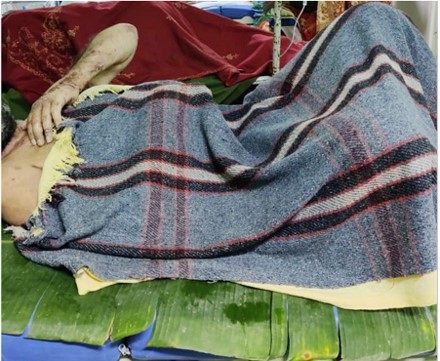
Introduction: Toxic Epidermal Necrolysis (TEN) and Steven Johnson Syndrome (SJS) are severe mucocutaneous reactions. Managing these conditions is challenging, especially in resource-limited settings. This case report introduces a cost-effective treatment approach in a developing country context. Case Report: A patient in India with TEN/SJS, likely due to homeopathic medication, was treated using autoclaved banana leaves. This innovative method provided pain relief and accelerated wound healing, demonstrating its potential as an alternative treatment. Conclusion: Utilizing banana leaves for TEN/SJS highlights a novel, economical approach suitable for developing countries. This case underscores the need for further research into such alternatives, especially in regions where standard medical resources are limited or too expensive.
References
- 1. Dharnidharka VR, Kandoth PW. Use of banana leaves in stevens johnson syndrome. Pediatric Dermatology. 1994 Sep;11(3):280-1.
- 2. Gerull R, Nelle M, Schaible T. Toxic epidermal necrolysis and Stevens-Johnson syndrome: a review. Critical care medicine. 2011 Jun 1; 39 (6):1521-32.
- 3. Kumar R, Das A, Das S. Management of Stevens-Johnson syndrome-toxic epidermal necrolysis: looking beyond guidelines!. Indian journal of dermatology. 2018 Mar; 63(2):117.
Data Sharing Statement
There are no additional data available.
Funding
This research received no funding.
Author Contributions
All authors contributed significantly to the work and approve its publication.
Acknowledgements
Information not provided.
Conflicts of Interest
We declare that we do not have any conflict of interest
About this article

Cite this article
Mani UA, Abbas H, Kumar M, Gupta P. Banana leaf for management of toxic epidermal necrolysis. Indian J Emerg Med. 2024;10(1):17-9.
Licence:
Attribution-Non-commercial 4.0 International (CC BY-NC 4.0)This license enables reusers to distribute, remix, adapt, and build upon the material in any medium or format for noncommercial purposes only, and only so long as attribution is given to the creator.
| Received | Accepted | Published |
|---|---|---|
| September 12, 2023 | October 30, 2023 | March 30, 2024 |
DOI: https://doi.org/10.21088/ijem.2395.311X.10124.3
Keywords
Dermatological EmergencyToxic Epidermal NecrolysisSteven–Johnson SyndromeBanana leafSearch for Similar Articles
Similar Articles
- Covid 19 Vaccine: Associated Henoch Schonlein Purpura in Young Adult Female
- A Rare Case of Intolerance to Medically Approved Dose of Sildenafil Citrate in a...
- Acute Mesenteric Ischemia: An Unusual Cause of Hematemesis in a 48 Year Old Man
- Brachial Artery Pseudoaneurysm Related Causally to Iatrogenic Coagulopathy in a...
- Combination Therapy for Acute Management of Yellow Oleander Poisoning: A Case Re...
Article Level Metrics
Last UpdatedSaturday 05 September 2026, 20:58:26 (IST)
4074
Accesses
18
922
00
Citations
NA
NA
NA
Download citation
Article Keywords
Keyword Highlighting
Highlight selected keywords in the article text.
Timeline
| Received | September 12, 2023 |
| Accepted | October 30, 2023 |
| Published | March 30, 2024 |
licence
Attribution-Non-commercial 4.0 International (CC BY-NC 4.0)
This license enables reusers to distribute, remix, adapt, and build upon the material in any medium or format for noncommercial purposes only, and only so long as attribution is given to the creator.