Full Text (PDF)
Indian Journal of Plant and Soil 13(1):p 23-43, January-June 2026. | DOI: https://doi.org/10.21088/ijps.2348.9677.13126.3
Original Article
Assessment of Weathering Pattern in Laterite Associated Soils of Nellore Schist Belt, Andhra Pradesh, India
Author Information
Licence:
Attribution-Non-commercial 4.0 International (CC BY-NC 4.0)This license enables reusers to distribute, remix, adapt, and build upon the material in any medium or format for noncommercial purposes only, and only so long as attribution is given to the creator.
Indian Journal of Plant and Soil 13(1):p 23-43, January-June 2026. | DOI: https://doi.org/10.21088/ijps.2348.9677.13126.3
How Cite This Article:
B.P. Bhaskar. Assessment of Weathering Pattern in Laterite Associated Soils of Nellore Schist Belt, Andhra Pradesh, India. Ind J Plant Soil. 2026; 13(1): 23-43.Timeline
Received : January 12, 2026
Accepted : February 15, 2026
Published : June 30, 2026
Abstract
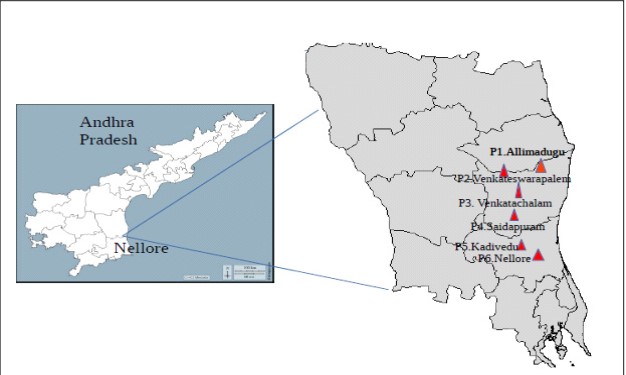
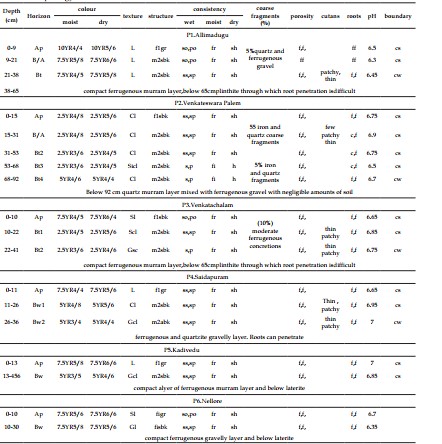
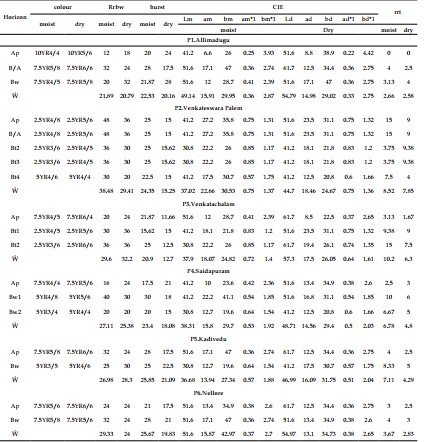
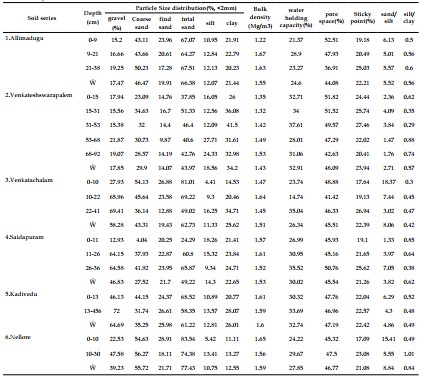
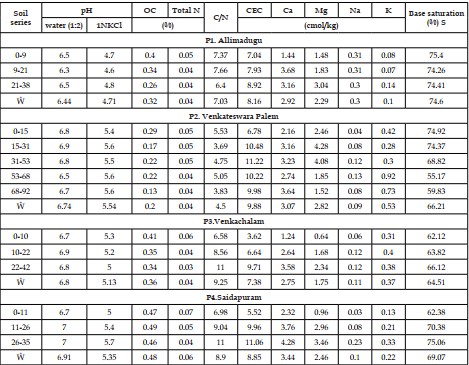
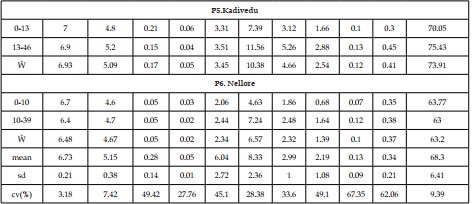
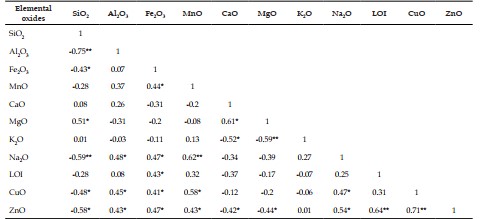
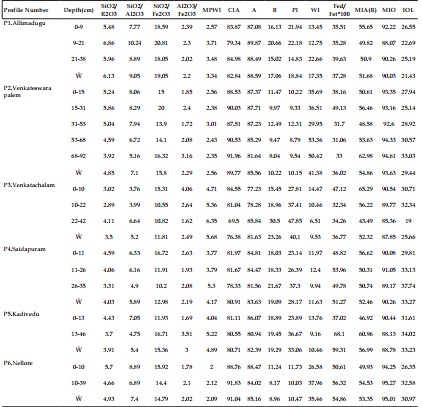
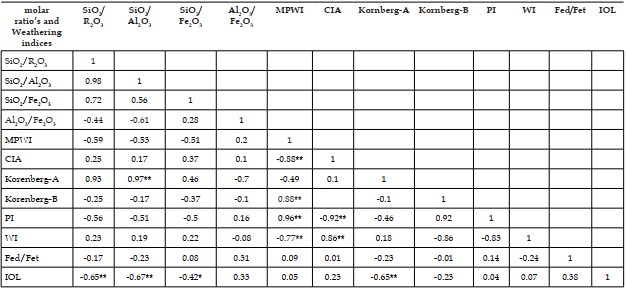
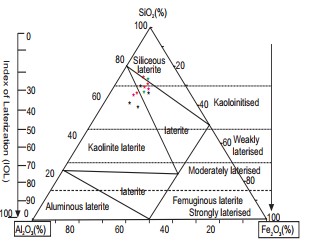
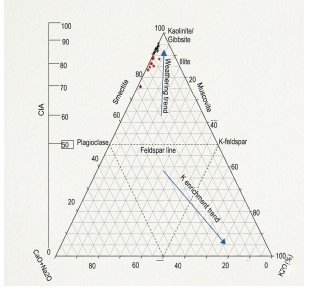
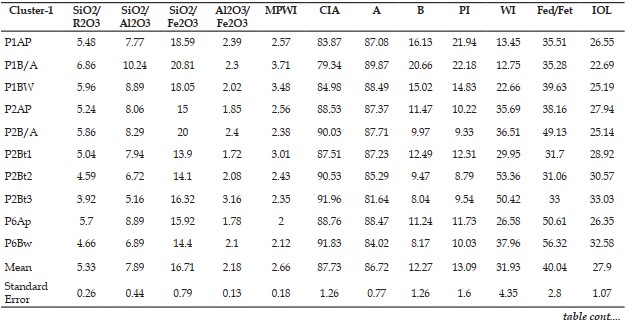
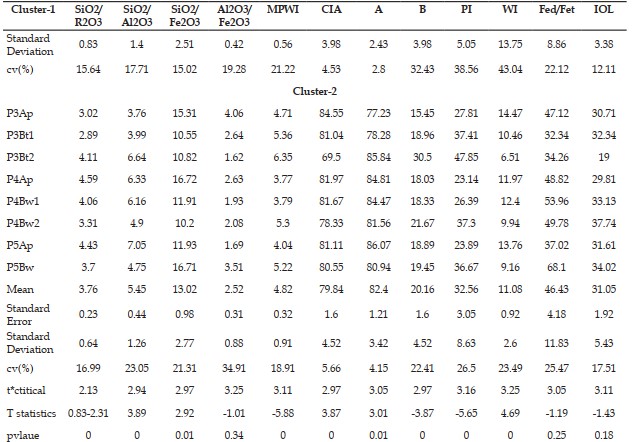
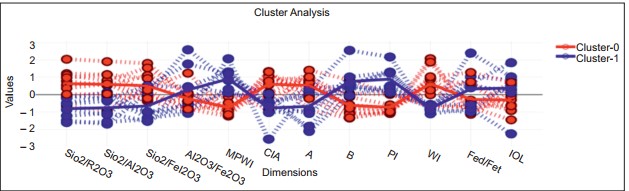
Weathering is extensively utilized for pedospheric data that helps in understanding genetic relationships and soil characteristics to address environmental challenges. In this study, six representative soil profiles from the Nellore schist belt were analyzed for their morphology, physical properties, chemical makeup, and elemental composition. These soils, located on the rolling peneplains of the Somasila project, exhibit a red to dark reddish-brown matrix with clay-rich argillic/cambic horizons, characterized by an Ap-Bt/Bw sequence along with compact ferruginous gravels and laterite. The depth trends of redness ratings and CIELab values in moist conditions are significantly higher than in dry conditions, but they show a decreasing trend with profile depth. Additionally, am demonstrates a strong positive correlation with redness rating (Torrent) at 0.73** in moist conditions and 0.83** in dry conditions, while showing a moderate positive correlation with clay at 0.57*. In Venkateswapalem (P2) and Venkatachalam (P3), there is an increase in clay by more than 1.2 times in the B horizons, indicating argillic characteristics, yet the silt to clay ratio exceeds 0.15, suggesting a young soil with a high degree of weathering potential. These soils are slightly acidic to neutral, exhibiting low organic carbon, total nitrogen, cation exchange capacity, and exchangeable bases, resulting in a base saturation of over 60%, categorizing them under the subgroups of Inceptisols and Alfisols. The high molar ratios of Si-Al-Fe indicate a non-lateritic nature; however, the ternary diagram along with IOL/CIA suggests that these soils are kaolinitized with an advanced stage of laterization, reflecting significant base loss and accumulation of Fe-Al oxides. Correlation results revealed a strong significant relationship between Kornberg-A and PI (r=0.92**), as well as a high positive correlation between CIA and WI (r=0.86**). The findings indicate that two clusters are classified within the subgroups of Entisols, Inceptisols, and Alfisols, exhibiting a high degree of weathering influenced by topographic position, which directly affects weathering intensities.
References
- 1. Brantley, S.L. Understanding soil time. Science, 2008, 321(5895), 1454–1455. https://doi.org/ 10.1126/science.1161132
- 2. Burke, B.C., Heimsath, A.M., & White, A.F. Coupling chemical weathering with soil production across soil-mantled landscapes. Earth Surface Processes and Landforms, 2007, 32, 853–873. https://doi.org/10.1002/esp.1443
- 3. Johnson, M.O., Mudd, S.M., Pillans, B., Spooner, N.A., Keith Fifield, L., Kirkby, M. J., & Gloor, M. Quantifying the rate and depth dependence of bioturbation based on optically-stimulated luminescence (OSL) dates and meteoric 10 be. Earth Surface Processes and Landforms,2014, 39(9), 1188–1196. https://doi. org/10.1002/esp.3520
- 4. Opolot, E., Yu, Y.Y., & Finke, P.A. Modeling soil genesis at pedon and landscape scales: Achievements and problems. Quaternary International, 2015, 376, 34–46. https://doi. org/10.1016/j. quaint.2014.02.017
- 5. Anderson, R.S. Particle trajectories on hillslopes: Implications for particle age and 10Be structure. Journal of Geophysical Research: Earth Surface, 2015, 120, 1626–1644. https:// doi.org/10. 1002/2015JF003479.
- 6. Jelinski, N.A., Campforts, B., Willenbring, J.K., Schumacher, T.E., Li, S., Lobb, D.A., Papiernik, S.K., & Yoo, K. Meteoric beryllium-10 as a tracer of erosion due to postsettlement land use in west-central Minnesota, USA. Journal of Geophysical Research: Earth Surface,2019, 124, 874–901. https://doi. org/10.1029/2018JF004720
- 7. Mehnatkesh, A., Ayoubi, S., Jalalian, A., & Sahrawat, K.L. Relationships between soil depth and terrain attributes in a semi arid hilly region in western Iran. Journal of Mountain Science, 2013, 10(1), 163–172. https://doi. org/10.1007/s11629-013-2427-9.
- 8. Vanacker, V., Ameijeiras-Mariño, Y., Schoonejans, J., Cornélis, J., Minella, J.P.G., Lamouline, F., Vermeire, M.L., Campforts, B., Robinet, J., van de Broek, M., Delmelle, P., & Opfergelt, S. Land use impacts on soil erosion and rejuvenation in southern Brazil. Catena, 2019, 178 (March), 256–266. https://doi. org/10.1016/j.catena.2019.03.024
- 9. Osat, M., Heidari, A., Karimian Eghbal, M., & Mahmoodi, S. Impacts of topographic attributes on soil taxonomic classes and weathering indices in a hilly landscape in Northern Iran. Geoderma, 2016, 281, 90–101. https://doi. org/10.1016/j.geoderma.2016.06.020
- 10. Bland, W.J., & Rolls, D. Weathering: An introduction to the scientific principles). Weathering: An introduction to the scientific principles. 2016, Abingdon: Routledge. https://doi.org/10.4324/9781315824918
- 11. Green, E., Dietrich, W., & Banfield, J. Quantification of chemical weathering rates across an actively eroding hillslope. Earth and Planetary Science Letters, 2006, 242(1–2), 155–169. https://doi.org/10.1016/j.epsl.2005.11.039
- 12. Mudd, S.M., Yoo, K., & Weinman, B. Quantifying geomorphic controls on time in weathering systems. Procedia Earth and Planetary Science,2014, 10, 249–253. https:// doi.org/10.1016/j.proeps.2014.08.033
- 13. Fiantis, D., Nelson, M., Shamshuddin, J., Goh, T.B., & Van Ranst, E. Determination of the geochemical weathering indices and trace elements content of new volcanic ash deposits from Mt. Talang (West Sumatra) Indonesia. Eurasian Soil Science, 2010, 43(13), 1477–1485. https://doi.org/10.1134/S1064229310130077
- 14. Ameijeiras-Mariño, Y., Opfergelt, S., Schoonejans, J., Vanacker, V., Sonnet, P., de Jong, J., & Delmelle, P. Impact of low denudation rates on soil chemical weathering intensity: A multiproxy approach. Chemical Geology, 2017, 456, 72–84. https://doi. org/10.1016/j.chemgeo.2017.03.007 ]
- 15. Buol, S.W., Southard, R.J., Graham, R.C., & McDaniel, P. A. Soil genesis and classification. 2011, Oxford, UK: Wiley-Blackwell. https:// doi.org/10.1002/9780470960622
- 16. Chesworth, W. In W. Chesworth (Ed.), Encyclopedia of soil science. 2008, Dordrecht: Springer Netherlands. https://doi. org/10.1007/978-1-4020-3995-9
- 17. Nesbitt, H.W., & Young, G.M. Formation and diagenesis of weathering profiles. The Journal of Geology, 1989,97(2), 129–147. https://doi. org/10.1086/629290
- 18. Fedo, C.M., Wayne Nesbitt, H., & Young, G.M. Unraveling the effects of potassium metasomatism in sedimentary rocks and paleosols, with implications for paleoweathering conditions and provenance. Geology, 1995, 23(10), 921. https://doi. org/10.1130/0091-7613(1995)023<0921:UTEO PM>2.3.CO;2
- 19. Chiltleborough, D.J. Indices of weathering for soils and paleosols formed on silicate rocks. Australian Journal ofEarth Sciences ,1991,38 (1):115–20. doi: 10.1080/08120099108727959
- 20. Baumann, F., K. Schmidt, C. Dorfer, J.S. He, T. Scholten, and P. Kuhn. Pedogenesis, permafrost, substrate andtopography: Plot and landscape scale interrelations of weathering processes on the central-eastern Tibetan Plateau. Geoderma, 2014, 226: 300–16. doi: 10.1016/j.geoderma.2014.02.019
- 21. Harnois, L. The CIW index: A new chemical index of weathering. Sedimentary Geology, 1988, 55 (3–4): 319–22. doi:10.1016/0037- 0738(88)90137-6
- 22. Parker, A. An index of weathering for silicate rocks. Geological Magazine,1970, 107 (6): 501– 04.
- 23. Hamadan, J., and C.P. Burnham. The contribution of nutrients from parent material in three deeply weathered soils of Peninsular Malaysia. Geoderma, 1996, 74 (3–4): 219–33. doi: 10.1016/S0016-7061(96)00062-6 .
- 24. Fedo, C.M., H.W. Nesbit, and G.M. Young. Unveiling the effects of potassium metasomatism in sedimentaryrocks and paleosols with implications for paleoweathering conditions and provenance. 1995, Geology 23 (10): 921–24. doi:10.1130/0091-7613(1995)023<0921:UTEOP M>2.3.CO;2 .
- 25. Voicu, G., and M. Bardoux. Geochemical behavior under tropical weathering of the Barama-Mazaruni greenstonebelt at Omai gold mine, Guiana Shield. Applied Geochemistry, 2002. 17 (3):321–36. doi: 10.1016/S0883- 2927(01)00085-3
- 26. Rao, A.T. The Kondra igneous complex from the Precambrian Nellore Scist belt, Andhra Pradesh. Indian Journal of Geology,1992, 64 187- 195.
- 27. Leelanandam C The Kondra volcanic in Andhra Pradesh, Possible ophiolites. Current Science,1990, 59 401-409.
- 28. Raychaudhuri, S.P. The occurrence, distribution,classification and management of laterite and lateriticsoils. O.R.S.T.O.M., sér. Pédol., 1980, vol., XVIII, noa 3-4: 249-252
- 29. Reddy RS, Naidu SL, Ramesh Kumar LGK, Budhilal SC, Krishnan P. Land resources of Medak District, Andhra Pradesh, 2005, NBSS Publ., NBSS and LUP, Nagpur. P. 791.
- 30. Chandran, P., Ray, S., Bhatacharyya, T., Srivastava, P., Krishnan, P. and Pal, D.K. Lateritic soils(Ultisols) of Kerala, India: their genesis and taxonomy. Australian Journal of Soil Research, 2005, 43: 839-852
- 31. Bhaskar, B.P. and Subbaiah, G.V. Genesis, characterization and classification of laterites and associatedsoils along the east coast of Andhra Pradesh. Journal ofthe Indian Society of Soil Science, 1995, 43(1): 107-112.
- 32. Basanta Singh T, Nandini Devi K, Bijen Kumar Y, Bishworjit N, Nongdren Khomba Singh L, Herojit Singh Athokpam,. haracterization, and evaluation for crop suitability in lateritic soils , African Journal of Agricultural Research, 2013, 8(37), 4628-4636.
- 33. Bhaskar, B.P., Raja, P. and Srinivas, C.V. Genetic interpretation of pedological characteristics of lateriteassociated soils of somasila project, Andhra Pradesh. Gondwana Geological Magazine, 1999, 14(2): 39-47.
- 34. Bhaskar , B.P. and Gopal Tiwari. Geochemical Interpretations of Laterite Associated Soils of East Coast Andhra Pradesh.Chem Sci Rev Lett 2017, 6(21), 187-197.
- 35. Vaidyanadhan, R. and Ghosh, R.N. (1993): Quaternary of the east coast of India. Current Science 64: 804 – 815
- 36. Ghosh S, Guchhait SK, Characterization and Evolution of Laterites in West Bengal: Implication on the Geology of Northwest Bengal Basin, Journal of Palaeogeography 2015, 4(2), 203-230.
- 37. Buntley, G.; Westin, F. A comparative study of developmental color in a ChestnutChernozem-Brunizem soilclimosequence. In: Soil Science of America Proceedings , 1965, 29: 579–582.
- 38. Hurst, V.J. Visual estimation of iron in saprolite. In: Geological Society of America Bulletin, 1977, 88: 174–176.
- 39. Torrent, J u; Schwertmann H and Fechter, F. A. Quantitative relationships between soil color and hematite content. SoilScience , 1983, 136/6: 354–358
- 40. Y.N. Vodyanitskii, N.P. KirillovaApplication of the CIE-L*a*b* system to characterize soil color.Eur. Soil Sci., 49 (11) (2016), pp. 1259-1268
- 41. Sarma VAK, Krishnan P, Budhihal SL, Laboratory methods –Soil Resource Mapping of Different States inIndia. NBSS Publ. Technical Bulletin 14. NBSS&LUP. Nagpur. 1987, 49p
- 42. Piper, C.S.: Soil and Plant Analysis. University of Adelaide. Australia. Interscience Publishers, 1966, 2, 1-368 (1966).
- 43. Jackson, M.L. Soil chemical analysis–advanced course. Univ. of Wisconsin, College of Agric., Dept. of SoilSci., Madison, WI Prentice-Hall, Inc., Englewood Cliffs, NJ. 1975.
- 44. Mehra, O.P. and Jackson, M.L. Iron Oxide Removal from Soils and Clay by a DithioniteCitrate System Buffered with Sodium Bicarbonate. Clays and Clay Minerals 1960, 7, 317-327.
- 45. Page AL, Miller RH, Keeney DR, Methods of Soil Analysis, Part-2: Chemical and microbiological properties.American Society of Agronomy and Soil Science Society of America, Madison, Wisconsin, 2002, pp. 159-164.
- 46. Van Wambeke, A.R. Criteria for classifying tropical soils by age. Journal of Soil Science 1962, 13 (1):124–32. doi:10.1111/ j.1365- 2389.1962.tb00689.x .
- 47. Singh, L.P., B. Parkash, and A.K. Singhvi. Evolution of the lower Gangetic Plain landforms and soils in West Bengal, India. Catena, 1998, 33 (2): 75–104. doi:10.1016/ S0341-8162(98)00066-6 .
- 48. Birkeland, P.W., 1984b, Soils and Geomorphology: Oxford University Press, New York, p. 372.
- 49. Vogel DE, Precambrian Weathering in Acid Metavolcanic Rocks from the Superior Province, Villebon Township, South-Central Québec. Canadian Journal of Earth Science, 1975, 12, 2080-2085.
- 50. Jackson, M.L. Soil chemical analysis–advanced course. Univ. of Wisconsin, College of Agric., Dept. of Soil Sci., Madison, WI Prentice-Hall, Inc., Englewood Cliffs, NJ. 1975.
- 51. Duchaufour, P. Pédologie et groupes écologiques. I: rôle du type d’humus et du pH Bulletin d’Ecologie, 20 (1989), pp. 1-6
- 52. Babechuk, M.G., Widdowson, M., Kamber, B.S., 2014. Quantifying chemical weath-ering intensity and trace element release from two contrasting basalt profiles, Deccan Traps, India. Chem. Geol. 363, 56e75.
- 53. Wilding, L.P. Spatial variability: its documentation, accommodation and implication to soil surveys, 1983, pp. 166-194. In D.R. Nielsen and J. Bouma (eds.). Soil Spatial Variability: Pudoc, Wageningen, Netherlands.
- 54. Mukaka MM. Statistics corner: a guide to appropriate useof correlation coefficient in medical research. Malawi Med J. 2012; 24: 69–71.
- 55. Akgul, M., Ali Isildar, A and Basayigit, L. Relationship between colour and some soil properties in red-reddish and neighbour soils in Isparta, Turkey. Asian Journal of Chemistry, 2005, 917(3): 1995-2000.
- 56. Schulze, D.G., Nagel, J.L., Van Scoyoc, G.E., Henderson, T.L., Baumgardner, M.F. and Stott, D.E. in: Bigham, J.M. and Coilkosz, E.J.(Eds), Significance of organic matter in determining soil colors, SSAS special publication Number 31, SSSA Inc., Madison, Wisconsin, USA, 1993, pp. 71-90.
- 57. Soil Survey Division Staff. Soil Survey Manual. United States Department of Agriculture 2017. Handbook No. 18.
- 58. Satyanarayana K.V.S. and Thomas P.K., Studies on Laterites and Associated Soils II. Chemical composition of laterite profilesJournal of the Indian Society of Soil Science 1962, 10: 211-222.
- 59. Maignien R., Review of Research on Laterites. UNESCO, Natural Resources Research Sc.IV., Paris. 1966, 4(21), pp. 148.
- 60. Traian Gavriloaiel. The Influence of Electrolyte Solutions on Soil pH Measurements.Rev Chem. 2012, 63 (4):396-400.http://www. revistadechimie.ro
- 61. Landon J.R., Booker Tropical Soil Manual, Longman Publishers, Harlow, UK., 1991, p. 134.
- 62. Dontsova, K. and L. Darrell Norton. 2001. Effects of exchangeable Ca:Mg ratio on soil clay flocculation,infiltration and erosion. In: Stott, D.E., R.H. Mohtar, and G.C. Steinhardt (ed.). Sustaining the global farm.Selected papers from the 10th International Soil Conservation organization meeting. May 24- 29, 1999. PurdueUniversity and the USDA-ARS National Soil Erosion Research Laboratory.
- 63. Bohn HL, McNeal, BL, O’ Connor GA, Soil Chemistry. 2nd edition. Wiley, New York. 1985.
- 64. Hallberg R.O., A Geochemical Method for Investigation of Palaeoredox Conditions in Sediments. Ambio, Special Report, 1976, 4, 139-147.
- 65. Karunakaran, C. and Roy, S.S. Laterite profle development linked with polycyclic geomorphic surfaces in South Kerala. Proceedings of the International Seminar on Lateritisation Processes, Trivandum, India: 1981, 221 – 231.
- 66. Bland, W. and Rolls, D. (1998): Weathering – An Introduction to the Scientic Principles. London: Arnold.
- 67. Souza JJLL, Abrahão WAP, Mello JWV, Silva J., Costa L.M., Oliveira TS. Geochemistry and spatial variability of metal(loid) concentrations in soils of the state of Minas Gerais, Brazil. Sci Total Environ. 2015; 505: 338-49. https://doi. org/10.1016/j.scitotenv.2014.09.098
- 68. Alloway B.J. Heavy metals in soils: trace metals and metalloids in soils and their Bioavailability. 3rd ed. New York: Springer; 2013. (Environmental Pollution 22).
- 69. Budihal, R., Pujar, G.Major and trace elements geochemistry oflaterites from the Swarnagadde Plateau, Uttar Kannada District, Karnataka,India. Journal of Geosciences and Geomatics, 2018, 6(1), 12–20. doi:10.12691/jgg-6-1-2.
- 70. Schellmann W. A new definition of laterites; Geol. Surv. India Memoir, 1986, 120 1–7.
- 71. Fedo C.M., Nesbitt H.W. and Young G.M. Unraveling the effects of potassium metasomatism in sedimentary rocks and paleosols, with implications for weathering conditions and provenance; Geology, 1995, 23 921–924.
- 72. Babechuk M. and Fedo C. Analysis of chemical weathering trends across three compositional dimensions: Applications to modern and ancient mafic-rock weathering profiles; Canadian J. Earth Sci., 2022, https://doi. org/10.1139/cjes-2022-0053.
Data Sharing Statement
There are no additional data available. All raw data and code are available upon request.
Funding
This research received no funding.
Author Contributions
All authors contributed significantly to the work and approve its publication.
Ethics Declaration
This article does not involve any human or animal subjects, and therefore does not require ethics approval.
Acknowledgements
We would like to express our gratitude to the patients, their families, and all those who have contributed to this study.
Conflicts of Interest
No conflicts of interest in this work.
About this article

Cite this article
B.P. Bhaskar. Assessment of Weathering Pattern in Laterite Associated Soils of Nellore Schist Belt, Andhra Pradesh, India. Ind J Plant Soil. 2026; 13(1): 23-43.
Licence:
Attribution-Non-commercial 4.0 International (CC BY-NC 4.0)This license enables reusers to distribute, remix, adapt, and build upon the material in any medium or format for noncommercial purposes only, and only so long as attribution is given to the creator.
| Received | Accepted | Published |
|---|---|---|
| January 12, 2026 | February 15, 2026 | June 30, 2026 |
DOI: https://doi.org/10.21088/ijps.2348.9677.13126.3
Keywords
LateriteWeathering indicesMolar ratioK mean clusteringCorrelationElemental compositionTernary diagramSearch for Similar Articles
Similar Articles
- Integrating Real-Time Soil Sensor Data with Precision Agriculture: A Comprehensi...
- Advances in Plant Phenotyping Tools for Agricultural Sustainability
- Organic and Natural Farming Based Disease Management Strategies in Pulse Crops
- Relationship between Yield and Yield Attributing Parameters of Rice (Oryza sativ...
- Influence of Weather Parameters on Alternaria Leaf Spot of Niger in Konkan Regio...
Article Level Metrics
Last UpdatedTuesday 08 September 2026, 00:03:52 (IST)
974
Accesses
31
208
00
Citations
NA
NA
NA
Download citation
Article Keywords
Keyword Highlighting
Highlight selected keywords in the article text.
Timeline
| Received | January 12, 2026 |
| Accepted | February 15, 2026 |
| Published | June 30, 2026 |
licence
Attribution-Non-commercial 4.0 International (CC BY-NC 4.0)
This license enables reusers to distribute, remix, adapt, and build upon the material in any medium or format for noncommercial purposes only, and only so long as attribution is given to the creator.