Full Text (PDF)
Physiotherapy and Occupational Therapy Journal 17(4):p 247-252, October-December 2024. | DOI: https://doi.org/10.21088/potj.0974.5777.17424.8
Review Article
Artificial Intelligence in Physiotherapy: A Narrative Review of Advancements in Education, Clinical Practice, and Research
Author Information
Licence:
Attribution-Non-commercial 4.0 International (CC BY-NC 4.0)This license enables reusers to distribute, remix, adapt, and build upon the material in any medium or format for noncommercial purposes only, and only so long as attribution is given to the creator.
Physiotherapy and Occupational Therapy Journal 17(4):p 247-252, October-December 2024. | DOI: https://doi.org/10.21088/potj.0974.5777.17424.8
How Cite This Article:
Ranjeet Singh, Artificial Intelligence in Physiotherapy: A Narrative Review of Advancements in Education, Clinical Practice, and Research. Physio. and Occ. Therapy Jr. 2024;17(4):247-252.Timeline
Received : September 09, 2024
Accepted : October 16, 2024
Published : December 25, 2024
Abstract
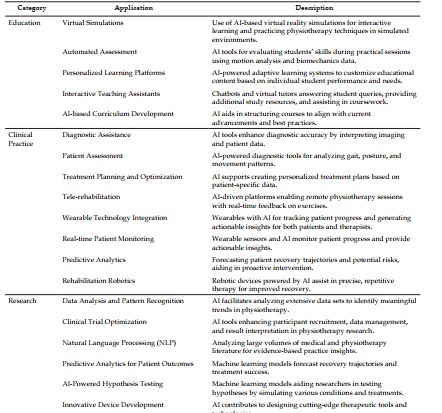
AI is transforming physiotherapy by advancing education, clinical practice, and research. Simulations, virtual reality, and personalized learning platforms enhance education, equipping students with adaptive skills for evolving environments. Machine learning algorithms and wearable sensors enable accurate diagnoses and tailored robotic-assisted therapies, thus improving patient outcomes. AI also accelerates data analysis, supports predictive modeling, and fosters evidence-based practices, driving innovation in the field. However, challenges like ethical concerns, poor digital literacy among practitioners, and high implementation costs hinder adoption. Addressing these requires interdisciplinary collaboration, ethical standards, and targeted training programs. Embracing AI can modernize physiotherapy, ensuring its relevance in healthcare by optimizing patient care and advancing education and research methodologies.
References
- 1. Sheikh H, Prins C, Schrijvers E. Artificial Intelligence: Definition and Background. In: Mission AI. Cham: Springer International Publishing; 2023 [cited 2024 Nov 18]. p. 15–41. (Research for Policy). Available from: https:// link.springer.com/10.1007/978-3-031-21448- 6_2
- 2. Lowe SW. The role of artificial intelligence in Physical Therapy education. Bull Fac Phys Ther. 2024 Apr 3;29(1):13.
- 3. Rathod A, Tiku R. Artificial Intelligence in Enhancing Physiotherapy Treatment: Brief Review. Int J Sci Healthc Res. 2024 Mar 19;9(1):241–4
- 4. Naik S.A Literature review of artificial intelligence in physiotherapy practice. In 2022. Available from: https://www.researchgate. net/publication/371566677_A_Literature_ r e v i e w _ o f _ a r t i f i c i a l _ i n t e l l i g e n c e _ i n _ physiotherapy_practice
- 5. Ramanandi V. Role and scope of artificial intelligence in physiotherapy: A scientific review of literature. 2020 Dec 26;6:11–4.
- 6. Alsobhi M, Khan F, Chevidikunnan MF, Basuodan R, Shawli L, Neamatallah Z. Physical Therapists’ Knowledge and Attitudes Regarding Artificial Intelligence Applications in Health Care and Rehabilitation: Crosssectional Study. J Med Internet Res. 2022 Oct 20;24(10):e39565.
- 7. Tanna M. Role of Artificial Intelligence (AI) in physiotherapy. J Epidemiol Found India. 2024 Mar 31;2(1):32–4.
- 8. Sumner J, Lim HW, Chong LS, Bundele A, Mukhopadhyay A, Kayambu G. Artificial intelligence in physical rehabilitation: A systematic review. Artif Intell Med. 2023 Dec; 146:102693.
- 9. Rowe M, Nicholls DA, Shaw J. How to replace a physiotherapist: artificial intelligence and the redistribution of expertise. Physiother Theory Pract. 2022 Nov 18;38(13):2275–83.
Data Sharing Statement
There are no additional data available. All raw data and code are available upon request.
Funding
This research received no funding.
Author Contributions
All authors contributed significantly to the work and approve its publication.
Ethics Declaration
This article does not involve any human or animal subjects, and therefore does not require ethics approval.
Acknowledgements
We would like to express our gratitude to the patients, their families, and all those who have contributed to this study.
Conflicts of Interest
No conflicts of interest in this work.
About this article

Cite this article
Ranjeet Singh, Artificial Intelligence in Physiotherapy: A Narrative Review of Advancements in Education, Clinical Practice, and Research. Physio. and Occ. Therapy Jr. 2024;17(4):247-252.
Licence:
Attribution-Non-commercial 4.0 International (CC BY-NC 4.0)This license enables reusers to distribute, remix, adapt, and build upon the material in any medium or format for noncommercial purposes only, and only so long as attribution is given to the creator.
| Received | Accepted | Published |
|---|---|---|
| September 09, 2024 | October 16, 2024 | December 25, 2024 |
DOI: https://doi.org/10.21088/potj.0974.5777.17424.8
Keywords
Artificial IntelligenceClinical PracticePhysiotherapy EducationResearchSearch for Similar Articles
Similar Articles
- Leadership in Physiotherapy: A Narrative Review
- Effectiveness of Low Level Laser Theapy in the Management of Temporomandibular J...
- The Impact of Air Pollution on Cardiopulmonary Health: Molecular Mechanisms, Pre...
- Efectiveness of Physiotherapy in Postpartum Women with Diastasis Recti: A Review
- Pain Neuroscience Education: Transforming Physiotherapy Practice
Article Level Metrics
Last UpdatedSunday 25 October 2026, 17:57:17 (IST)
4407
Accesses
9
739
00
Citations
NA
NA
NA
Download citation
Article Keywords
Keyword Highlighting
Highlight selected keywords in the article text.
Timeline
| Received | September 09, 2024 |
| Accepted | October 16, 2024 |
| Published | December 25, 2024 |
licence
Attribution-Non-commercial 4.0 International (CC BY-NC 4.0)
This license enables reusers to distribute, remix, adapt, and build upon the material in any medium or format for noncommercial purposes only, and only so long as attribution is given to the creator.