Full Text (PDF)
Indian Journal of Ancient Medicine and Yoga 16(4):p 171-174, October - December 2023. | DOI: https://doi.org/10.21088/ijamy.0974.6986.16423.1
Original Article
An Observational Study on Prakruthi and Dactylography
Author Information
Licence:
Attribution-Non-commercial 4.0 International (CC BY-NC 4.0)This license enables reusers to distribute, remix, adapt, and build upon the material in any medium or format for noncommercial purposes only, and only so long as attribution is given to the creator.
Indian Journal of Ancient Medicine and Yoga 16(4):p 171-174, October - December 2023. | DOI: https://doi.org/10.21088/ijamy.0974.6986.16423.1
How Cite This Article:
Arya VM, Nagaraj Kamath. An Observational Study on Prakruthi and Dactylography. Indian J Ancient Yoga. 2023;16(4):171-174.Timeline
Received : April 29, 2023
Accepted : May 21, 2023
Published : June 30, 2023
Abstract
Background: Ayurveda differs from other medical sciences by virtue of its unique concepts, independent ways of diagnosis and treatment. The prime aim of Ayurveda is two fold, i.e., maintaining health of the healthy individual and curing the diseases of diseased person. Determination of Prakruthi in newborn stage helps to differentiate the baby from other children by knowing peculiar characters. It also helps to maintain the health through out the life span, by proper measures. Hence, Charaka considered Prakruthi examination, as the first points of investigations regarding the patients.
Aims and objective: To evaluate the relation between Prakruthi and Dactylography.
Materials and Methods: 150 subjects within age group of 18-30 years were selected and given with questionnaires for Shareerika Prakruthi assessment and their 10 fingerprints were obtained through rolled method.
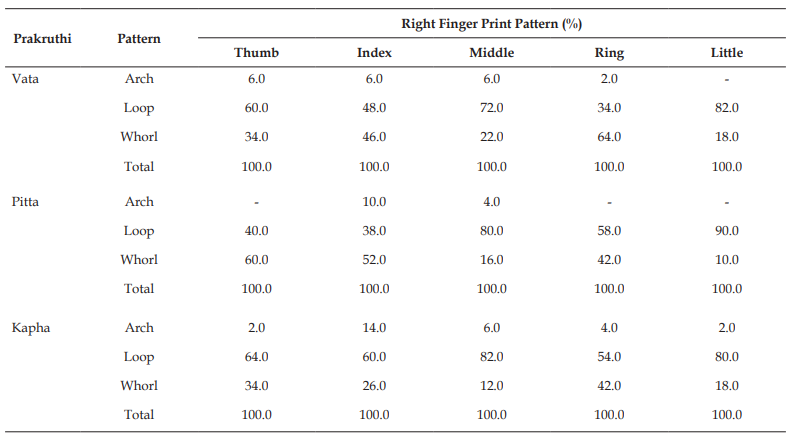
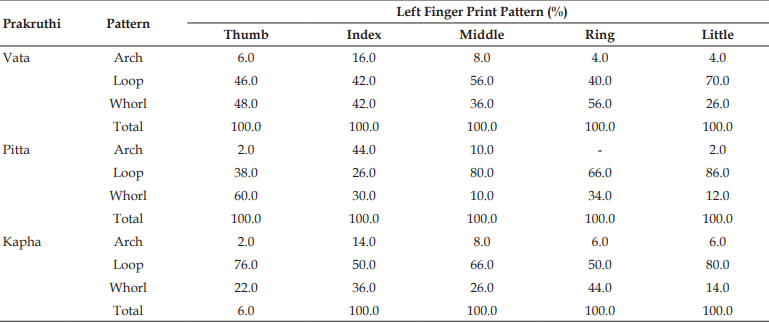
Discussion & Conclusion: A healthy individual is born out of normal Sukra, Artava, Atma, Prakruthi and various Vikaras and the predominance of Dosha at the time of conception determines the Prakruthi of the individual. No individual is alike another; all are different with respect to their own characteristic features. A fingerprint is the pattern on the inside of the finger in the area between the tip and the first joint and stays the same from the day of a person's birth to the day they die. On the basis of observation it is found that Kapha Dosha shows less variation were loop being the most repeated fingerprint pattern, whereas Vata Dosha shows maximum variation and Pitta Doshain between the two.
References
- 1. Agnivesha. Charakasamhitha with Ayurveda Commentary by Chakrapanidatta, editor Acharya YT. Varanasi: Choukhambha Orientalia; 2011. p. 301.
- 2. Sushrutha. Sushrutha Samhitha Dalhana. In: Acharya YT edi. Nibandhasangraha Commentary. Reprint ed. Varanasi: Chaukhambha Sanskrit Sansthan; 2012. Shareerasthana; ch-4, sloka no 63, p. 360.
- 3. Dhargalkar ND. Sharira Kriya Vijnana. 2nd ed. Varanasi. Chaukhamba Sanskrit Series Office; 2009. p. 149.
- 4. Agnivesha. Charaka Samhitha. Chakrapani datta. In: Acharya YT edi. Ayurveda Dipika Commentary. Reprint ed. Varanasi: Chaukhambha Prakashan; 2011.Vimanasthana; ch- 6, sloka no 12, p. 255.
- 5. Vagbhata. Astangahrdaya. Arunadatta. In: Hari Sadasiva Sastriedi. Sarvangasundara Commentary. Reprint ed. Chaukhambha Sanskrit Sansthan; 2011. Sutrasthana; ch-1, sloka no 8, p.7.
- 6. Agnivesha. Charaka Samhitha. Chakrapanidatta. In: Acharya YT edi. Ayurveda Dipika Commentary. Reprint ed. Varanasi: ChaukhambhaPrakashan; 2011. Shareerasthana; ch- 4, sloka no 36, p.323.
- 7. Krishnan Vij. Textbook of Forensic Medicine and Toxicology Principles and Practice, Ed. 2, New Delhi, B. I. Churchill Livingstone Pvt Ltd 2002. p.112.
- 8. Naomi Hemy (link unavailable) Sex estimation using anthropometry of feet and footprints in a Western Australian population. Forensic Science International, 2013;231(1- 2): 402.e1– 402.e6.
- 9. Christophe Champod, Chris Lennard, Pierre Margot, and Milutin Stoilovic -2004, Fingerprints and Other Ridge Skin Impressions, CRC Press LLC.
- 10. Binorkar, Sandeep V. Role of dactylography in the determination of gender of person in relation with prakruthi: Maharashtra; 2018.
Data Sharing Statement
There are no additional data available. All raw data and code are available upon request.
Funding
This research received no funding.
Author Contributions
Whether all authors contributed significantly to the work and approve its publication.
Ethics Declaration
This article does not involve any human or animal subjects, and therefore does not require ethics approval.
Acknowledgements
We would like to express our gratitude to the patients, their families, and all those who have contributed to this study.
Conflicts of Interest
The authors report no conflicts of interest in this work.
About this article

Cite this article
Arya VM, Nagaraj Kamath. An Observational Study on Prakruthi and Dactylography. Indian J Ancient Yoga. 2023;16(4):171-174.
Licence:
Attribution-Non-commercial 4.0 International (CC BY-NC 4.0)This license enables reusers to distribute, remix, adapt, and build upon the material in any medium or format for noncommercial purposes only, and only so long as attribution is given to the creator.
| Received | Accepted | Published |
|---|---|---|
| April 29, 2023 | May 21, 2023 | June 30, 2023 |
DOI: https://doi.org/10.21088/ijamy.0974.6986.16423.1
Keywords
PrakruthiDactylographyFingerprint patternRidge densitySearch for Similar Articles
Similar Articles
- Efficacy of Katupila Ghrita in the Management of Itartha dagdha Vrana (Burn Woun...
- Clinical Outcomes of Ayurvedic Management in Acute Influenza Like Illness: A Cas...
- Effect of Ayurvedic Drugs on Scalp Psoriasis (Kitibha Kustha)
- Yogic Elements in the Brahma Mahapurana: A Textual and Comparative Study
- Management of Adenoid Hypertrophy: An Ayurvedic Perspective
Article Level Metrics
Last UpdatedTuesday 15 September 2026, 13:43:35 (IST)
4098
Accesses
14
833
00
Citations
NA
NA
NA
Download citation
Article Keywords
Keyword Highlighting
Highlight selected keywords in the article text.
Timeline
| Received | April 29, 2023 |
| Accepted | May 21, 2023 |
| Published | June 30, 2023 |
licence
Attribution-Non-commercial 4.0 International (CC BY-NC 4.0)
This license enables reusers to distribute, remix, adapt, and build upon the material in any medium or format for noncommercial purposes only, and only so long as attribution is given to the creator.