Full Text (PDF)
Indian Journal of Maternal-Fetal & Neonatal Medicine 11(2):p 63-65, July-December 2024. | DOI: https://doi.org/10.21088/ijmfnm.2347.999X.11224.5
Case Report
An Inevitable Caesarean Section Secondary to Iatrogenic Cervical Stenosis following Hysteroscopic Polypectomy
Anusha Devalla, Puja Bhol, VedPrakash Rao Cheruvu
Author Information
Licence:
Attribution-Non-commercial 4.0 International (CC BY-NC 4.0)This license
enables reusers to distribute, remix, adapt, and build upon the material in any
medium or format for noncommercial purposes only, and only so long as
attribution is given to the creator.
Indian Journal of Maternal-Fetal & Neonatal Medicine 11(2):p 63-65, July-December 2024. | DOI: https://doi.org/10.21088/ijmfnm.2347.999X.11224.5
How Cite This Article:
Anusha Devalla, Puja Bhol, VedPrakash Rao Cheruvu. An Inevitable Caesarean Section Secondary to Iatrogenic Cervical Stenosis following Hysteroscopic Polypectomy. Ind J Matern-Fetal & Neonatal Med 2024;11(2):63-65.Timeline
Received : October 10, 2024
Accepted : November 12, 2024
Published : December 30, 2024
Abstract
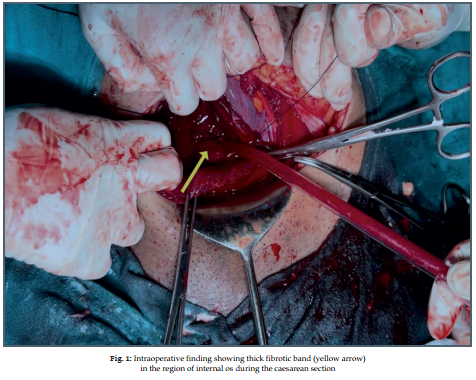
Background: Cervical septum, a rare congenital uterine anomaly, can occasionally be acquired following surgical procedures on the cervix or in the uterus. While most cases are diagnosed incidentally during evaluation for infertility or recurrent miscarriage, acquired cervical septa have been rarely reported following cervical interventions such as hysteroscopy, conization. The impact of such abnormality on subsequent pregnancy outcomes still remains largely unexplored. Aim: Here, we report the case of a 28-year-old female, gravida 3, abortion 2, at 37+4 weeks, with gestational hypertension, who presented for safe confinement and was found to have a cervical septum. Discussion and conclusion: This anomaly is believed to have developed following a hysteroscopic cervical polypectomy performed. The clinical course and management of this patient underscore the need for heightened awareness of potential complications following such interventions on labour.
References
- 1. Baldauf JJ, Dreyfus M, Ritter J, Meyer P, Philippe E. Risk of cervical stenosis after large loop excision or laser conization. Obstet Gynecol. 1996 Dec;88(6):933–8.
- 2. Higuchi N, Sako Y, Shiota K, Hirata T. Cervical Stenosis After Hysteroscopic Surgery for Cesarean Scar Disorder. Cureus. 16(3):e56922.
- 3. Kalstone C. Cervical stenosis in pregnancy: A complication of cryotherapyin diethylstilbestrolexposed women. American Journal of Obstetrics and Gynecology. 1992 Feb 1;166(2):502–3.
- 4. Vitale SG, De Angelis MC, Della Corte L, Saponara S, Carugno J, Laganà AS, et al. Uterine cervical stenosis: from classification to advances in management. Overcoming the obstacles to access the uterine cavity. Arch Gynecol Obstet. 2024 Mar 1;309(3):755–64.
- 5. Bettocchi S, Bramante S, Bifulco G, Spinelli M, Ceci O, Fascilla FD, et al. Challenging the cervix: strategies to overcome the anatomic impediments to hysteroscopy: analysis of 31,052 office hysteroscopies. Fertil Steril. 2016 May;105(5):e16–7.
- 6. Pluchino N, Ninni F, Angioni S, Artini P, Araujo VG, Massimetti G, et al. Office vaginoscopic hysteroscopy in infertile women: effects of gynecologist experience, instrument size, and distention medium on patient discomfort. J Minim Invasive Gynecol. 2010;17(3):344–50.
- 7. The Use of Hysteroscopy for the Diagnosis and Treatment of Intrauterine Pathology | ACOG [Internet]. [cited 2024 Dec 31]. Available from:https://www.acog.org/clinical/clinicalguidance/committee-opinion/articles/2020/03/the-use-of-hysteroscopy-for-the-diagnosis-andtreatment-of-intrauterine-pathology
- 8. Hysteroscopy: a technique for all? Analysis of 5,000 outpatient hysteroscopies - PubMed [Internet]. [cited 2024 Dec 31]. Available from:https://pubmed.ncbi.nlm.nih.gov/17482613/
- 9. Groutz A, Lessing JB, Wolf Y, Yovel I, Azem F, Amit A. Cervical dilatation during ovum pickup in patients with cervical stenosis: effect on pregnancy outcome in an in vitro fertilizationembryo transfer program. Fertil Steril. 1997 May;67(5):909–11.
Data Sharing Statement
There are no additional data available. All raw data and code are available upon request.
Funding
This research received no funding.
Author Contributions
All authors contributed significantly to the work and approve its publication.
Ethics Declaration
This article does not involve any human or animal subjects, and therefore does not require ethics approval.
Acknowledgements
We would like to express our gratitude to the patients, their families, and all those who have contributed to this study.
Conflicts of Interest
No conflicts of interest in this work.
About this article

Cite this article
Anusha Devalla, Puja Bhol, VedPrakash Rao Cheruvu. An Inevitable Caesarean Section Secondary to Iatrogenic Cervical Stenosis following Hysteroscopic Polypectomy. Ind J Matern-Fetal & Neonatal Med 2024;11(2):63-65.
Licence:
Attribution-Non-commercial 4.0 International (CC BY-NC 4.0)This license
enables reusers to distribute, remix, adapt, and build upon the material in any
medium or format for noncommercial purposes only, and only so long as
attribution is given to the creator.
| Received | Accepted | Published |
|---|---|---|
| October 10, 2024 | November 12, 2024 | December 30, 2024 |
DOI: https://doi.org/10.21088/ijmfnm.2347.999X.11224.5
Keywords
Acquired cervical stenosisHysteroscopic polypectomylabour dystociaOperative hysteroscopy.Hysteroscopic polypectomylabour dystociaOperative hysteroscopy.Search for Similar Articles
Similar Articles
- Maternal Mental-Health During Pregnancy and Postpartum Period: A Review of Recen...
- Prenatal Diagnosis of Costello Syndrome: A Case Report
- Innovations in Obstetric Hemorrhage Management: The Evolution of Transvaginal Ba...
- Maternal Plasma Cytokines and the Subsequent Risk of Uterine Atony and Postpartu...
- Amniotic Band Syndrome
Article Level Metrics
Last UpdatedSaturday 17 October 2026, 14:07:13 (IST)
1730
Accesses
29
189
00
Citations
NA
NA
NA
Download citation
Article Keywords
Keyword Highlighting
Highlight selected keywords in the article text.
Timeline
| Received | October 10, 2024 |
| Accepted | November 12, 2024 |
| Published | December 30, 2024 |
licence
Attribution-Non-commercial 4.0 International (CC BY-NC 4.0)
This license
enables reusers to distribute, remix, adapt, and build upon the material in any
medium or format for noncommercial purposes only, and only so long as
attribution is given to the creator.