Full Text (PDF)
Indian Journal of Trauma and Emergency Pediatrics 18(1):p 29-32, January-June 2026. | DOI: https://doi.org/10.21088/ijtep.2348.9987.18126.5
Case Report
Airway Management in Cut-Throat Injury: Endotracheal Intubation Followed by Surgical Tracheostomy: A Case Report
Sanjay Kumar, Rajesh Kumar, Rekha Kumari, Saket Prakash, Sunil Kumar, Anil Kumar, Anurag Kumar, Majid Anwer
Author Information
Licence:
Attribution-Non-commercial 4.0 International (CC BY-NC 4.0)This license enables reusers to distribute, remix, adapt, and build upon the material in any medium or format for noncommercial purposes only, and only so long as attribution is given to the creator.
Indian Journal of Trauma and Emergency Pediatrics 18(1):p 29-32, January-June 2026. | DOI: https://doi.org/10.21088/ijtep.2348.9987.18126.5
How Cite This Article:
Rajesh Kumar, Rekha Kumari, Sanjay Kumar et. al, Airway Management in Cut-Throat Injury: Endotracheal Intubation Followed by Surgical Tracheostomy: A Case Report. Indian J Trauma Emerg Pediatr. 2026;18(1):29–32Timeline
Received : April 01, 2026
Accepted : May 05, 2026
Published : June 30, 2026
Abstract
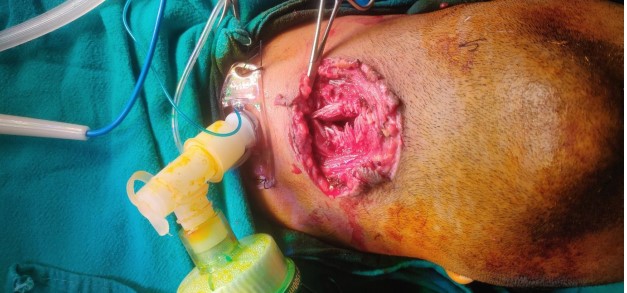
Cut-throat injuries represent a critical emergency due to the high risk of airway compromise, hemorrhage, and distortion of normal anatomy. Prompt airway management is crucial in preventing hypoxia and mortality. We report a case of a middle-aged male presenting with a deep anterior neck laceration and exposed airway structures. The airway was initially secured using endotracheal intubation under controlled anaesthetic conditions, followed by definitive surgical tracheostomy. Careful planning, maintenance of oxygenation, and coordination between anaesthesia and surgical teams played a crucial role in successful management. This case highlights the importance of a stepwise airway approach in managing complex neck trauma.
References
- 1. Nason RW, Assuras GN, Grey PR, Lipschitz J. Penetrating neck injuries: analysis and management. J Otolaryngol Head Neck Surg. 2019;48:1–7. doi:10.1186/s40463-019-0337-9.
- 2. Sperry JL, Moore EE, Coimbra R, et al. Western Trauma Association critical decisions in trauma: airway management in trauma patients. J Trauma Acute Care Surg. 2020;88(6):875–883. doi:10.1097/TA.0000000000002693.
- 3. Lockey DJ, Crewdson K, Davies G. Traumatic airway management: current evidence and practice. Resuscitation. 2020;156:186–195. doi:10.1016/j.resuscitation.2020.09.017.
- 4. Austin DR, Chang MG, Bittner EA. Airway management in penetrating neck trauma: a review. Anesth Analg. 2021;132(4):1001–1009. doi:10.1213/ANE.0000000000005315.
- 5. Heffner AC, Swords DS, Neale MN, Jones AE. Incidence and factors associated with difficult airway in emergency settings. Ann Emerg Med. 2021;78(6):741–750. doi:10.1016/j. annemergmed.2021.05.007
- 6. Apfelbaum JL, Hagberg CA, Connis RT, et al. 2022 ASA practice guidelines for management of the difficult airway. Anesthesiology. 2022;136(1):31–81. doi:10.1097/ALN.000000000 0004002
- 7. Frerk C, Mitchell VS, McNarry AF, et al. Updates in difficult airway management strategies. Br J Anaesth. 2022;128(4):e195–e208. doi:10.1016/j.bja.2021.12.028
- 8. Latif RK, Karim HM, et al. Airway management strategies in neck trauma: recent advances. Indian J Anaesth. 2023;67(5):345– 352. doi:10.4103/ija.ija_XXX_23 (Note: confirm final DOI from journal site before submission, as IJA DOIs can vary by Number).
- 9. Higgs A, Cook TM, McGrath BA. Airway management in critically ill patients: evolving concepts. Anaesthesia. 2023;78(Suppl 1):9–17. doi:10.1111/anae.15864
Data Sharing Statement
There are no additional data available. All raw data and code are available upon request.
Funding
This research received no funding.
Author Contributions
All authors contributed significantly to the work and approve its publication.
Ethics Declaration
This article does not involve any human or animal subjects, and therefore does not require ethics approval.
Acknowledgements
We would like to express our gratitude to the patients, their families, and all those who have contributed to this study.
Conflicts of Interest
No conflicts of interest in this work.
About this article

Cite this article
Rajesh Kumar, Rekha Kumari, Sanjay Kumar et. al, Airway Management in Cut-Throat Injury: Endotracheal Intubation Followed by Surgical Tracheostomy: A Case Report. Indian J Trauma Emerg Pediatr. 2026;18(1):29–32
Licence:
Attribution-Non-commercial 4.0 International (CC BY-NC 4.0)This license enables reusers to distribute, remix, adapt, and build upon the material in any medium or format for noncommercial purposes only, and only so long as attribution is given to the creator.
| Received | Accepted | Published |
|---|---|---|
| April 01, 2026 | May 05, 2026 | June 30, 2026 |
DOI: https://doi.org/10.21088/ijtep.2348.9987.18126.5
Keywords
Cut-Throat InjuryPenetrating Neck TraumaAirway ManagementEndotracheal IntubationTracheostomyDifficult AirwayTrauma AnaesthesiaArticle Level Metrics
Last UpdatedSunday 18 October 2026, 12:57:18 (IST)
1777
Accesses
10
245
00
Citations
NA
NA
NA
Download citation
Article Keywords
Keyword Highlighting
Highlight selected keywords in the article text.
Timeline
| Received | April 01, 2026 |
| Accepted | May 05, 2026 |
| Published | June 30, 2026 |
licence
Attribution-Non-commercial 4.0 International (CC BY-NC 4.0)
This license enables reusers to distribute, remix, adapt, and build upon the material in any medium or format for noncommercial purposes only, and only so long as attribution is given to the creator.