Full Text (PDF)
Journal of Forensic Chemistry and Toxicology 11(1):p 50-56, Jan-June 2025. | DOI: 10.21088/jfct.2454.9363.11125.6
Review Article
Advancements in Sensor Technologies for Forensic Toxicology: Enlightens the Way for Future Toxic Detection
Suman Sangwan, Jasbir Lather, Sitaram ,, Jyoti Malik, Diksha Thakur, Madhup Singh, Rinku ,, Ajay Kumar
Author Information
Licence:
Attribution-Non-commercial 4.0 International (CC BY-NC 4.0)This license enables reusers to distribute, remix, adapt, and build upon the material in any medium or format for noncommercial purposes only, and only so long as attribution is given to the creator.
Journal of Forensic Chemistry and Toxicology 11(1):p 50-56, Jan-June 2025. | DOI: 10.21088/jfct.2454.9363.11125.6
How Cite This Article:
Sangwan S, Lather J, Sitaram, et al. Advancements in Sensor Technologies for Forensic Toxicology: Enlightens the Way for Future Toxic Detection. J Forensic Chemistry Toxicol. 2025;11(1):50–6.Timeline
Received : May 09, 2025
Accepted : May 30, 2025
Published : June 12, 2025
Abstract
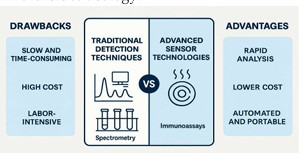
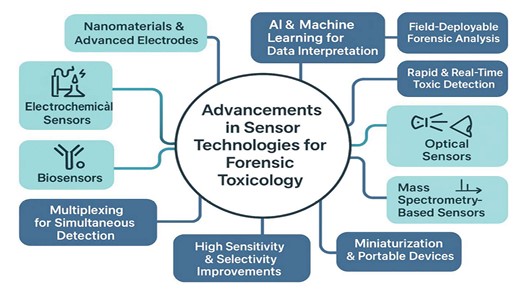
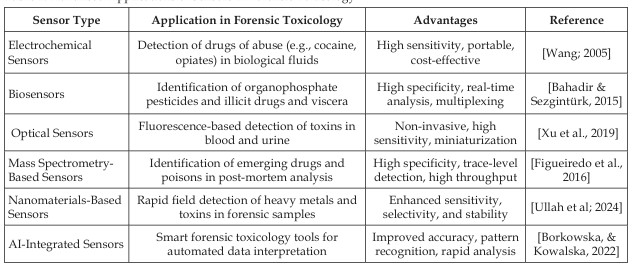
Theevolutionofsensortechnologieshassignicantlyimpactedforensictoxicology, offers more efficient, sensitive, and precise means of detectingt oxic substances in biological samples. This review critically examines the recent advancements in sensor techniques employed in forensic toxicology, focusing on their potential toimprovethedetectionandidenticationof toxins,drugs,poisons, andother harmful substances in forensic investigations. From electrochemical sensors and biosensors to optical and mass spectrometric techniques, sensor-based technologies are enhancing the speed, accuracy, and accessibility of toxicological testing.Thiscritical review paper explores the benefits, limitations, andfuture directions of these advanced sensor systems, highlighting their role in simplifying and accelerating toxicological analyses in both clinical and criminal investigations.
References
- 1. Arduini, F., et al. (2017). Electrochemical sensors as an innovative approach for clinical and forensic toxicology. Trends in Analytical Chemistry, 97, 179-190.
- 2. Bahadir, E. B., & Sezgintürk, M. K. (2015). Applications of electrochemical biosensors to pharmaceuticals. Analytical Biochemistry, 478, 107-120.
- 3. Borkowska, E., & Kowalska, T. (2022). “AI Powered Toxicological Screening: A New Era in Forensic Investigations.” Forensic Science International, 314, 110380.
- 4. Britzi, M., Friedman, S., Miron, J., Solomon, R., Cuneah, O., Shimshoni, J. A., ... & Shlosberg, A.(2013).Carry-overofa atoxinB1toa atoxin M1 in high yielding Israeli cows in mid-and late-lactation. Toxins, 5(1), 173-183.
- 5. Dhawan, D., & Garg, A. (2021). “Biosensors for Detection of Toxicological Agents in Forensic Investigations.” Sensors and Actuators B: Chemical, 329, 129089.
- 6. Fan, X., et al. (2008). Sensitive optical biosensors for unlabeled targets: A review. Analytica Chimica Acta, 620(1-2), 8-26.
- 7. Figueiredo, R., et al. (2016). Advances in mass spectrometry for forensic toxicology. Trends in Analytical Chemistry, 85, 1-10.
- 8. Gao, A. (2024). Advances in biosensors for poison detection applications. In E3S Web of Conferences (Vol. 553, p. 05002). EDP Sciences.
- 9. Johnson, P. E., & Miller, M. R. (2020). “Mass Spectrometry in Forensic Toxicology: Recent Advances in Sensor Applications.” Forensic Science International, 317, 110514.
- 10. Khan, R., Anwar, F., & Ghazali, F. M. (2024). A comprehensive review of mycotoxins: Toxicology, detection, and effective mitigation approaches. Heliyon.
- 11. Kumar R., Sheikh N., Bashar M., Vasudeva A., Kumar A., Yadav A., et al. (2023). Journal of Family Medicine and Primary Care. J. 12, 70.
- 12. Kumar, V., et al. (2019). “Biosensors in forensic toxicology: Current status and future trends.” Analytical and Bioanalytical Chemistry.
- 13. Ligler F. S., Taitt C. R., Shriver–Lake L. C., Sapsford K. E., Shubin Y. S., Golden J. P. (2003). Analytical and Bioanalytical Chemistry. J. 377, 469.
- 14. López, M., et al. (2020). “Advances in biosensor technologies for toxin detection.” Journal of Toxicology.
- 15. Parra, M., et al. (2020). “Recent Advances in Electrochemical Sensors for Forensic Toxicology Applications.” Trends in Analytical Chemistry, 123, 115-123.
- 16. Ryan, M. A., & Smith, S. P. (2018). “Integrating AI and Mass Spectrometry in Forensic Toxicology.” Journal of Forensic Toxicology, 36(5), 204-210.
- 17. Smith, R. D. (2004). Advances in mass spectrometry instrumentation. Annual Review of Analytical Chemistry, 1(1), 349-378.
- 18. Turner, A. P. F. (2013). Biosensors: Sense and sensibility. Chemical Society Reviews, 42(8), 3184-3196.
- 19. Ullah, M. F., Khan, Y., Khan, M. I., Abdullaeva, B. S., & Waqas, M. (2024). Exploring nanotechnology in forensic investigations: Techniques, innovations, and future prospects. Sensing and Bio-Sensing Research, 100674.
- 20. Wang, J. (2005). Electrochemical biosensors: Towards point-of-care cancer diagnostics. Biosensors and Bioelectronics, 21(10), 1887 1892.
- 21. Xu, X., et al. (2019).Advancesin uorescence based biosensors for food safety detection. Trends in Food Science & Technology, 91, 240 252.
- 22. Yáñez-Sedeño, P., Agüí, L., Villalonga, R., & Pingarrón, J. M. (2014). Biosensors in forensic analysis. A review. Analytica chimica acta, 823, 1-19.
- 23. Yang, L., et al. (2022). “Optical Sensing in Forensic Toxicology: A Review.” Journal of Forensic Sciences, 67(2), 578-591.
- 24. Zhang, Y., et al. (2019). “Advances in Portable Sensors for Toxicological Analysis in Forensic Investigations.” Sensors, 19(24), 5478.
- 25. Zhu, Z., et al. (2021). “Deep Learning in Mass Spectrometry for Forensic Toxicology.” Nature Biotechnology, 39(8), 1052-1060.
Data Sharing Statement
There are no additional data available. All raw data and code are available upon request.
Funding
This research received no funding.
Author Contributions
All authors contributed significantly to the work and approve its publication.
Ethics Declaration
This article does not involve any human or animal subjects, and therefore does not require ethics approval.
Acknowledgements
No Information Provided
Conflicts of Interest
No conflicts of interest in this work.
About this article

Cite this article
Sangwan S, Lather J, Sitaram, et al. Advancements in Sensor Technologies for Forensic Toxicology: Enlightens the Way for Future Toxic Detection. J Forensic Chemistry Toxicol. 2025;11(1):50–6.
Licence:
Attribution-Non-commercial 4.0 International (CC BY-NC 4.0)This license enables reusers to distribute, remix, adapt, and build upon the material in any medium or format for noncommercial purposes only, and only so long as attribution is given to the creator.
| Received | Accepted | Published |
|---|---|---|
| May 09, 2025 | May 30, 2025 | June 12, 2025 |
DOI: 10.21088/jfct.2454.9363.11125.6
Keywords
Forensic ToxicologySensorsDiagnosisSearch for Similar Articles
Similar Articles
- Simultaneous Determination and Method Validation For Opioids, Cannabinol and Nic...
- Algorithm for Investigating Suspected Mothball Poisoning
- Analytical Advances in Date Rape Drug Detection: A Comparative Study of Metaboli...
- An Empirical Assessment of Dermatoglyphics & Psychological Profiling of Juvenile...
- Detection of Mustard Oil Adulteration in Kanpur City
Article Level Metrics
Last UpdatedTuesday 08 September 2026, 23:41:47 (IST)
1386
Accesses
7
143
00
Citations
NA
NA
NA
Download citation
Article Keywords
Keyword Highlighting
Highlight selected keywords in the article text.
Timeline
| Received | May 09, 2025 |
| Accepted | May 30, 2025 |
| Published | June 12, 2025 |
licence
Attribution-Non-commercial 4.0 International (CC BY-NC 4.0)
This license enables reusers to distribute, remix, adapt, and build upon the material in any medium or format for noncommercial purposes only, and only so long as attribution is given to the creator.