Full Text (PDF)
Journal of Forensic Chemistry and Toxicology 11(1):p 7-15, Jan-June 2025. | DOI: https://doi.org/10.21088/jfct.2454.9363.11125.1
Original Article
Simultaneous Determination and Method Validation For Opioids, Cannabinol and Nicotine in Postmortem Whole Blood Using High Performance thin Layer Chromatography Mass Spectrometry
Pallavi Choudhary, Kanak Lata Verma, Lijo T. Varghese, A. K. Jaiswal, Adarsh Kumar
Author Information
Licence:
Attribution-Non-commercial 4.0 International (CC BY-NC 4.0)This license enables reusers to distribute, remix, adapt, and build upon the material in any medium or format for noncommercial purposes only, and only so long as attribution is given to the creator.
Journal of Forensic Chemistry and Toxicology 11(1):p 7-15, Jan-June 2025. | DOI: https://doi.org/10.21088/jfct.2454.9363.11125.1
How Cite This Article:
Pallavi Choudhary, Kanak Lata Verma, Lijo T. Varghese et. al, Simultaneous Determination And Method Validation For Opioids, Cannabinol and Nicotine in Postmortem Whole Blood Using High -Performance thin Layer Chromatography–Mass Spectrometry. J Forensic Chemistry Toxicol. 2025; 11(1): 07–15.Timeline
Received : May 15, 2025
Accepted : June 19, 2025
Published : June 30, 2025
Abstract
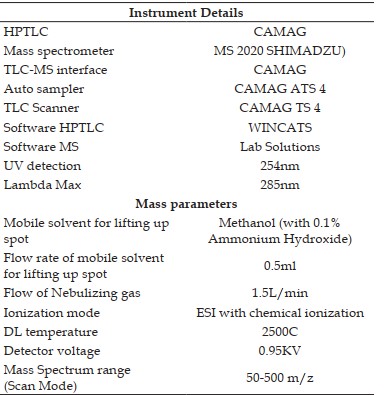
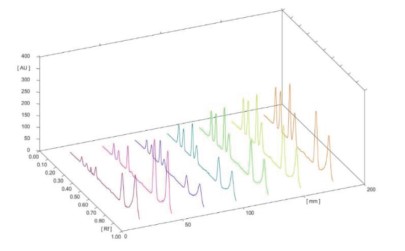
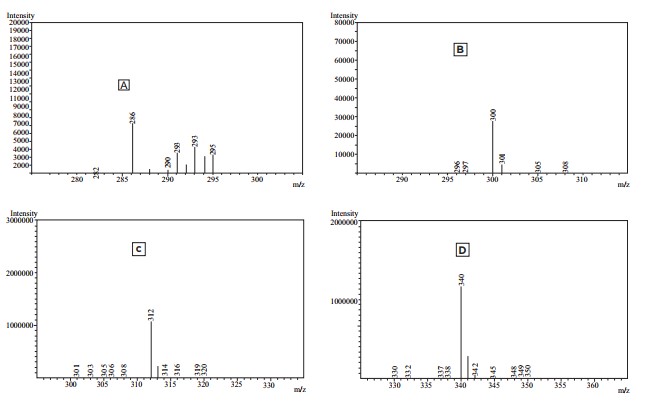
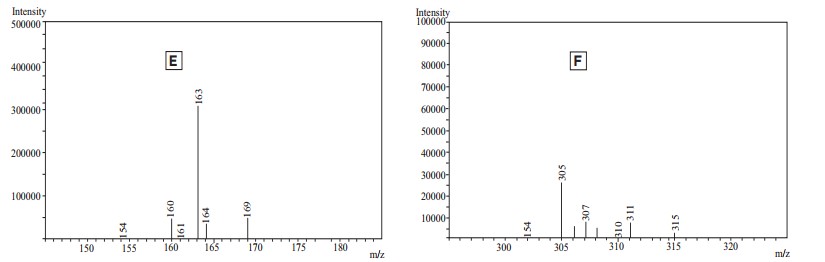
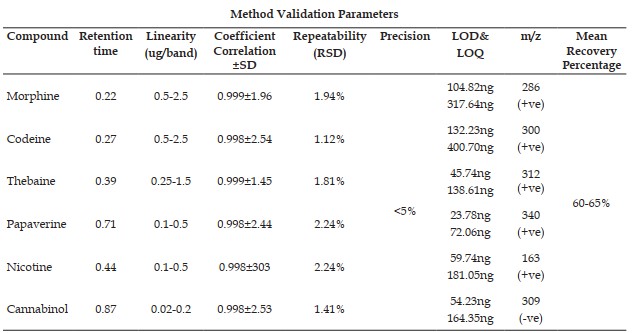
Background: Opioids, cannabis and nicotine are the oldest and highly abused substances globally. The detection and identification of these drugs is a major challenge for the law enforcement agencies as well as forensic chemists, especially when the cases pertain to sexual assaults/drug-facilitated sexual assaults. Aim: To develop a determination method which can quantify opioids, cannabinol and nicotine simultaneously in whole blood. Objective: This paper presents a validated method for the identification and quantitation of Morphine (MOR), Codeine (COD), Thebaine (THB), Papaverine (PAPA), Cannabinol (CBN) & nicotine (NIC) using High performance thin layer chromatography- Mass spectrometry HPTLC-MS, from whole blood at postmortem. Material & Method: Quantitative analysis of MOR, COD, THB, PAPA, CBN and NIC were done using HPTLC and MS was operating in selective ion-monitoring mode for accurate identification of the drugs under study. Small Volume Liquid extraction (SVLE) technique using ethyl acetate-hexane (80:20) were used for the extraction of blood. Pre-coated HPTLC (silica gel G 60 F254) plates were developed using mobile phase ethyl acetate: methanol: ammonia (8.5:1:0.5). Result: The screening of HPTLC plates was done by UV light and the m/z ratio of drugs was obtained by lifting spots from plates using the HPTLC-MS interface. Method validation was done according to the International Council for Harmonisation of Technical Requirements for Pharmaceuticals for Human Use (ICH) guidelines. The technique will encourage forensic chemists to embrace the validated HPTLC-MS method. Conclusion: The developed HPTLC-MS method is simple, sensitive, precise, accurate, economic and can be used for quantitative analysis of MOR, COD, THB, PAPA, NIC and CBN in blood.
References
- 1. Sharma B, Arora A, Singh K, Singh H, Kaur P. Drug Abuse: Uncovering the Burden in Rural Punjab. J Family Med Prim Care. 2017; 6(3):558-562.
- 2. Kulsudjarit K. Drug problem in Southeast and Southwest Asia. Ann.N.Y. Acad. Sci. 2004; 1025:446-457.
- 3. Huffman A. Controlling Opioid Abuse in the Emergency Department. Annals of Emergency Medicine. 2013; 61(6):A13-A15.
- 4. Bridgeman MB, Abazia DT. Medical Cannabis History, Pharmacology & Implications for the Acute Care Setting. Pharmacy & Therapeutics. 2017; 42(3):180-188.
- 5. Biological Process Underlying Co-Use of Alcohol & Nicotine: Neuronal Mechanism, Cross-Tolerance & Genetics Factors. https:// pubs.niaaa.nih.gov/publications/arh293/186- 192.htm. Accessed on 01/05/2023.
- 6. TheOpium Alkaloid. https://www.unodc. org/unodc/en/data-and-analysis/bulletin/ bulletin-1953-01-01-3-page005.html. Accessed on 01/05/2023.
- 7. Green TC, Park JN, Gilbert M, McKenzie M, Struth E, Lucas R, Clarke W, Sherman SG. An assessment of the limits of detection, sensitivity and specificity of three devices for public health-based drug checking of fentanyl in street-acquired samples. International Journal of Drug Policy.2020;77:102661:https:// doi.org/10.1016/j.drugpo.2020.102661.
- 8. Gilbert N, Antonides L.H, SchoÒeld C.J., et al. Hitting the Jackpot – development of gas chromatography–mass spectrometry (GC– MS) and other rapid screening methods for the analysis of 18 fentanyl– derived synthetic opioids. Drug Testing and Analysis.2020; 12(6) 798-811.
- 9. Shende C, Farquharson A, Brouillette C, Smith W, Farquharson S. Quantitative Measurements of Codeine and Fentanyl on a SurfaceEnhanced Raman-Active Pad.Molecules. 2019; 24(14): 2578.
- 10. Liu L, Wheeler S. E,Venkataramanan R, Rymer J. A, Pizon A.F. , Lynch M.J., Tamama K.Newly Emerging Drugs of Abuse and Their Detection Methods, An ACLPS Critical Review. Am J Clin Pathol.2018;149:105-116
- 11. Sharma P, Murthy P, Bharath MMS. Chemistry, Metabolism and Toxicology of Cannabis: clinical Implications. Iranian Journal of Psychiatry.2012; 7(4):149-156.
- 12. Drug Market Trends Cannabis Opioids. https://www.unodc.org/res/wdr2022/ MS/WDR22_Booklet_3.pdf Accessed on 30/04/2023.
- 13. Magnitude of Substance Use in India 2019. socialjustice.nic.in/writereaddata/uploadfile/ magnitude-substance-use-India-Reportpdf. Accessed on 30/04/2023.
- 14. Cannabis-and-Opium-based-drugs Cheapest in India. https://timesofindia.indiatimes. com/indian-drugs-cheapest-in theworld/ articlesshow/59230170cms. Accessed on 30/04/2023.
- 15. Sheehan T.J, Hamnett H.J, BeasleyR, Fitzmaurice P.S. Chemical and physical variations of cannabis smoke from a variety of cannabis samples in New Zealand. Forensic Sciences Research. 2019; 4 (2):168–178.
- 16. Verma KL, Kumar M, Singh AP. HPTLCMS as a Neoteric Hyphenated Technique for Separation and Forensic Identification of Drugs. Journal of analytical, Methods and Instrumentation. 2018; 8:1-5.
- 17. Ala A. Alhusban, Samah A. Ata .Simple HPLC method for rapid quantification of nicotine content in e-cigarettes liquids. Acta Chromatographica, 2020, DOI: 10.1556/1326.2020.00832 https:// akjournals.com/view/journals/1326/ aop/article-10.1556-1326.2020.00832/ article-10.1556-1326.2020.00832.xml (accessed on 30.04.2023)
- 18. Chan KW, Harun H. Method Validation for the Identification of Nicotine in Vapes by GCMS.Kimia Science Communication Magazine . 2019; 42(2).(accessed on 30.04.2023)
- 19. Tobacco use Causes 1 Death Every 6 seconds. https://timesofindia.indiatimes.com/ city/nagpur/5891475.cms. Accessed on 30/04/2023.
- 20. Smoking & Tobacco Use. https://www. cdc.gov/tobacco/basic-information/healtheffects/index.htm. Accessed on 30/04/2023.
- 21. Validation of analytical Procedures: Text and Methodology Q2(R1). https://www.ich.org/ home.html. Accessed on 30/04/2023.
- 22. Rao MS Toxicological Manual, Directorate of Forensic Science, Ministry of Home Affairs Government of India, New Delhi, (2005) 1st Edn. Selective and Scientific Books.
- 23. Meng P, Wang Y. Small Volume Liquid Extraction of Amphetamines in Saliva. Forensic Science International.2010; 197(1-3):80-4.
- 24. Clark’s Analysis of Drugs and Poison 3rd edition Pharmaceutical Press 2005.
- 25. Jug U, Glavnik V, Kranjc E, Vovk I. HPTLCDensitometric & HPTLC-MS Methods for analysis of Flavonoids. Journal of Liquid Chromatography & Related Technologies 2018; 41(6):329-341.
Data Sharing Statement
There are no additional data available. All raw data and code are available upon request.
Funding
This research received no funding.
Author Contributions
All authors contributed significantly to the work and approve its publication.
Ethics Declaration
This article does not involve any human or animal subjects, and therefore does not require ethics approval.
Acknowledgements
We would like to express our gratitude to the patients, their families, and all those who have contributed to this study.
Conflicts of Interest
No conflicts of interest in this work.
About this article

Cite this article
Pallavi Choudhary, Kanak Lata Verma, Lijo T. Varghese et. al, Simultaneous Determination And Method Validation For Opioids, Cannabinol and Nicotine in Postmortem Whole Blood Using High -Performance thin Layer Chromatography–Mass Spectrometry. J Forensic Chemistry Toxicol. 2025; 11(1): 07–15.
Licence:
Attribution-Non-commercial 4.0 International (CC BY-NC 4.0)This license enables reusers to distribute, remix, adapt, and build upon the material in any medium or format for noncommercial purposes only, and only so long as attribution is given to the creator.
| Received | Accepted | Published |
|---|---|---|
| May 15, 2025 | June 19, 2025 | June 30, 2025 |
DOI: https://doi.org/10.21088/jfct.2454.9363.11125.1
Keywords
HPLTC-MSOpioidsNicotineCannabinolForensic ScienceSearch for Similar Articles
Similar Articles
- Post Mortem Examination of COVID-19 Deceased and Collection Preservation of Spec...
- A Guide to Forensic Photography: An Indispensable Tool in Modern Forensic Medici...
- Evaluation of Total Carotenoids in Chilly: A Guide to Forensic Examination of Ch...
- "Masseur": A Therapist or Sexual Abuser?
- Sudden Death Due to 5-Fluorouracil-Induced Cardiotoxicity in a Case of Esophagea...
Article Level Metrics
Last UpdatedSunday 18 October 2026, 16:10:35 (IST)
2007
Accesses
16
180
00
Citations
NA
NA
NA
Download citation
Article Keywords
Keyword Highlighting
Highlight selected keywords in the article text.
Timeline
| Received | May 15, 2025 |
| Accepted | June 19, 2025 |
| Published | June 30, 2025 |
licence
Attribution-Non-commercial 4.0 International (CC BY-NC 4.0)
This license enables reusers to distribute, remix, adapt, and build upon the material in any medium or format for noncommercial purposes only, and only so long as attribution is given to the creator.