Full Text (PDF)
Journal of Microbiology and Related Research 9(1):p 19-22, January-June 2023. | DOI: https://doi.org/10.21088/jmrr.2395.6623.9123.2
Original Article
Acinetobacter Baumanii as Cause of Septicemia in Burn
Ravi Kumar Chittoria, Naveen Raj S, Amrutha JS
Author Information
Licence:
Attribution-Non-commercial 4.0 International (CC BY-NC 4.0)This license enables reusers to distribute, remix, adapt, and build upon the material in any medium or format for noncommercial purposes only, and only so long as attribution is given to the creator.
Journal of Microbiology and Related Research 9(1):p 19-22, January-June 2023. | DOI: https://doi.org/10.21088/jmrr.2395.6623.9123.2
How Cite This Article:
Naveen Raj S, Ravi Kumar Chittoria, Amrutha JS/Acinetobacter Baumanii as Cause of Septicemia in Burn/J Microbiol Relat Res. 2023;9(1): 19–22.Timeline
Received : May 04, 2023
Accepted : June 15, 2023
Published : June 25, 2023
Abstract
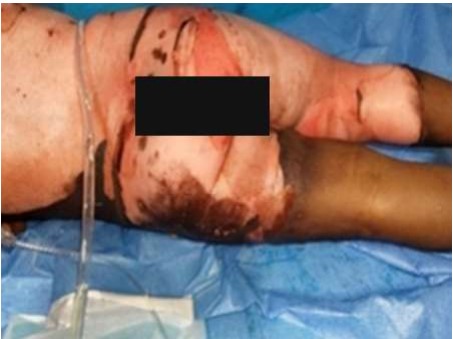
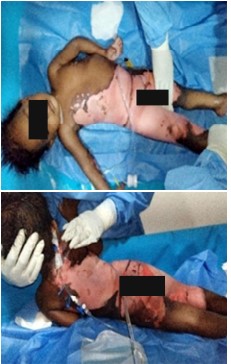
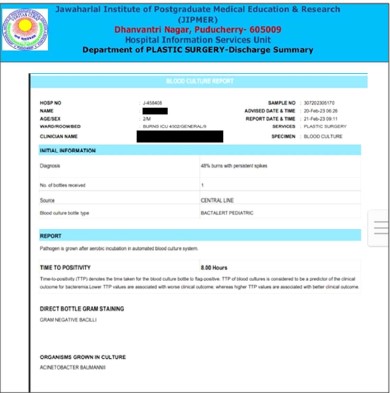
Burn patients are prone to sepsis mainly due to the loss of the skin barrier and immunosuppression. Burn wound infections may originate from the patient's endogenous skin, gastrointestinal, and respiratory flora or may be transferred through contact with contaminated external surfaces and infected hands of healthcare workers. Burn patients are vulnerable to infections, especially infections with multidrug resistant organisms which are usually healthcare associated. Healthcare associated infections refer to infections affecting patients in a hospital or other healthcare facility that were not present or incubating at admission. These include occupational infections among healthcare workers and infections acquired in the hospital or other healthcare facilities but appearing after discharge. This study highlights the role of Acineto bacter baumanii as the cause of septicemia in burns.
References
- 1. Tekin R, Dal T, Bozkurt F, Deveci O, Palanc Y, Arslan E, et al. Risk factors for nosocomial burn wound infection caused by multidrug-resistant Acinetobacter baumannii. J Burn Care Res 2014;35: e73-80.
- 2. Sharma S, Kaur N, Malhotra S, Madan P, Hans C. Control of an Outbreak of Acinetobacter baumannii in Burn Unit in a Tertiary Care Hospital of North India. Adv Public Health. 2014; 2014:1.
- 3. Van Duin D, Strassel PD, DiBiase LM, Lachiewicz AM, Rutala WA, Eitas T, et al. Timeline of healthcareassociated infections and pathogens after burn injuries. Am J Infect Control 2016; 44:1511-6.
- 4. Cardoso T, Almeida M, Friedman ND, Aragão I, Costa-Pereira A, Sarmento AE, et al. Classification of healthcare-associated infection: A systematic review 10 years after the first proposal. BMC Med 2014; 12:40.
- 5. Mahjoub M, Amara A, Bouafia N, Fredj SB, Abdeljalil AB, Njah M. Healthcare-associated infection specificities' in a Tunisian University Hospital: Overview of the Results. J Adv Med Res 2017; 24:1-9.
- 6. Lowman W, Kalk T, Menezes CN, John MA, Grobusch MP. A case of community-acquired Acinetobacter baumannii meningitis-has the threat moved beyond the hospital? J Med Microbiol 2008; 57:676-8.
- 7. Lee CR, Lee JH, Park M, Park KS, Bae IK, Kim YB, et al. Biology of Acinetobacter baumannii: Pathogenesis, antibiotic resistance mechanisms, and prospective treatment options. Front Cell Infect Microbiol 2017; 7:55.
- 8. Vincent JL, Rello J, Marshall J, Silva E, Anzueto A, Martin CD, et al. The international study of the prevalence and outcomes of infection in Intensive Care Units. JAMA 2009; 302:2323-9.
- 9. Uwingabiye J, Frikh M, Lemnouer A, Bssaibis F, Belefquih B, Maleb A, et al. Acinetobacter infections prevalence and frequency of the antibiotic’s resistance: Comparative study of Intensive Care Units versus other hospital units. Pan Afr Med J 2016; 23:191
Data Sharing Statement
There are no additional data available. All raw data and code are available upon request.
Funding
This research received no funding.
Author Contributions
All authors contributed significantly to the work and approve its publication.
Ethics Declaration
This article does not involve any human or animal subjects, and therefore does not require ethics approval.
Acknowledgements
We would like to express our gratitude to the patients, their families, and all those who have contributed to this study.
Conflicts of Interest
No conflicts of interest in this work.
About this article

Cite this article
Naveen Raj S, Ravi Kumar Chittoria, Amrutha JS/Acinetobacter Baumanii as Cause of Septicemia in Burn/J Microbiol Relat Res. 2023;9(1): 19–22.
Licence:
Attribution-Non-commercial 4.0 International (CC BY-NC 4.0)This license enables reusers to distribute, remix, adapt, and build upon the material in any medium or format for noncommercial purposes only, and only so long as attribution is given to the creator.
| Received | Accepted | Published |
|---|---|---|
| May 04, 2023 | June 15, 2023 | June 25, 2023 |
DOI: https://doi.org/10.21088/jmrr.2395.6623.9123.2
Keywords
Acineto bacter BaumaniSepticemiaBurnsSearch for Similar Articles
Similar Articles
- Preparation of Organic Compost from Kitchen Waste and its Efficiency: Managing W...
- Leprosy Pathophysiology, Clinical Features and Management
- Unusual Presentation of Cysticercosis: A detailed Case Report
- A Review on Monkey Pox: From Pandemic to Endemic
- Role of Low Level Laser Therapy in Adult Burn Patient
Article Level Metrics
Last UpdatedThursday 10 September 2026, 17:24:10 (IST)
1332
Accesses
2
173
00
Citations
NA
NA
NA
Download citation
Article Keywords
Keyword Highlighting
Highlight selected keywords in the article text.
Timeline
| Received | May 04, 2023 |
| Accepted | June 15, 2023 |
| Published | June 25, 2023 |
licence
Attribution-Non-commercial 4.0 International (CC BY-NC 4.0)
This license enables reusers to distribute, remix, adapt, and build upon the material in any medium or format for noncommercial purposes only, and only so long as attribution is given to the creator.