Full Text (PDF)
Journal of Social Welfare and Management 15(3):p 145-151, September-December 2023. | DOI: http://dx.doi.org/10.21088/jswm.0975.0231.15323.6
Original Article
A Study on the Factors Impacting Digital Innovation in E-Learning Business
Author Information
Licence:
Attribution-Non-commercial 4.0 International (CC BY-NC 4.0)Journal of Social Welfare and Management 15(3):p 145-151, September-December 2023. | DOI: http://dx.doi.org/10.21088/jswm.0975.0231.15323.6
How Cite This Article:
Priyadarshini J, Ashiq T. A study on the factors impacting digital innovation in e-learning business. J Soc Welfare Manag. 2023;15(3 Pt 1):145–51.Timeline
Received : July 11, 2023
Accepted : August 29, 2023
Published : December 12, 2023
Abstract
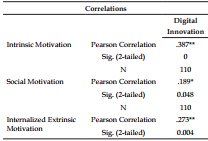
Edtech, or educational technology, is the way information and communication technology tools are introduced into the classroom to produce more engaging, comprehensive and individualized reading and jotting aids. Classrooms have moved beyond the clumsy desktop computers that were formerly the norm and now feature tablets, interactive online courses, and robots that can take notes and record lectures for absent scholars. The broad field of Ed Tech includes devices and software programs commonly known as "remote literacy," "distance literacy," or "online education," as well as literacy suggestions and the most effective ways to teach people new knowledge and skills. A wealth of Edtech tools is transforming the classroom in many ways. The objectives of the study are: 1. To study the innovative methodologies employed in the work process and the work deliverables. 2. To determine the impact of Intrinsic Motivation on Digital Innovation. 3. To analyse the effect of Social Motivation on Digital Innovation. 4. To understand the impact of Internalized Extrinsic Motivation on Digital Innovation. There is found to be a signi cant positive impact of Intrinsic Motivation, Social Motivation and Internalized Extrinsic Motivation on Digital Innovation. Keywords: Intrinsic Motivation; Social Motivation; Internalized Extrinsic Motivation; Digital Innovation; Edu Tech Industry; Work deliverables.
References
- 1. Chen and Jennifer A. Woolf (2017). Intrinsic Motivation and Creativity in the Classroom: Have We Come Full Circle. Frontiers in Psychology.
- 2. Dwivedi, Michael D. Williams (2019). Digitalization of Human Resource Management through Social Media Technology. Journal of Business Research.
- 3. Edward E. Lawler III, John W. Boudreau & Erin E. Lavelle (2019). Digitalization and the Future of Work: Understanding the Impact on Work, Skills and Employment Relations.” Annual Review of Organizational Psychology and Organizational Behaviour.
- 4. Maarten Vansteenkiste (2020). Motivational Pro les from a Self-Determination Perspective: The Quality of Motivation Matters. Journal of Educational Psychology.
- 5. Nunnally, J. C. (1978). Psychometric Theory (2nd ed.). New York: McGraw-Hill.
- 6. Rachel Lee (2021). Internalization of Extrinsic Motivation: Effects on Persistence. Journal of Personality and Social Psychology.
- 7. Sarah E. A. Lee (2019). Motivational and Cognitive Predictors of Achievement: Exploring the Complexities of Achievement Motivation. Journal of Personality and Social Psychology.
- 8. T. M. A. Batenburg (2018). Digital innovation and its organizational enablers: A dynamic capabilities perspective. Journal of Business Research.
- 9. Tapiwa Madondo, Gift Mahere & Tendai Mugwagwa (2016). The Digitisation of Personnel Systems as a Necessity for Effective Practice of Human Resource Management in the Public Sector of Zimbabwe. Journal of Human Resource Studies.
- 10. Wang, Pei-Luen Patrick Rau, and Hsin-Chen Lin (2020). Exploring the Bene ts of Arti cial Intelligence for Human Resource Management: A Conceptual Framework. Journal of Business Research.
About this article

Cite this article
Priyadarshini J, Ashiq T. A study on the factors impacting digital innovation in e-learning business. J Soc Welfare Manag. 2023;15(3 Pt 1):145–51.
Licence:
Attribution-Non-commercial 4.0 International (CC BY-NC 4.0)| Received | Accepted | Published |
|---|---|---|
| July 11, 2023 | August 29, 2023 | December 12, 2023 |
DOI: http://dx.doi.org/10.21088/jswm.0975.0231.15323.6
Keywords
Intrinsic MotivationSocial MotivationInternalized Extrinsic MotivationDigital InnovationEdu Tech IndustryWork deliverablesSearch for Similar Articles
Similar Articles
- A Study on Skilling and Employment Portal at Entry level IT Jobs
- Investigate and Evaluate the Level of Customer Satisfaction with Service Provide...
- Impact of Consumer's Attitude and Perception on Online Purchasing Behavior
- A Study on Factors Influencing Job Performance at Rappo Phygitals
- A Study on Supply Chain Management Practices of Zuko Overseas Private Limited: C...
Article Level Metrics
Last UpdatedSunday 30 August 2026, 01:22:12 (IST)
2196
Accesses
6
206
00
Citations
NA
NA
NA
Download citation
Article Keywords
Keyword Highlighting
Highlight selected keywords in the article text.
Timeline
| Received | July 11, 2023 |
| Accepted | August 29, 2023 |
| Published | December 12, 2023 |