Full Text (PDF)
New Indian Journal of Surgery 15(4):p 141-145, October-December 2024. | DOI: https://doi.org/10.21088/nijs.0976.4747.15424.2
Original Article
A Study of Genitourinary Fistulas and its Implications
Tanvi Arora, K Nischal, Shruthirachita Malagatti
Author Information
Licence:
Attribution-Non-commercial 4.0 International (CC BY-NC 4.0)This license enables reusers to distribute, remix, adapt, and build upon the material in any medium or format for noncommercial purposes only, and only so long as attribution is given to the creator.
New Indian Journal of Surgery 15(4):p 141-145, October-December 2024. | DOI: https://doi.org/10.21088/nijs.0976.4747.15424.2
How Cite This Article:
Tanvi Arora, K Nischal, Shruthirachita Malagatti, A Study of Genitourinary Fistulas and its Implications. New Indian J Surg. 2024; 15(4):141-145Timeline
Received : September 07, 2024
Accepted : November 22, 2024
Published : December 30, 2024
Abstract
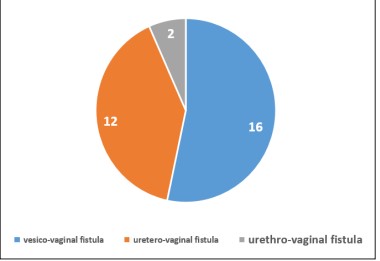
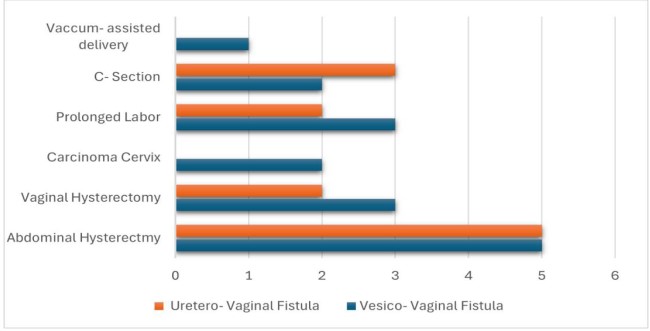
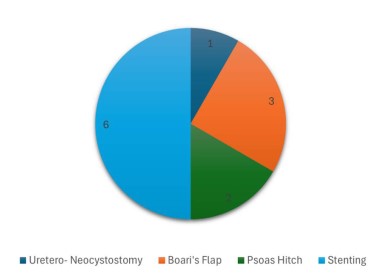
Context: Genitourinary fistulas present significant challenges in surgical management, often causing considerable distress. In developing countries, these are commonly linked to obstetric trauma, while in developed regions, they often result from gynecologic or pelvic surgeries. Aims: This retrospective study aims to analyze the etiology, diagnostic methods, surgical approaches, and outcomes of genitourinary fistulas treated over four years at a tertiary care center. Settings and Design: The study is a single-center retrospective review of 30 cases treated surgically from 2020 to 2023. Methods and Material: Patient data on demographics, etiologies, diagnostic methods, and surgical techniques were gathered from medical records. Statistical analysis used: Descriptive statistics were applied to summarize demographics, fistula types, and surgical outcomes, with success rates calculated for each technique. Results: Vesico-vaginal fistulas were the most common, often following abdominal hysterectomies. Trans-abdominal repairs, especially with omental repair, showed high success rates. There was a decline in obstetric-related fistulas and an increase in cases linked to gynecologic surgeries, especially hysterectomies. Conclusions: The study identifies a shift in genitourinary fistula etiologies, with a decline in vesico-vaginal fistulas (VVF) due to better obstetric care and an increase in uretero-vaginal fistulas (UVF) linked to rising hysterectomy rates. Trans-abdominal repair techniques showed high success rates, emphasizing the importance of surgical principles for optimal outcomes. Key Messages: This study demonstrates a notable shift in genitourinary fistula trends, with decreased vesico-vaginal fistulas due to better obstetric care and rising uretero-vaginal fistulas linked to hysterectomies. These findings underline the critical need for skilled surgical intervention and a multidisciplinary approach for optimal patient outcomes.
References
- 1. Osman SA, Al-Badr AH, Malabarey OT, Dawood AM, AlMosaieed BN, Rizk DEE. Causes and management of urogenital fistulas. A retrospective cohort study from a tertiary referral center in Saudi Arabia. Saudi Med J. 2018 Apr;39(4):373–8.
- 2. Mandava A, Koppula V, Sharma G, Kandati M, Raju KVVN, Subramanyeshwar Rao T. Evaluation of genitourinary fistulas in pelvic malignancies with etiopathologic correlation: role of cross sectional imaging in detection and management. Br J Radiol. 2020 Jul;93(1111):20200049.
- 3. Vikram S, Om Kumar Y, Arjun Singh S, Mahendra S, Deepak Prakash B, Shashank T, et al. Genitourinary Fistula: epidemiology, changing trends in etiology and management: A tertiary care institute’s perspective. Urologia Journal. 2024 May 18;91(2):243–8.
- 4. Blaivas JG, Heritz DM, Romanzi LJ. Early Versus Late Repair of Vesicovaginal Fistulas: Vaginal and Abdominal Approaches. Journal of Urology. 1995 Apr;153(4):1110–3.
- 5. Kızılay F, Özdemir T, Aliyev B, Şimşir A, Kalemci S, Özyurt C. Comparison of the Abdominal and Transvaginal Techniques in the Surgical Treatment of Vesicovaginal Fistula and Analyzing the Factors Affecting Its Recurrence. Journal of Urological Surgery. 2020 Aug 20;7(3):238–44.
Data Sharing Statement
There are no additional data available. All raw data and code are available upon request.
Funding
This research received no funding.
Author Contributions
All authors contributed significantly to the work and approve its publication.
Ethics Declaration
This article does not involve any human or animal subjects, and therefore does not require ethics approval.
Acknowledgements
We would like to express our gratitude to the patients, their families, and all those who have contributed to this study.
Conflicts of Interest
No conflicts of interest in this work.
About this article

Cite this article
Tanvi Arora, K Nischal, Shruthirachita Malagatti, A Study of Genitourinary Fistulas and its Implications. New Indian J Surg. 2024; 15(4):141-145
Licence:
Attribution-Non-commercial 4.0 International (CC BY-NC 4.0)This license enables reusers to distribute, remix, adapt, and build upon the material in any medium or format for noncommercial purposes only, and only so long as attribution is given to the creator.
| Received | Accepted | Published |
|---|---|---|
| September 07, 2024 | November 22, 2024 | December 30, 2024 |
DOI: https://doi.org/10.21088/nijs.0976.4747.15424.2
Keywords
Genitourinary fistulavesico-vaginal fistulauretero-vaginal fistulasurgical repair techniquesSearch for Similar Articles
Similar Articles
- Role of Bates-Jenson Wound Assessment Tool (BJWAT) in Wound Management
- Role of New Antimicrobial Solution in the Management of a Chronic Left Foot Woun...
- Laparoscopic Excision of a Giant Retroperitoneal Benign Mesenteric Cyst Encasing...
- Endoscopic-Assisted Sural Nerve and Biceps Femoris Muscle Biopsy in a Young Woma...
- Amniotic Membrane in Wound Healing: Biological Basis, Clinical Evidence and Futu...
Article Level Metrics
Last UpdatedSunday 22 November 2026, 19:39:22 (IST)
9572
Accesses
12
879
00
Citations
NA
NA
NA
Download citation
Article Keywords
Keyword Highlighting
Highlight selected keywords in the article text.
Timeline
| Received | September 07, 2024 |
| Accepted | November 22, 2024 |
| Published | December 30, 2024 |
licence
Attribution-Non-commercial 4.0 International (CC BY-NC 4.0)
This license enables reusers to distribute, remix, adapt, and build upon the material in any medium or format for noncommercial purposes only, and only so long as attribution is given to the creator.