Full Text (PDF)
Indian Journal of Medical and Health Sciences 11(2):p 97-106, Oct - Dec. 2024. | DOI: https://doi.org/10.21088/ijmhs.2347.9981.11224.6
Original Article
A Study of Clinical Parameters and Outcomes of Acute Kidney Injury Hepatorenal Syndrome in Patients with Cirrhosis of Liver and Ascites
Gownisha P., Shashibhushan J., Raghavendra F.N., Mudegoudara Lingaraj
Author Information
Licence:
Attribution-Non-commercial 4.0 International (CC BY-NC 4.0)This license enables reusers to distribute, remix, adapt, and build upon the material in any medium or format for noncommercial purposes only, and only so long as attribution is given to the creator.
Indian Journal of Medical and Health Sciences 11(2):p 97-106, Oct - Dec. 2024. | DOI: https://doi.org/10.21088/ijmhs.2347.9981.11224.6
How Cite This Article:
Shashibhushan J., Gownisha P., et al., A Study of Clinical Parameters and Outcomes of Acute Kidney InjuryHepatorenal Syndrome in Patients with Cirrhosis of Liver and Ascites. Jr. Med. & Health Sci. 2024;11(2):97–106.Timeline
Received : September 26, 2024
Accepted : October 29, 2024
Published : December 30, 2024
Abstract
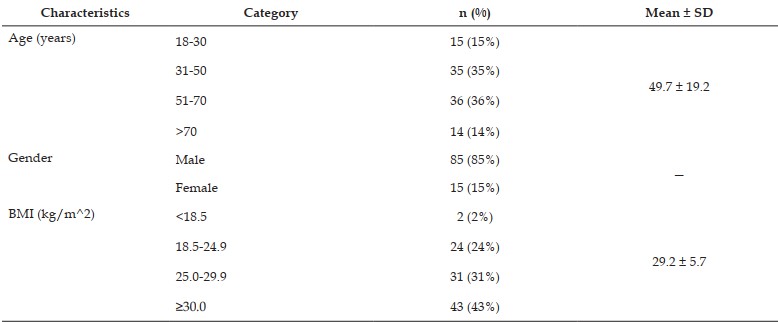
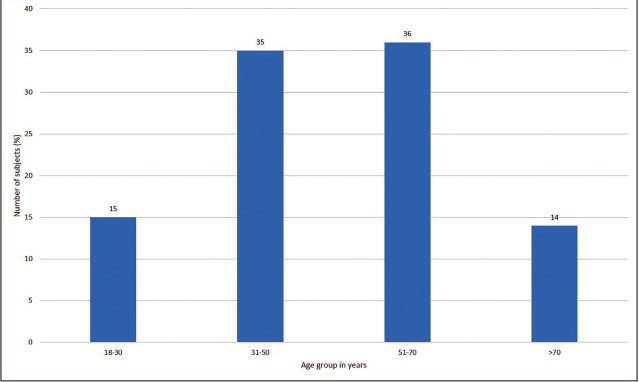
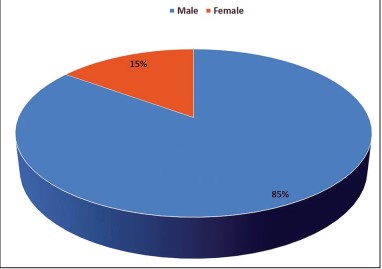
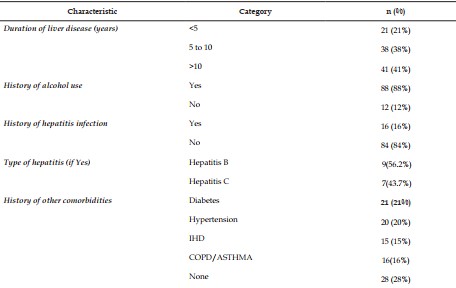
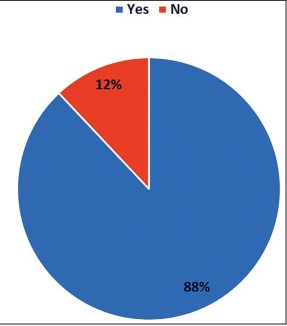
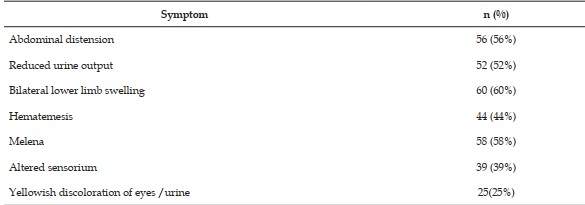
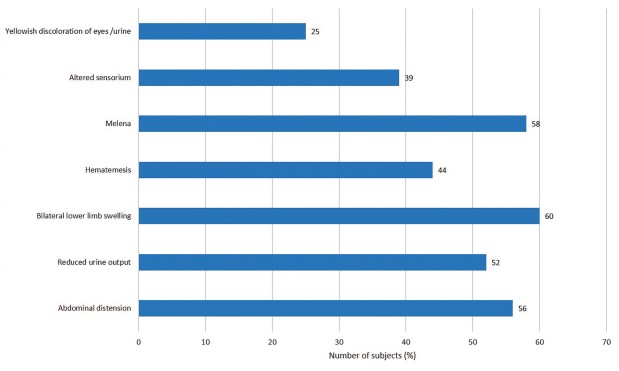
Introduction: Liver cirrhosis can cause serious complications. One of the most common and serious complications which causes increased mortality is Hepatorenal syndrome. The clinical parameters and treatment modify the outcome of the disease. Objectives: To assess the demographic and clinical parameters in patients with Cirrhosis and ascites with acute kidney injury hepatorenal syndrome and to assess the outcome and improvement in Acute kidney injury hepatorenal syndrome with conservative management. Materials and Methods: This a cross-sectional, descriptive study was conducted at the Department of General Medicine and Gastroenterology, Ballari Medical College & Research Centre, Ballari, India, between July 2022 and December 2023 witha sample size of 100 cases. The study aimed to investigate the clinical parameters and outcomes of acute kidney injury, specifically hepatorenal syndrome, in patients with cirrhosis of the liver and ascites. Results: Out of these 100 cases, majority were from 51-70 years age group (36%) with a mean 49.7 ± 19.2 years with Male predominance 85%. 88% of the cases had history of alcohol use. The most common presentations were Abdominal distension-56%, Reduced urine output-52%, Bilateral lower limb swelling-60%. USG abdomen revealed cirrhosis with ascites in 90% cases. Albumin infusion was given to majority 40% patients. Response to treatment showed improvement in 41% cases, stable in 30% and condition worsened in 29% cases. Death rate in the study was 46%. Long-term renal function outcome revealed improvement in 32% cases, stability in 35% and worsened condition in 33% cases. Serum creatinine >3 mg/dL with OR -1.97 (0.62-3.04) (p-0.0441), serum bilirubin >10 mg/dL with OR- 1.93 (0.69-3.41) and (p-0.0298), response to treatment (worsened) with OR as 3.61 (1.44- 9.05) and (p-0.006) and Complications (present) with OR -3.12 (1.38-7.08) and p value of 0.006. 41.9% of the patients on Albumin infusion were improved as against 39% that were worsened (p<0.05). Conclusion: This study demonstrates the most common presentations and clinical parameters seen in cirrhosis of liver with hepatorenal syndrome and a significant association between serum creatinine and bilirubin with worsened outcomes as prognostic indicators. The treatment outcomes show that there is significant improvement with Albumin infusion treated patients. These findings highlight the importance of comprehensive management of cirrhosis at the earlier stage and prevention of hepatorenal syndrome.
References
- 1. Tsochatzis E.A., Bosch J., Burroughs A.K. Liver cirrhosis. Lancet. 2014; 383(9930):1749-1761.
- 2. Angeli P., Garcia-Tssao G., Nadim M.K., Parikh CR. News in pathophysiology, definition and classification of hepatorenal syndrome: A step beyond the International Club of Ascites (ICA) consensus document. J. Hepatol. 2019; 71(4):811-822.
- 3. Ginès P., Solà E., Angeli P., Wong F., Nadim M.K., Kamath P.S. Hepatorenal syndrome. Nat Rev Dis Primers. 2018; 4(1):23.
- 4. European Association for the Study of the Liver. EASL Clinical Practice Guidelines for the management of patients with decompensated cirrhosis. J Hepatol. 2018; 69(2):406-460.
- 5. Arroyo V., Ginès P., Gerbes A.L., et al. Definition and diagnostic criteria of refractory ascites and hepatorenal syndrome in cirrhosis. International Ascites Club. Hepatology. 1996; 23(1):164-176.
- 6. Bernardi M., Moreau R., Angeli P., Schnabl B., Arroyo V. Mechanisms of decompensation and organ failure in cirrhosis: From peripheral arterial vasodilation to systemic inflammation hypothesis. J. Hepatol. 2015;63(5):1272-1284.
- 7. Ruiz-del-Arbol L., Monescillo A., Arocena C, et al. Circulatory function and hepatorenal syndrome in cirrhosis. Hepatology. 2005; 42(2):439-447.
- 8. Runyon B.A.; AASLD Practice Guidelines Committee. Management of adult patients with ascites due to cirrhosis: an update. Hepatology. 2009; 49(6):2087-2107.
- 9. Tsien C., Rabie R., & Wong F. (2012). Acute kidney injury in decompensated cirrhosis. Gut, 62, 131-137.
- 10. Allegretti A., Ortiz G., Wenger J., Deferio J.J., Wibecan J., Kalim S., Chung R, Karumanchi S, & Thadhani R. (2015). Prognosis of Acute Kidney Injury and Hepatorenal Syndrome in Patients with Cirrhosis: A Prospective Cohort Study. International Journal of Nephrology.
- 11. Kumar U., Kumar R., Jha S., Jha A., Dayal V., & Kumar A. (2020). Short-term mortality in patients with cirrhosis of the liver and acute kidney injury: A prospective observational study. Indian Journal of Gastroenterology, 39, 457-464
Data Sharing Statement
There are no additional data available. All raw data and code are available upon request.
Funding
This research received no funding.
Author Contributions
All authors contributed significantly to the work and approve its publication.
Ethics Declaration
This article does not involve any human or animal subjects, and therefore does not require ethics approval.
Acknowledgements
We would like to express our gratitude to the patients, their families, and all those who have contributed to this study.
Conflicts of Interest
No conflicts of interest in this work.
About this article

Cite this article
Shashibhushan J., Gownisha P., et al., A Study of Clinical Parameters and Outcomes of Acute Kidney InjuryHepatorenal Syndrome in Patients with Cirrhosis of Liver and Ascites. Jr. Med. & Health Sci. 2024;11(2):97–106.
Licence:
Attribution-Non-commercial 4.0 International (CC BY-NC 4.0)This license enables reusers to distribute, remix, adapt, and build upon the material in any medium or format for noncommercial purposes only, and only so long as attribution is given to the creator.
| Received | Accepted | Published |
|---|---|---|
| September 26, 2024 | October 29, 2024 | December 30, 2024 |
DOI: https://doi.org/10.21088/ijmhs.2347.9981.11224.6
Keywords
Hepatorenal syndromeAcute kidney injuryCirrhosis of liver.Acute kidney injuryCirrhosis of liver.Search for Similar Articles
Similar Articles
- Wound Assessment using a Smartphone-based Application: Imitomeasure in Pressure...
- Emerging Pandemic and Silent Killer – Non Aloholic Fatty Liver Disease: A Compr...
- Prenatal and Postnatal Healthcare in Odisha
- Assessment of Diabetic Foot Ulcers: A Review
- IBS – Irritable Bowel Syndrome – Management through Comprehensive Non-Pharmacolo...
Article Level Metrics
Last UpdatedSaturday 24 October 2026, 08:25:04 (IST)
1895
Accesses
11
404
00
Citations
NA
NA
NA
Download citation
Article Keywords
Keyword Highlighting
Highlight selected keywords in the article text.
Timeline
| Received | September 26, 2024 |
| Accepted | October 29, 2024 |
| Published | December 30, 2024 |
licence
Attribution-Non-commercial 4.0 International (CC BY-NC 4.0)
This license enables reusers to distribute, remix, adapt, and build upon the material in any medium or format for noncommercial purposes only, and only so long as attribution is given to the creator.