Full Text (PDF)
Journal of Social Welfare and Management 16(3):p 115-126, September - December 2024. | DOI: https://doi.org/10.21088/jswm.0975.0231.16324.2
Review Article
A Short Overview of Various Leadership Theories and their Approach in the Teaching Sector
Author Information
Licence:
Attribution-Non-commercial 4.0 International (CC BY-NC 4.0)This license enables reusers to distribute, remix, adapt, and build upon the material in any medium or format for noncommercial purposes only, and only so long as attribution is given to the creator.
Journal of Social Welfare and Management 16(3):p 115-126, September - December 2024. | DOI: https://doi.org/10.21088/jswm.0975.0231.16324.2
How Cite This Article:
Rohit Kumar Pal, A Short Overview of Various Leadership Theories and their Approach in the Teaching Sector. J Soc Welfare Manag. 2024;16(3):115–126.Timeline
Received : August 02, 2024
Accepted : October 04, 2024
Published : December 30, 2024
Abstract
Leadership is an important element of directing managerial functions in an organization. The power of leadership means the power of integration. Good leadership is essential to achieve an organizational goal. It is the ability to build up confidence and zeal among people. To be a successful leader, a manager must possess qualities of encouragement, foresight, drive, initiative, personal integrity, etc. In this article, I am trying to give an overview of various leadership styles and their impact in the teaching sector. This will give an idea about various leadership theories and how they are implemented in teaching roles. Hope this will be helpful to other members of our teacher community also. The idea of leadership theories will enrich the students who wish to pursue public administration, polity, and human resource management in the future.
References
- 1. Deshwal, V., & Ali, M. A. (2020). A systematic review of various leadership theories. Shanlax International Journal of Commerce, 8(1), 38-43.
- 2. Malakyan PG. Followership in leadership studies: A case of leader-follower trade approach. Journal of Leadership Studies. 2014;7(4):6-22. doi:10.1002/ jls.21306
- 3. Spencer, H. The Study of Sociology. Appleton, 1874.
- 4. Yukl G. Effective leadership behavior: What we know and what questions need more attention. Acad Manag Perspect. 2012;26(4):66-85. doi:10.5465/ amp.2012.0088.
- 5. Kets de Vries M, Cheak-Baillargeon A. Leadership in organizations, sociology of. In: International Encyclopedia of the Social & Behavioral Sciences. Elsevier; 2015:664-669. doi:10.1016/B978-0-08- 097086-8.73080-7
- 6. Spector, B. Carlyle, Freud, and the great man theory more fully considered. Leadership. 2016;12(2). doi: 10.1177/1742715015571392
- 7. Stogdill, Ralph M. Personal Factors Associated With Leadership: A Survey Of The Literature. The Journal of Psychology 25.1 (1948): 35-71. Web.
- 8. Allport, G. W. (1937). Personality: A psychological interpretation. New York: Holt, Rinehart & Winston.
- 9. Mischel, W. (1968). Personality and Assessment. New York: Wiley.
- 10. Fleeson, W. (2001). Toward a structure- and processintegrated view of personality: Traits as density distributions of states. Journal of Personality and Social Psychology, 80(6), 1011-1027.
- 11. Hogan, R., & Shelton, D. (1998). A socio-analytic perspective on job performance. Human Performance, 11(2-3), 129-144.
- 12. Church, A. T. (2000). Culture and personality: Toward an integrated cultural trait psychology. Journal of Personality, 68(4), 651-703.
- 13. Roberts, B. W., & DelVecchio, W. F. (2000). The rank-order consistency of personality traits from childhood to old age: A quantitative review of longitudinal studies. Psychological Bulletin, 126(1), 3-25.
- 14. Fiedler, F. E. (1967). A Theory of Leadership Effectiveness. New York: McGraw-Hill.
- 15. Fiedler, F. E. (1978). The Contingency Model and the Dynamics of the Leadership Process. Advances in Experimental Social Psychology, 11, 59-112.
- 16. Northouse, P. G. (2018). Leadership: Theory and Practice (8th ed.). Thousand Oaks, CA: Sage Publications.
- 17. Hersey, P., & Blanchard, K. H. (1977). Management of Organizational Behavior: Utilizing Human Resources (3rd ed.). Englewood Cliffs, NJ: Prentice Hall.
- 18. Graeff, C. L. (1997). Evolution of Situational Leadership Theory: A Critical Review. Leadership Quarterly, 8(2), 153-170.
- 19. Northouse, P. G. (2018). Leadership: Theory and Practice (8th ed.). Thousand Oaks, CA: Sage Publications.
- 20. Ohio State Leadership Studies (1950s): Focused on identifying specific behaviors that contribute to effective leadership.
- 21. McGregor, D. (1960). The Human Side of Enterprise. McGraw-Hill.
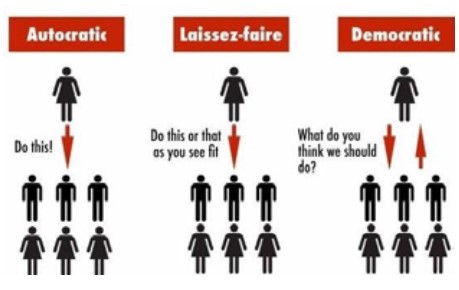
- 22. Image reference of various leadership styles: https://images.app.goo.gl/guvTkxa88yqhXjk79
- 23. House, R. J. (1971). A Path-Goal Theory of Leader Effectiveness. Administrative Science Quarterly, 16(3), 321-339.
- 24. Evans, M. G. (1970). The effects of supervisory behavior on the path-goal relationship. Organizational Behavior and Human Performance, 5(3), 277-298.
- 25. House, R. J., & Mitchell, T. R. (1974). Path-Goal Theory of Leadership. Journal of Contemporary Business, 3(4), 81-97.
- 26. Northouse, P. G. (2018). Leadership: Theory and Practice. Sage Publications.
- 27. Goleman, D. (1998). Working with Emotional Intelligence. Bantam Books.
- 28. Bradberry, T., & Greaves, J. (2009). Emotional Intelligence 2.0. TalentSmart.
- 29. Mayer, J.D., & Salovey, P. (1997). What is Emotional Intelligence? In P. Salovey & D. Sluyter (Eds.), Emotional Development and Emotional Intelligence: Educational Implications (pp. 3-31). Basic Books.
- 30. Brackett, M. A., & Rivers, S. E. (2014). Transforming Students’ Lives with Social and Emotional Learning. Yale Center for Emotional Intelligence.
- 31. Jennings, P. A., & Greenberg, M. T. (2009). The Prosocial Classroom: Teacher Social and Emotional Competence in Relation to Student and Classroom Outcomes. Review of Educational Research, 79(1), 491-525.
- 32. Pal, R. K. Leadership: An Introductory Overview. Journal homepage: www. ijrpr. com ISSN, 2582, 7421.
Data Sharing Statement
There are no additional data available. All raw data and code are available upon request.
Funding
This research received no funding.
Author Contributions
All authors contributed significantly to the work and approve its publication.
Ethics Declaration
This article does not involve any human or animal subjects, and therefore does not require ethics approval.
Acknowledgements
We would like to express our gratitude to the patients, their families, and all those who have contributed to this study.
Conflicts of Interest
No conflicts of interest in this work.
About this article

Cite this article
Rohit Kumar Pal, A Short Overview of Various Leadership Theories and their Approach in the Teaching Sector. J Soc Welfare Manag. 2024;16(3):115–126.
Licence:
Attribution-Non-commercial 4.0 International (CC BY-NC 4.0)This license enables reusers to distribute, remix, adapt, and build upon the material in any medium or format for noncommercial purposes only, and only so long as attribution is given to the creator.
| Received | Accepted | Published |
|---|---|---|
| August 02, 2024 | October 04, 2024 | December 30, 2024 |
DOI: https://doi.org/10.21088/jswm.0975.0231.16324.2
Keywords
LeadershipLeadership theoriesTeacher’s lifeStudentsSearch for Similar Articles
Similar Articles
- Electronic Publishing: A Powerful Tool in Academic Environment
- Natural Farming & the Concept of Recycle, Reuse through Case Studies
- From Home to the Gig: Empowering Women in Thoothukudi District of Tamil Nadu sta...
- Determinants of FinTech Adoption: An Analysis of Perceptual and Behavioural Infl...
- The Illusion of Prestige: Pay-and-Take Awards and the Glorified Profile Culture...
Article Level Metrics
Last UpdatedSunday 20 September 2026, 23:17:10 (IST)
2735
Accesses
8
292
00
Citations
NA
NA
NA
Download citation
Article Keywords
Keyword Highlighting
Highlight selected keywords in the article text.
Timeline
| Received | August 02, 2024 |
| Accepted | October 04, 2024 |
| Published | December 30, 2024 |
licence
Attribution-Non-commercial 4.0 International (CC BY-NC 4.0)
This license enables reusers to distribute, remix, adapt, and build upon the material in any medium or format for noncommercial purposes only, and only so long as attribution is given to the creator.