Full Text (PDF)
Indian Journal of Medical and Health Sciences 11(2):p 77-86, Oct - Dec. 2024. | DOI: https://doi.org/10.21088/ijmhs.2347.9981.11224.4
Original Article
A Prospective Observational Study on Clinical Profile, Laboratory Parameter and Outcomes of Rodenticide Poisoning
Author Information
Licence:
Attribution-Non-commercial 4.0 International (CC BY-NC 4.0)This license enables reusers to distribute, remix, adapt, and build upon the material in any medium or format for noncommercial purposes only, and only so long as attribution is given to the creator
Indian Journal of Medical and Health Sciences 11(2):p 77-86, Oct - Dec. 2024. | DOI: https://doi.org/10.21088/ijmhs.2347.9981.11224.4
How Cite This Article:
Shyamala G., Manjunath, A Prospective Observational Study on Clinical Profile, Laboratory Parameter and Outcomes of Rodenticide Poisoning. Jr. Med. & Health Sci. 2024;11(2):77–86.Timeline
Received : October 21, 2024
Accepted : November 11, 2024
Published : December 30, 2024
Abstract
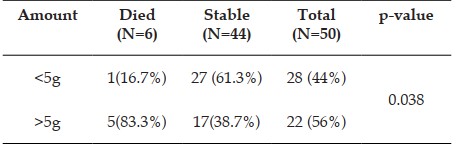
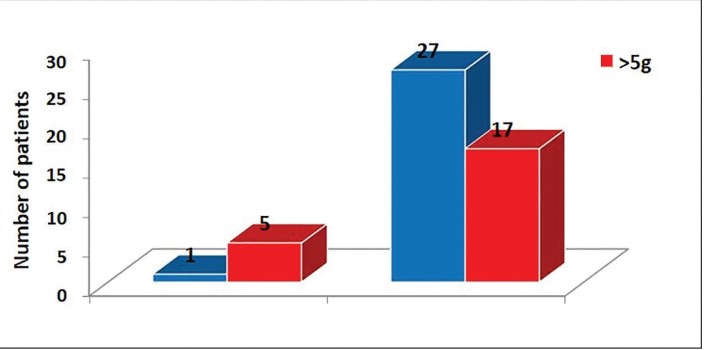
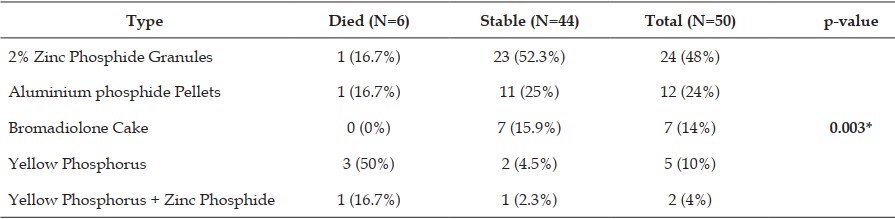
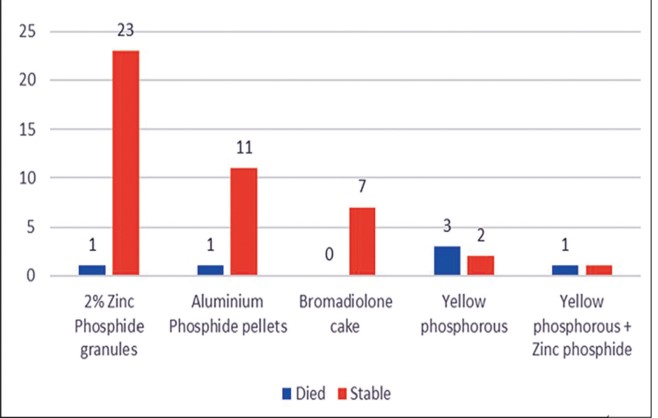
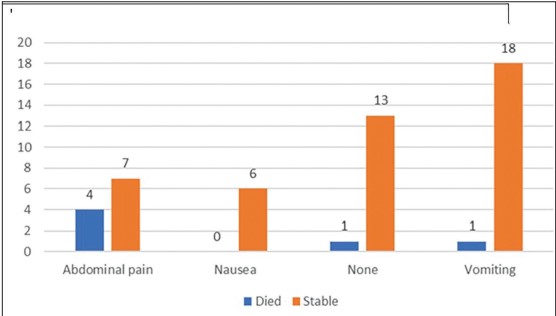
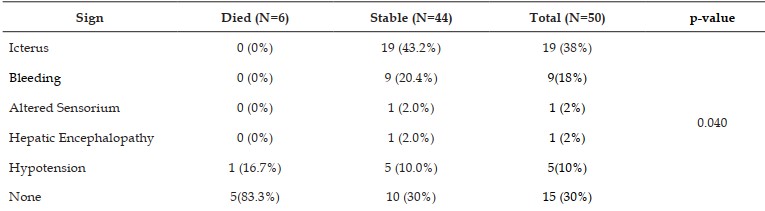
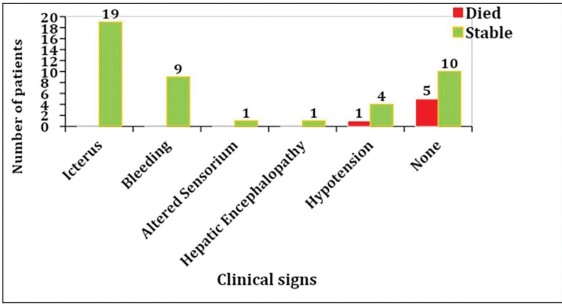
Introduction: In India, rodenticide poisoning poses a serious threat to public health due to its high rate of morbidity and mortality. The purpose of this study was to assess rodenticide poisoning’s clinical characteristics, laboratory results, and outcomes at an Indian tertiary care facility. Material and Methods: 50 patients with rodenticide poisoning who were hospitalized to a tertiary care facility in India for a period of one and a half years participated in a prospective observational research. Results were assessed in connection to the type of rodenticide consumed, and clinical symptoms, indicators, and laboratory parameter evaluations were conducted. Results: In our investigation, the prevalence of rodenticide poisoning throughout the study period was 6.7%. The bulk of the people (58.00%) are under the age of twenty decades. Vomiting (38%) and abdominal discomfort (22%) were the most common symptoms. Clinically, icterus was the most prevalent sign (38%) of all. Symptoms (p=0.043), signs (p=0.040), rodenticide kind (p=0.003), amount of rodenticide consumed (0.038), and metabolic acidosis presence (p=0.001) were all significantly correlated with survival status. Patients who passed away had considerably worse liver function tests, coagulation profiles, and renal functions than those who survived (p<0.05). There was a 12% overall mortality rate. Conclusion: Young adults are the age group most affected by rodenticide poisoning, which is linked to considerable morbidity and mortality. Improving patient outcomes requires early detection, timely treatment, and careful observation.In environments with limited resources, the findings of this study can direct the creation of evidence-based management plans and preventative actions for rodenticide poisoning.
References
- 1. Gummin D.D., Mowry J.B., Spyker D.A., Brooks D.E., Osterthaler K.M., Banner W. 2018 Annual Report of the American Association of Poison Control Centres’ National Poison Data System (NPDS): 36th Annual Report. Clin Toxicol (Phila). 2019; 57(12):1220-1413.
- 2. Watt B.E., Proudfoot A.T., Bradberry S.M., Vale J.A. Anticoagulant rodenticides. Toxicol Rev. 2005; 24(4):259-269.
- 3. Agrawal V.K., Bansal A., Singh R.K., Kumawat B.L., Mahajan P. Aluminium phosphide poisoning: Possible role of supportive measures in the absence of specific antidote. Indian J Crit Care Med. 2015; 19(2):109-112.
- 4. Gunja N., Coggins A., Bidny S. Management of intentional superwarfarin poisoning with longterm vitamin K and brodifacoum levels. Clin Toxicol (Phila). 2011; 49(5):385-390.
- 5. Batra A.K., Keoliya A.N., Jadhav GU. Poisoning: an unnatural cause of morbidity and mortality in rural India. J Assoc Physicians India. 2003; 51:955-959.
- 6. Ahasan H.N., Mamun A.A., Rasul C.H., Assaduzzaman FM, Bakar MA. Rodenticide poisoning: A common public health problem. Mymensingh Med J. 2009;18(2):201-205.
- 7. Ruan W., Guo Y., Chen J., et al. Trends in Pesticide Poisoning in China from 2006 to 2016. Clin Toxicol (Phila). 2021; 59(3):205-211.
- 8. King N., Tran M.H. Long-Acting Anticoagulant Rodenticide (Superwarfarin) Poisoning: A Review of Its Historical Development, Epidemiology, and Clinical Management. Transfus Med Rev. 2015; 29(4):250-258.
- 9. Mehrpour O., Jafarzadeh M., Abdollahi M.A. systematic review of aluminium phosphide poisoning. Arh Hig Rada Toksikol. 2012; 63(1):61-73.
- 10. Palmer R.B., Alakija P., de Baca J.E., Nolte K.B. Fatal brodifacoum rodenticide poisoning: autopsy and toxicologic findings. J Forensic Sci. 1999; 44(4):851-855.
- 11. Agrawal V.K., Bansal A., Singh R.K., Kumawat B.L., Mahajan P. Aluminium phosphide poisoning: Possible role of supportive measures in the absence of specific antidote. Indian J Crit Care Med. 2015; 19(2):109-112.
- 12. Proudfoot A.T. Aluminium and zinc phosphide poisoning. Clin Toxicol (Phila). 2009; 47(2):89-100.
- 13. Murali R., Bhalla A., Singh D., Singh S. Acute pesticide poisoning: 15 years experience of a large North-West Indian hospital. Clin Toxicol (Phila). 2009; 47(1):35-38.
- 14. Chugh S.N., Aggarwal H.K., Mahajan SK. Zinc phosphide intoxication symptoms: analysis of 20 cases. Int J Clin Pharmacol Ther. 1998; 36(7):406-407.
- 15. Bumbrah G.S., Krishan K., Kanchan T., Sharma M, Sodhi G.S. Phosphide poisoning: a review of literature. Forensic Sci Int. 2012; 214(1-3):1-6.
- 16. Sciuto AM, Wong BJ, Martens ME, HoardFruchey H, Perkins MW. Phosphine toxicity: a story of disrupted mitochondrial metabolism. Ann N Y Acad Sci. 2016;1374(1):41-51.
- 17. Anand R, Sharma DR, Verma D, Bhalla A, Gill KD, Singh S. Mitochondrial electron transport chain complexes, catalase and markers of oxidative stress in platelets of patients with severe aluminium phosphide poisoning. Hum Exp Toxicol. 2013; 32(8):807-816.
- 18. Mehrpour O, Jafarzadeh M, Abdollahi M.A. systematic review of aluminium phosphide poisoning. Arh Hig Rada Toksikol. 2012; 63(1):61-73.
- 19. Wahab A., Zaheer MS, Wahab S., Khan R.A. Acute aluminium phosphide poisoning: an update. Hong Kong J Emerg Med. 2008; 15(3):152-155.
Data Sharing Statement
There are no additional data available. All raw data and code are available upon request.
Funding
This research received no funding.
Author Contributions
All authors contributed significantly to the work and approve its publication.
Ethics Declaration
This article does not involve any human or animal subjects, and therefore does not require ethics approval.
Acknowledgements
We would like to express our gratitude to the patients, their families, and all those who have contributed to this study.
Conflicts of Interest
No conflicts of interest in this work.
About this article

Cite this article
Shyamala G., Manjunath, A Prospective Observational Study on Clinical Profile, Laboratory Parameter and Outcomes of Rodenticide Poisoning. Jr. Med. & Health Sci. 2024;11(2):77–86.
Licence:
Attribution-Non-commercial 4.0 International (CC BY-NC 4.0)This license enables reusers to distribute, remix, adapt, and build upon the material in any medium or format for noncommercial purposes only, and only so long as attribution is given to the creator
| Received | Accepted | Published |
|---|---|---|
| October 21, 2024 | November 11, 2024 | December 30, 2024 |
DOI: https://doi.org/10.21088/ijmhs.2347.9981.11224.4
Keywords
Rodenticide poisoningClinical profileLaboratory parametersOutcomestertiary care centerIndiaSearch for Similar Articles
Similar Articles
- Wound Assessment using a Smartphone-based Application: Imitomeasure in Pressure...
- Emerging Pandemic and Silent Killer – Non Aloholic Fatty Liver Disease: A Compr...
- Prenatal and Postnatal Healthcare in Odisha
- Assessment of Diabetic Foot Ulcers: A Review
- IBS – Irritable Bowel Syndrome – Management through Comprehensive Non-Pharmacolo...
Article Level Metrics
Last UpdatedTuesday 08 September 2026, 01:53:43 (IST)
1394
Accesses
13
326
00
Citations
NA
NA
NA
Download citation
Article Keywords
Keyword Highlighting
Highlight selected keywords in the article text.
Timeline
| Received | October 21, 2024 |
| Accepted | November 11, 2024 |
| Published | December 30, 2024 |
licence
Attribution-Non-commercial 4.0 International (CC BY-NC 4.0)
This license enables reusers to distribute, remix, adapt, and build upon the material in any medium or format for noncommercial purposes only, and only so long as attribution is given to the creator