Full Text (PDF)
Indian Journal of Maternal-Fetal & Neonatal Medicine 10(1):p 9-14, January-June 2023. | DOI: https://doi.org/10.21088/ijmfnm.2347.999X.10123.1
Original Article
A Prospective Comparative Study of Modes of Delivery in between induced and spontaneous labour
Salil Barsode, Anuja Sachapara, Vaishali Taralekar
Author Information
Licence:
Attribution-Non-commercial 4.0 International (CC BY-NC 4.0)This license enables reusers to distribute, remix, adapt, and build upon the material in any medium or format for noncommercial purposes only, and only so long as attribution is given to the creator.
Indian Journal of Maternal-Fetal & Neonatal Medicine 10(1):p 9-14, January-June 2023. | DOI: https://doi.org/10.21088/ijmfnm.2347.999X.10123.1
How Cite This Article:
Anuja Sachapara, Salil Barsode, Vaishali Taralekar/A Prospective Comparative Study of Modes of Delivery in between induced and spontaneous labour/ Indian Journal of Maternal-Fetal & Neonatal Medicine 2023;10(1):09–14.Timeline
Received : February 20, 2023
Accepted : April 11, 2023
Published : June 30, 2023
Abstract
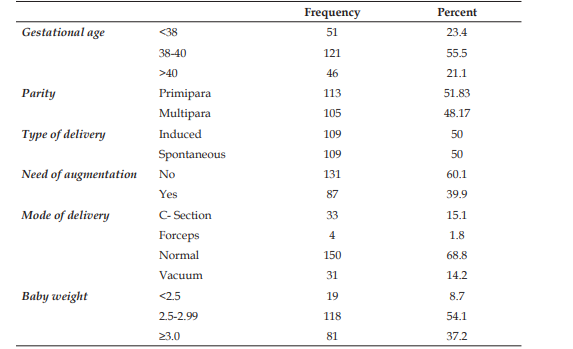
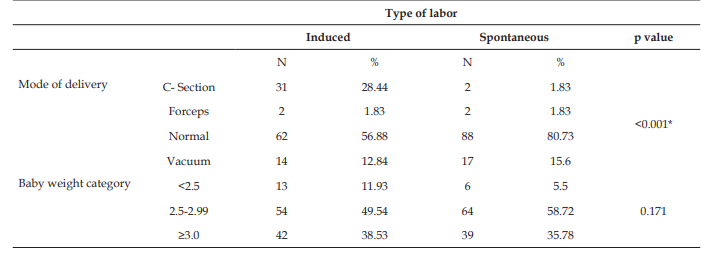
Background: The majority of women in their reproductive years are in good health, giving birth to healthy babies at term with spontaneous Labor. In situations where the mother, fetus, or both need the pregnancy to end because continuing the pregnancy would be harmful to both the mother and the unborn child, inducing Labor is one option. Aim and objective: To study the mode of delivery and need of augmentation in women with induced labor as compared to those who go in spontaneous labor. Methodology: The clinical trial was conducted for period of 2 years in OBGY department of Bharati Vidyapeeth University Pune. 218 pregnant women were included in study and divided into two group A and B. Modes of delivery and need of augmentation data collected, data analysis was done and appropriate statistical tests were applied. Results: There were 150(68.8%) normal deliveries, followed by 33(15.1%) cesarean sections, 31(14.2%) using vacuum and among 4(1.8%) forceps were used. Out of total 218 augmentation was required in 87 patients (39.9%). Section rate in induced group was 28.44% and in spontaneous group was 1.83% Conclusion: There were significantly more cesarean sections in induced labor group compared to spontaneous labor group. While rate of normal deliveries was more in spontaneous group than induced. The distribution of forceps deliveries and vacuum deliveries were almost similar in both the groups.
References
- 1. Singh A, Rao SB, Sherigar B, D’souza R, Soumya R, Kaveri V. Comparison of progress of Labor and maternofetal outcome among induced versus spontaneous Labor in nulliparous women using modified WHO partograph. Int J Reprod Contracept Obstet Gynecol. 2018 Feb;7(2):415-418.
- 2. Mozurkewich EL, Chilimigras JL, Berman DR, Perni UC, Romero VC, King VJ, et al. Methods of induction of Labor: a systematic review. BMC Pregnancy Childbirth. 2011 Oct 27;11:84.
- 3. Caughey AB, Sundaram V, Kaimal AJ, Cheng YW, Gienger A, Little SE, et al. Maternal and neonatal outcomes of elective induction of labor. Evid Rep Technol Assess (Full Rep). 2009;(176):1–257.
- 4. Lawani OL, Iyoke CA, Okafo CN, Ajah LO. Obstetric Outcome and Significance of Labor Induction in a Health Resource Poor Setting. Obstet Gynecol Int. 2014;2014:419619.
- 5. Battista L, Chung JH, Lagrew DC, et al. Complications of labor induction among multiparous women in a community-based hospital system. Am J Obstet Gynecol. 2007;197(3):240.e1-7.
- 6. Hedegaard M, et al. Reduction in stillbirths at term after new birth induction paradigm: results of a national intervention. BMJ. 2014;349:g5031.
- 7. Kolkman DG, Verhoeven CJ, Brinkhorst SJ, van der Post JA, Pajkrt E, Opmeer BC, et al. The Bishop score as a predictor of labor induction success: a systematic review. Am J Perinatol. 2013 Sep;30(8):625-30.
- 8. Marconi AM. Recent advances in the induction of labor. F1000Res. 2019 Oct 30;8:F1000 Faculty Rev-1829.
- 9. Babu S, Manjeera ML. Elective induction versus spontaneous labor at term: prospective study of outcome and complications. Int J Reprod Contracept Obstet Gynecol. 2017;6(11):4899-907.
- 10. Lee HR, Kim MN, You JY, Choi SJ, Oh SY, Roh CR, et al. Risk of cesarean section after induced versus spontaneous labor at term gestation. Obstet Gynecol Sci. 2015 Sep;58(5):346-52.
- 11. Vardo JH, Thornburg LL, Glantz JC. Maternal and neonatal morbidity among nulliparous women undergoing elective induction of labor. J Reprod Med. 2011;56(1-2):25-30.
- 12. Vrouenraets FP, Roumen FJ, Dehing CJ, van den Akker ES, Aarts MJ, Scheve EJ. Bishop score and risk of cesarean delivery after induction of labor in nulliparous women. Obstet Gynecol. 2005 Apr;105(4):690-700.
- 13. Alalem D, Kafy S, Hashim H, Aldukkan L, Bajahmom H. Spontaneous versus Induced Labor Delivery, a Retrospective Analysis. Adv Reprod Sci. 2019;7(1):1-6.
Data Sharing Statement
There are no additional data available. All raw data and code are available upon request.
Funding
This research received no funding.
Author Contributions
All authors contributed significantly to the work and approve its publication.
Ethics Declaration
This article does not involve any human or animal subjects, and therefore does not require ethics approval.
Acknowledgements
We would like to express our gratitude to the patients, their families, and all those who have contributed to this study.
Conflicts of Interest
No conflicts of interest in this work.
About this article

Cite this article
Anuja Sachapara, Salil Barsode, Vaishali Taralekar/A Prospective Comparative Study of Modes of Delivery in between induced and spontaneous labour/ Indian Journal of Maternal-Fetal & Neonatal Medicine 2023;10(1):09–14.
Licence:
Attribution-Non-commercial 4.0 International (CC BY-NC 4.0)This license enables reusers to distribute, remix, adapt, and build upon the material in any medium or format for noncommercial purposes only, and only so long as attribution is given to the creator.
| Received | Accepted | Published |
|---|---|---|
| February 20, 2023 | April 11, 2023 | June 30, 2023 |
DOI: https://doi.org/10.21088/ijmfnm.2347.999X.10123.1
Keywords
Labour InductionSpontaneous LabourCaesarean SectionAugmentationSearch for Similar Articles
Similar Articles
- Maternal Mental-Health During Pregnancy and Postpartum Period: A Review of Recen...
- Prenatal Diagnosis of Costello Syndrome: A Case Report
- Innovations in Obstetric Hemorrhage Management: The Evolution of Transvaginal Ba...
- Maternal Plasma Cytokines and the Subsequent Risk of Uterine Atony and Postpartu...
- Amniotic Band Syndrome
Article Level Metrics
Last UpdatedSaturday 17 October 2026, 14:06:39 (IST)
1730
Accesses
16
189
00
Citations
NA
NA
NA
Download citation
Article Keywords
Keyword Highlighting
Highlight selected keywords in the article text.
Timeline
| Received | February 20, 2023 |
| Accepted | April 11, 2023 |
| Published | June 30, 2023 |
licence
Attribution-Non-commercial 4.0 International (CC BY-NC 4.0)
This license enables reusers to distribute, remix, adapt, and build upon the material in any medium or format for noncommercial purposes only, and only so long as attribution is given to the creator.