Full Text (PDF)
Journal of Global Public Health 6(2):p 47-54, July - Dec 2024. | DOI: NA
Original Article
A Cross-sectional Study to Determine Knowledge, Attitude, and Practices of Exclusive Breastfeeding Amongst Lactating Migrant Mothers Working in the Informal Sector of Pune
Gajendra Singh, Ritika Rupal, Abha Arya
Author Information
Licence:
Attribution-Non-commercial 4.0 International (CC BY-NC 4.0)This license enables reusers to distribute, remix, adapt, and build upon the material in any medium or format for noncommercial purposes only, and only so long as attribution is given to the creator.
Journal of Global Public Health 6(2):p 47-54, July - Dec 2024. | DOI: NA
How Cite This Article:
Ritika Rupal, Abha Arya, Gajendra Singh, A Cross-sectional Study to Determine Knowledge, Attitude, and Practices of Exclusive Breastfeeding Amongst Lactating Migrant Mothers Working in the Informal Sector of Pune. Jr of Glob Pub Hea. 2024; 6(2): 47-54.Timeline
Received : October 08, 2024
Accepted : November 11, 2024
Published : December 25, 2024
Abstract
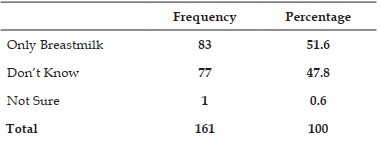
Context: Migration to urban areas, especially within the informal workforce, is often driven by the pursuit of better economic prospects, with many women among these migrants. Such transitions can influence health determinants, sometimes negatively impacting the well-being of migrant mothers and their children. Exclusive breastfeeding (EBF) is a highly effective intervention that can alleviate critical public health issues, including reducing rates of infant mortality, malnutrition, and chronic diseases in later life. Aims: This study investigates the knowledge, attitudes, and practices related to exclusive breastfeeding among lactating migrant mothers and examines associated variables within Pune’s informal sector. Settings and Design: Using purposive sampling, data was collected from various locations across Pune between March and April 2023. Participants were lactating migrant mothers engaged in informal work sectors. Information was gathered through a questionnaire, recorded in Excel, and analyzed for coding. Statistical Analysis: Analyses included Frequency, Percentages, and Pearson Correlation. Results: Among participants, 72% had moved to Pune for family reasons, including marriage, while others migrated for work. Half of the mothers identified breast milk as the primary food for a newborn and viewed EBF as beneficial for their child. A practice rate of 68.9% for exclusive breastfeeding over six months was observed. Conclusions: The study found a significant number of mothers practicing pre-lacteal feeding, and more than half did not start breastfeeding within the first hour after birth. However, a substantial proportion of mothers administered colostrum to their infants, often upon recommendations from doctors or other healthcare providers, despite some cultural reservations about its benefits.
References
- 1. World Health Organization. Infant and young child feeding: Model chapter for textbooks for medical students and allied health professionals.
- 2. Five Great Benefits of Breastfeeding. (2021, July 27). Centers for Disease Control and Prevention. Retrieved September 12, 2022, from https://www.cdc.gov/nccdphp/ dnpao/features/breastfeeding-benefits/index. html#:%7E:text=Breastfeeding%20can%20 help%20protect%20babies,ear%20infections%20 and%20stomach%20bugs
- 3. editor. (2022, June 13). Colostrum – The Superfood for Your Newborn. American Pregnancy Association. Retrieved September 12, 2022, from https://americanpregnancy.org/ healthy-pregnancy/breastfeeding/colostrum-issuperfood-for-your-newborn/
- 4. Ekubay, M., Berhe, A. &Yisma, E. Initiation of breastfeeding within one hour of birth among mothers with infants younger than or equal to 6 months of age attending public health institutions in Addis Ababa, Ethiopia. Int Breastfeed J 13, 4 (2018). https://doi.org/10.1186/s13006-018- 0146-0
- 5. global strategy for infant and young child feeding. (n.d.). https://apps.who.int/iris/bitstream/ handle/10665/42590/9241562218.pdf
- 6. Maternal, Infant and Young Child Feeding Nutrition (MIYCN) Campaign. (n.d.). UNICEF Lao People’s Democratic Republic. Retrieved October 8, 2022, from https://www.unicef.org/ laos/miycn-campaign
- 7. World Health Organization. (n.d.). Breastfeeding. World Health Organization. Retrieved September 1, 2022, from https://www.who.int/healthtopics/breastfeeding#tab=tab_1
- 8. National Family Health Survey (NFHS - 5), 2019– 21. Retrieved September 1, 2022, from http:// rchiips.org/nfhs/NFHS-5Reports/NFHS-5_ India_report.pdf
- 9. The Rationale for BFHI-India | BFHI India. (n.d.). Https://Www.Bfhi-India.in/the-Rationalefor-Bfhi-India. https://www.bfhi-india.in/therationale-for-bfhi-india
- 10. Tran, L. M., Avula, R., Kohli, N., Mani, S., Nguyen, P. H., & Menon, P. (2017). Trends in nutrition outcomes, determinants, and interventions in India (2006–2016) (Vol. 10). Intl Food Policy Res Inst.
- 11. National Institute of Population Studies (NIPS) Pakistan and Macro International Inc. Pakistan demographic and health survey 2012-2013, Islamabad, Pakistan. National Institute of Population studies and Macro international Inc. 2009
- 12. Publichealthupdate. (2021, July 29). Breastfeeding fact sheet: Nepal. Public Health Update. Retrieved September 1, 2022, from https:// publichealthupdate.com/breastfeeding-factsheet-nepal/
- 13. Chowdhury, A. R., Surie, A., &Bhan, G. (2021). Breastfeeding knowledge and practices of working mothers in the informal economy in New Delhi: A formative study to explore new intervention pathways towards improved maternal and child health outcomes. Social science & medicine (1982), 281, 114070. https://doi. org/10.1016/j.socscimed.2021.114070
- 14. Horwood, C., Surie, A., Haskins, L. et al. Attitudes and perceptions about breastfeeding among female and male informal workers in India and South Africa. BMC Public Health 20, 875 (2020)
- 15. Kumar N, Mitra A. (2021). Inter- state Migration in India. https://www.ies.gov.in/pdfs/Seminarneerajkumar.pdf
- 16. Akram, A. A., Chowdhury, S., &Mobarak, A. M. (2017). Effects of Emigration on Rural Labor Markets. National Bureau of Economic Research. https://doi.org/10.3386/w23929
- 17. Census, 2011, Office of the Registrar General & Census Commissioner, Ministry of Home Affairs.
- 18. periodic labour force survey 2020-2021. (n.d.). pib.gov. Retrieved September 14, 2022, from https://pib.gov.in/PressReleaseIframePage. aspx?PRID=1833855
- 19. CEICdata.com. (2022, August 11). India Census: Number of Migrants: Maharashtra. Retrieved October 8, 2022, from https://www.ceicdata. com/en/india/census-of-india-migrationnumber-of-migrants-by-states/census-numberof-migrants-maharashtra
- 20. Maternal, Infant and Young Child Nutrition (MIYCN) Policy Maharashtra. (n.d.). In https:// arogya.maharashtra.gov.in/Site/Uploads/GR/ Rev%20draft%2024%20May%20MIYCN%20 Policy%201.pdf
- 21. Krishnendu M, Devaki G. (2017). Knowledge, Attitude and Practice Towards Breasfeeding Among Lactating Mothers in Rural Areas of Thrissur District of Kerala, India: A CrossSectional Study. Biomed Pharmacol J ;10(2)
- 22. Das A, Singh A Kapoor R, Kishore J. (2017). A Study on Pattern of Breast Feeding Practices among Recently Delivered Mothers in Najafgarh, New Delhi. National Journal of Medical and Allied Sciences; 6(1):23-29
- 23. Iarŭkov, A., Nin’o, A., Iarŭkova, N., Doĭcheva, E., & Kolev, D. (1992). Rannozakŭrmianeprinovorodenite The early breast feeding of newborn infants. Akusherstvoiginekologiia, 31(1), 13–15.
Data Sharing Statement
There are no additional data available. All raw data and code are available upon request.
Funding
This research received no funding.
Author Contributions
All authors contributed significantly to the work and approve its publication.
Ethics Declaration
This article does not involve any human or animal subjects, and therefore does not require ethics approval.
Acknowledgements
We would like to express our gratitude to the patients, their families, and all those who have contributed to this study.
Conflicts of Interest
No conflicts of interest in this work.
About this article

Cite this article
Ritika Rupal, Abha Arya, Gajendra Singh, A Cross-sectional Study to Determine Knowledge, Attitude, and Practices of Exclusive Breastfeeding Amongst Lactating Migrant Mothers Working in the Informal Sector of Pune. Jr of Glob Pub Hea. 2024; 6(2): 47-54.
Licence:
Attribution-Non-commercial 4.0 International (CC BY-NC 4.0)This license enables reusers to distribute, remix, adapt, and build upon the material in any medium or format for noncommercial purposes only, and only so long as attribution is given to the creator.
| Received | Accepted | Published |
|---|---|---|
| October 08, 2024 | November 11, 2024 | December 25, 2024 |
DOI: NA
Keywords
Exclusive BreastfeedingMigrant MothersKnowledgeAttitudePracticeMalnutritionMaternal and Child HealthSearch for Similar Articles
Similar Articles
- A Comprehensive Review of Digital Detoxification: Fostering Healthier Digital Ha...
- Higher Education in Telangana: Access, Equity, and Quality
- Fungal Infections in Humans: An Emerging Threat
- Understanding and Addressing Vaccine Hesitancy: A Comprehensive Analysis
- Association of Tobacco Smoking with Periodontal Health and Early Loss of Teeth a...
Article Level Metrics
Last UpdatedSaturday 05 September 2026, 16:13:31 (IST)
802
Accesses
2
126
00
Citations
NA
NA
NA
Download citation
Article Keywords
Keyword Highlighting
Highlight selected keywords in the article text.
Timeline
| Received | October 08, 2024 |
| Accepted | November 11, 2024 |
| Published | December 25, 2024 |
licence
Attribution-Non-commercial 4.0 International (CC BY-NC 4.0)
This license enables reusers to distribute, remix, adapt, and build upon the material in any medium or format for noncommercial purposes only, and only so long as attribution is given to the creator.