Full Text (PDF)
Indian Journal of Communicable Diseases 10(2):p 45-48, July - Dec 2024. | DOI: https://doi.org/10.21088/ijcd.2395.6631.10224.2
Original Article
A Case Report on Management of Hand Burns in a Leprosy Patient
Anirudh Dwajan, Ravi Kumar Chittoria, Amrutha J.S.
Author Information
Licence:
Attribution-Non-commercial 4.0 International (CC BY-NC 4.0)This license enables reusers to distribute, remix, adapt, and build upon the material in any medium or format for noncommercial purposes only, and only so long as attribution is given to the creator.
Indian Journal of Communicable Diseases 10(2):p 45-48, July - Dec 2024. | DOI: https://doi.org/10.21088/ijcd.2395.6631.10224.2
How Cite This Article:
Dwajan A, Chittoria RK, et al. A Case Report on Management of Hand Burns in a Leprosy Patient. Indian J Community Dis. 2024;10(2):45-48.Timeline
Received : November 26, 2024
Accepted : December 28, 2024
Published : December 30, 2024
Abstract
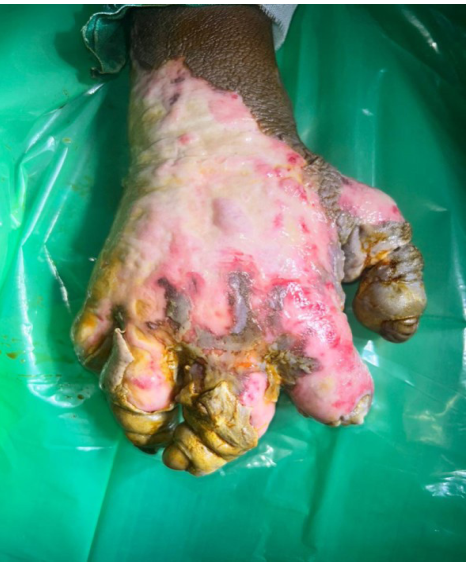
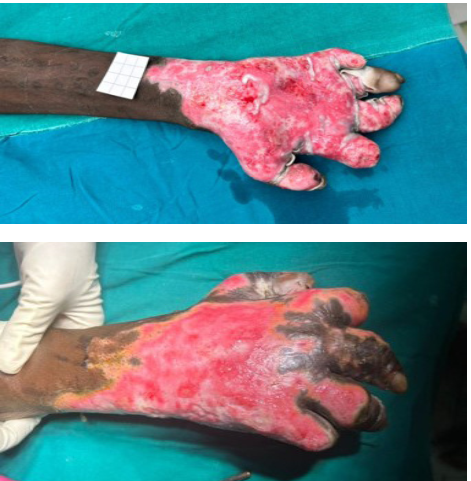
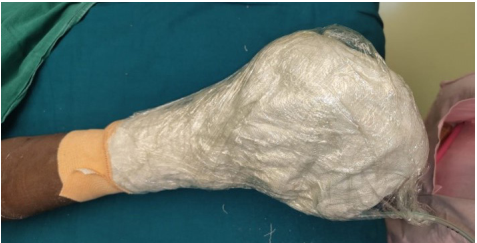
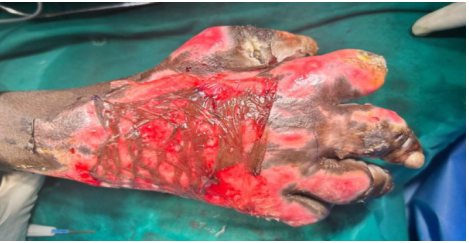
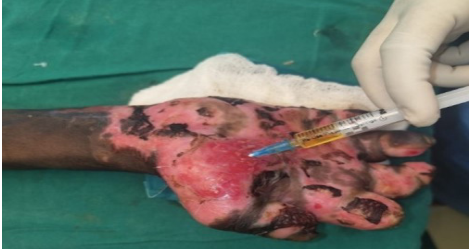
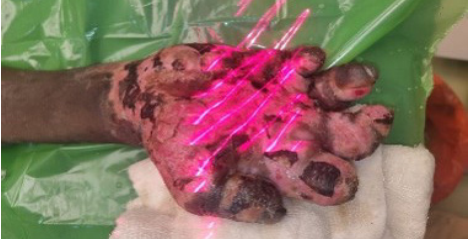
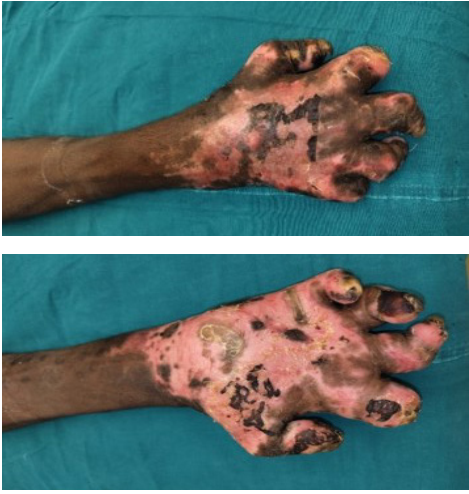
Leprosy, or Hansen’s disease, is a chronic infectious condition caused by Mycobacterium leprae, characterized by skin and peripheral nerve involvement. Theanaesthetic nature of leprosy lesions predisposes patients to unnoticed injuries, complicating the management of burns and chronic wounds. Burn injuries in leprosy patients are challenging due to delayed presentation, impaired healing, and increased susceptibility to infections. Advanced wound care modalities, including Autologous Platelet-Rich Plasma (APRP) and Low-Level Laser Therapy (LLLT), have emerged as promising solutions to address these challenges.APRP, rich in growth factors like PDGF, VEGF, and TGF-β, enhances angiogenesis, reduces inflammation, accelerates epithelialization, and promotes tissue regeneration, thereby improving wound healing. LLLT utilizes specific wavelengths of light to stimulate cellular activity, enhance microcirculation, boost collagen synthesis, and facilitate faster wound closure. When incorporated into a comprehensive management strategy, these techniques can significantly improve outcomes for burn wounds in leprosy patients. This article highlights the unique challenges of burn management in leprosy and emphasizes the role of advanced therapies such as APRP and LLLT in optimizing wound healing and reducing complications. A multidisciplinary approach combining these modalities with conventional wound care, infection control, rehabilitation, and patient education is essential for achieving favorable outcomes.
References
- 1. Britton W.J., Lockwood D.N. Leprosy. The Lancet. 2004; 363:1209-19.
- 2. G. Weddell and E. Palmer, “The pathogenesis of leprosy. An experimental approach,” Leprosy Review, vol. 34, pp. 57–61, 1963.
- 3. J.C. Pedley, “The nasal mucus in leprosy,” Leprosy Review, vol. 44, no. 1, pp. 33–35, 1973.
- 4. Hopkins J.T., McLoda T.A., Seegmiller J.G., David Baxter G. Low level laser Therapy Facilitates superficial wound healing in humans: A tripleblind, sham-controlled study. J Athl Train. 2004; 39:223-229.
- 5. Gaida K., Koller R., Isler C., Aytekin O., AlAwami M., Meissl G., Frey M. Low level Laser Therapy – a conservative approach to the Burns. 2004; 30:362-367.
- 6. Widgerow A.D., Chait L.A., Stals R., Stals P.J. New innovations in scar manag.ement. Aesthetic Plast Surg. 2000; 24:227-234.
- 7. Sudhanva H.K., Panday S., chittoria R.K., Mohapatra D.P., friji M.T., Dinesh K.S. Role of APRP in the successful uptake of Split Skin DONOR. Dermatology international Volume 1 number 2 July to December 2016.
- 8. Elankumar S., Sudhanva H.K., Abhinav A, Chittoria R.K. APRP spray devices: a novel technique of applying APRP. Dermatology international Volume 2 number 2, July to December 2017.
- 9. Weibrich G., Kleis W.K., Hafner G., Hitzler W.E,. Growth factor levels in platelet- rich plasma and correlation with donor age, sex and platelet count. Journal of cranio-maxillofacial surgery. 2002; 30(2): 97 -102.
- 10. Karr J.C., de Mola F.L., Pham T., Tooke L. Wound healing and cost-saving benefits of combining negative-pressure wound therapy with silver. Adv Skin Wound Care. 2013; 26(12):562-5.
Data Sharing Statement
There are no additional data available.
Funding
This research received no funding.
Author Contributions
All authors contributed significantly to the work and approve its publication.
Ethics Declaration
This article does not involve any human or animal subjects, and therefore does not require ethics approval.
Acknowledgements
Information not provide.
Conflicts of Interest
The authors report no conflicts of interest in this work.
About this article

Cite this article
Dwajan A, Chittoria RK, et al. A Case Report on Management of Hand Burns in a Leprosy Patient. Indian J Community Dis. 2024;10(2):45-48.
Licence:
Attribution-Non-commercial 4.0 International (CC BY-NC 4.0)This license enables reusers to distribute, remix, adapt, and build upon the material in any medium or format for noncommercial purposes only, and only so long as attribution is given to the creator.
| Received | Accepted | Published |
|---|---|---|
| November 26, 2024 | December 28, 2024 | December 30, 2024 |
DOI: https://doi.org/10.21088/ijcd.2395.6631.10224.2
Keywords
LeprosyBurnsHansen’s diseaseAutologous Platelet Rich PlasmaLow Level Laser TherapyAdult burnsSearch for Similar Articles
Similar Articles
- A Review on the Medicinal Properties, Phytoconstituents, and Biological Activiti...
- Rare Diseases in India: Burden, Health-System Response and Policy Implications f...
- Need Assessment for Planning HIV/AIDS Services in the Wake of World AIDS Day The...
- A Nation in the Grip of Dengue: How Climate, Pollution, and Urbanization are Fee...
- Emergence of Rabies Cases in Kerala: A Public Health Concern
Article Level Metrics
Last UpdatedSunday 06 September 2026, 01:41:52 (IST)
1118
Accesses
13
231
00
Citations
NA
NA
NA
Download citation
Article Keywords
Keyword Highlighting
Highlight selected keywords in the article text.
Timeline
| Received | November 26, 2024 |
| Accepted | December 28, 2024 |
| Published | December 30, 2024 |
licence
Attribution-Non-commercial 4.0 International (CC BY-NC 4.0)
This license enables reusers to distribute, remix, adapt, and build upon the material in any medium or format for noncommercial purposes only, and only so long as attribution is given to the creator.