Full Text (PDF)
Journal of Emergency and Trauma Nursing 7(1):p 25-30, January - June 2026. | DOI: NA
Case Report
Transfusion-Related Acute Lung Injury: Trali
Rajathi. S, Madhumitha. K, D.K. Sriram
Author Information
Licence:
Attribution-Non-commercial 4.0 International (CC BY-NC 4.0)This license enables reusers to distribute, remix, adapt, and build upon the material in any medium or format for noncommercial purposes only, and only so long as attribution is given to the creator.
Journal of Emergency and Trauma Nursing 7(1):p 25-30, January - June 2026. | DOI: NA
How Cite This Article:
Madhumitha, Rajathisakthivel, D.K. Sriram. Transfusion-Related Acute Lung Injury: Trali. J of Emer and Trauma Nurs. 2025; 7(1): 25–30.Timeline
Received : February 14, 2026
Accepted : March 16, 2026
Published : June 30, 2026
Abstract
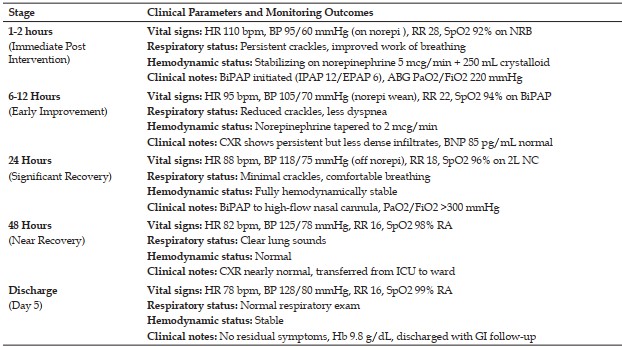
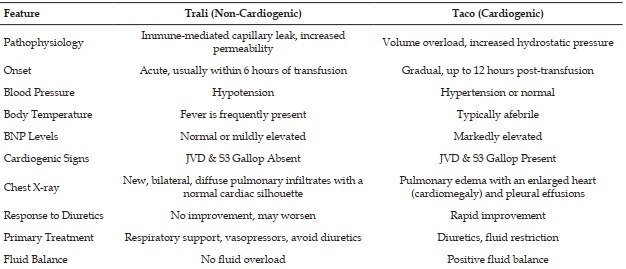
Transfusion-Related Acute Lung Injury (TRALI) is a severe, life-threatening transfusion reaction characterised by the acute onset of non-cardiogenic pulmonary edema and hypoxemia occurring within six hours of blood product administration. A 55-year-old female with chronic iron deficiency anemia (Hb 7.1 g/dL) presented with fatigue, dyspnea, and melena, receiving one unit of packed red blood cells (PRBCs) while hemodynamically stable. After forty-five minutes of transfusion, she developed acute respiratory distress (SpO2 85%, RR 32, BP 90/55, HR 115, fever 38.5°C), bilateral crackles without Jugular Venous Distention (JVD) or S3, confirming TRALI over Transfusion associated circulatory overload (TACO). Transfusion was stopped; immediate management included BiPAP, high-flow oxygen, crystalloid bolus, norepinephrine, and diuretic avoidance. The patient showed significant recovery within 24 hours and was discharged on day 5 with no residual respiratory deficits and GI follow-up.
References
- 1. Bux J. (2005). Transfusion-related acute lung injury (TRALI): a serious adverse event of blood transfusion. Vox sanguinis, 89(1), 1–10. https://doi.org/10.1111/j.1423- 0410.2005.00648.x
- 2. Kuriri F. A. (2025). Transfusion-related acute lung injury (TRALI): Current understanding, challenges, and future directions. Saudi medical journal, 46(8), 865–877. https://doi. org/10.15537/smj.2025.46.8.20250233
- 3. Toy, P., & Lowell, C. (2007). TRALIdefinition, mechanisms, incidence and clinical relevance. Best practice & research. Clinical anaesthesiology, 21(2), 183–193. https://doi. org/10.1016/j.bpa.2007.01.003
- 4. Toy, P., Looney, M. R., Popovsky, M., Palfi, M., Berlin, G., Chapman, C. E., Bolton-Maggs, P., & Matthay, M. A. (2022). Transfusion-related Acute Lung Injury: 36 Years of Progress (1985- 2021). Annals of the American Thoracic Society, 19(5), 705–712. https://doi.org/10.1513/ AnnalsATS.202108-963CME
- 5. Popovsky, M. A., & Moore, S. B. (1985). Diagnostic and pathogenetic considerations in transfusion-related acute lung injury. Transfusion, 25(6), 573–577. https://doi. org/10.1046/j.1537-2995.1985.25686071434.x
- 6. Kopko, P. M., Marshall, C. S., MacKenzie, M. R., Holland, P. V., & Popovsky, M. A. (2002). Transfusion-related acute lung injury: report of a clinical look-back investigation. JAMA, 287(15), 1968–1971. https://doi.org/10.1001/ jama.287.15.1968
- 7. Singh, A. K., Agrahari, R., & Tripathi, G. (2023). The unforeseen complication of blood transfusion: Transfusion-related acute lung injury – A case report. Indian Journal of Medical Sciences, 75, 194–196. https://doi. org/10.25259/ijms_127_2023
- 8. Kuldanek, S. A., Kelher, M., & Silliman, C. C. (2019). Risk factors, management and prevention of transfusion-related acute lung injury: a comprehensive update. Expert review of hematology, 12(9), 773–785. https://doi.org /10.1080/17474086.2019.1640599
- 9. Roubinian N. (2018). TACO and TRALI: biology, risk factors, and prevention strategies. Hematology. American Society of Hematology. Education Program, 2018(1), 585–594. https:// doi.org/10.1182/asheducation-2018.1.585
- 10. Skeate, R. C., & Eastlund, T. (2007). Distinguishing between transfusion related acute lung injury and transfusion associated circulatory overload. Current opinion in hematology, 14(6), 682–687. https://doi. org/10.1097/MOH.0b013e3282ef195a
- 11. Semple, J. W., Rebetz, J., & Kapur, R. (2019). Transfusion-associated circulatory overload and transfusion-related acute lung injury. Blood, 133(17), 1840–1853. https://doi. org/10.1182/blood-2018-10-860809
- 12. Collins, K. P., & Patterson, T. L. (n.d.). Transfusion-Related Acute Lung Injury: What the Allied Health Professional Needs to Know about this Life -Threatening Hazard of Blood Transfusion. NSUWorks. https://nsuworks. nova.edu/ijahsp/vol12/iss2/4/
- 13. Marik, P. E., & Corwin, H. L. (2008). Acute lung injury following blood transfusion: expanding the definition. Critical care medicine, 36(11), 3080–3084. https://doi.org/10.1097/CCM. 0b013e31818c3801
Data Sharing Statement
There are no additional data available. All raw data and code are available upon request.
Funding
This research received no funding.
Author Contributions
All authors contributed significantly to the work and approve its publication.
Ethics Declaration
This article does not involve any human or animal subjects, and therefore does not require ethics approval.
Acknowledgements
We would like to express our gratitude to the patients, their families, and all those who have contributed to this study.
Conflicts of Interest
No conflicts of interest in this work.
About this article

Cite this article
Madhumitha, Rajathisakthivel, D.K. Sriram. Transfusion-Related Acute Lung Injury: Trali. J of Emer and Trauma Nurs. 2025; 7(1): 25–30.
Licence:
Attribution-Non-commercial 4.0 International (CC BY-NC 4.0)This license enables reusers to distribute, remix, adapt, and build upon the material in any medium or format for noncommercial purposes only, and only so long as attribution is given to the creator.
| Received | Accepted | Published |
|---|---|---|
| February 14, 2026 | March 16, 2026 | June 30, 2026 |
DOI: NA
Keywords
Transfusion reactionNon-cardiogenic pulmonary edemaAcute Lung InjuryDiureticPacked Red Blood CellsHypoxemiaSearch for Similar Articles
Similar Articles
- Fall Risk Assessment and Management: Nursing Role and Responsibilities
- A Study to assess the Effectiveness of a Structured Teaching Programme on Knowle...
- Non-randomized Control Trial to assess the Effectiveness of Structured Teaching...
- Peripheral Nerve Damage: Local “Pehalwan” or Injection Induced? The Challenge
- Role of Cyclical Negative Pressure Wound Therapy in Post-Traumatic Raw Area
Article Level Metrics
Last UpdatedSaturday 17 October 2026, 08:39:11 (IST)
1107
Accesses
18
209
00
Citations
NA
NA
NA
Download citation
Article Keywords
Keyword Highlighting
Highlight selected keywords in the article text.
Timeline
| Received | February 14, 2026 |
| Accepted | March 16, 2026 |
| Published | June 30, 2026 |
licence
Attribution-Non-commercial 4.0 International (CC BY-NC 4.0)
This license enables reusers to distribute, remix, adapt, and build upon the material in any medium or format for noncommercial purposes only, and only so long as attribution is given to the creator.