Full Text (PDF)
Journal of Emergency and Trauma Nursing 4(2):p 57-59, July - December 2023. | DOI: NA
Case Report
Role of Cyclical Negative Pressure Wound Therapy in Post-Traumatic Raw Area
Ravi Kumar Chittoria, Kishore Kumar U, Jacob Antony
Author Information
Licence:
Attribution-Non-commercial 4.0 International (CC BY-NC 4.0)This license enables reusers to distribute, remix, adapt, and build upon the material in any medium or format for noncommercial purposes only, and only so long as attribution is given to the creator.
Journal of Emergency and Trauma Nursing 4(2):p 57-59, July - December 2023. | DOI: NA
How Cite This Article:
Kishore Kumar U, Ravi Kumar Chittoria, Jacob Antony/Role of Cyclical Negative Pressure Wound Therapy in Post-Traumatic Raw Area/Journal of Emergency and Trauma Nursing. 2023;4(2):57–59.Timeline
Received : May 15, 2023
Accepted : June 18, 2023
Published : December 25, 2023
Abstract
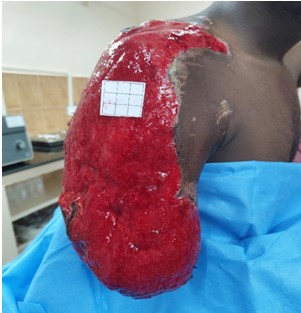
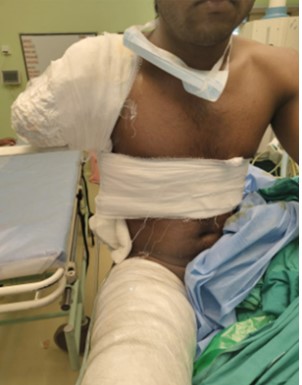
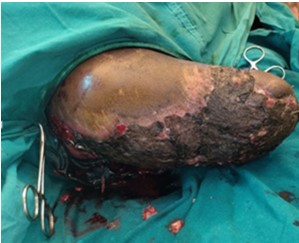
Negative pressure wound therapy is shown to improve tissue blood flow and tissue oxygen saturation. Application of negative pressure causes subtotal capillary occlusion, which acts as a stimulus for post occlusive reactive hyperaemia. This promotes wound bed granulation, contraction of wound margins and reduction of bacterial load. There are 3 modes of applying negative pressure: continuous, intermittent and cyclical. The aim of this article is to assess the role of cyclical negative pressure wound therapy in management of raw post traumatic wounds.
References
- 1. Argenta LC, Morykwas MJ. Vacuum-assisted closure: a new method for wound control and treatment: clinical experience. Ann PlastSurg 1997;38:563-76 discussion 577.
- 2. Morykwas MJ, ArgentaLC, Shelton-Brown El, McGuirtW. Vacuum-assisted closure: a new method for wound control and treatment: animal studies and basic foundation. Ann PlastSurg1997;38:553-62.
- 3. Glass GE, Nanchahal J. The methodology of negative pressure wound therapy: separating fact from fiction. J Plast Reconstr AesthetSurg. (2012) 65:989-1001.
- 4. KairinosN, Voogd AM, Botha PH, KotzeT, KahnD, Hudson DA, et al. Negative-pressure wound therapy II: negative-pressure wound therapy and increased perfusion. Just an illusion? PlastReconstr Surg. (2009) 123:601-12.
- 5. Borgquist 0, Ingemansson R, Malmsjo M. Woundedge microvascular blood flow during negative pressure wound therapy: examining the effects of pressures from-10 to-175 mmHg. PlastReconstr Surg. (2010) 125:502- 9.
- 6. KairinosN, McKuneA, SolomonsM, Hudson DA, Kahn D. The flaws of laser Doppler in negative pressure wound therapy research. Wound Repair Regen. (2014) 22:424-9.
- 7. Muenchow S, Horch RE, Dragu A. Effect softopical negative pressure therapy on perfusion and microcirculation of human skin. ClinHemorheolMicrocirc.(2019)72:365-74.
Data Sharing Statement
There are no additional data available. All raw data and code are available upon request.
Funding
This research received no funding.
Author Contributions
All authors contributed significantly to the work and approve its publication.
Ethics Declaration
This article does not involve any human or animal subjects, and therefore does not require ethics approval.
Acknowledgements
We would like to express our gratitude to the patients, their families, and all those who have contributed to this study.
Conflicts of Interest
No conflicts of interest in this work.
About this article

Cite this article
Kishore Kumar U, Ravi Kumar Chittoria, Jacob Antony/Role of Cyclical Negative Pressure Wound Therapy in Post-Traumatic Raw Area/Journal of Emergency and Trauma Nursing. 2023;4(2):57–59.
Licence:
Attribution-Non-commercial 4.0 International (CC BY-NC 4.0)This license enables reusers to distribute, remix, adapt, and build upon the material in any medium or format for noncommercial purposes only, and only so long as attribution is given to the creator.
| Received | Accepted | Published |
|---|---|---|
| May 15, 2023 | June 18, 2023 | December 25, 2023 |
DOI: NA
Keywords
Cyclical Negative Pressure Wound TherapyPost Traumatic Raw AreaWoundSearch for Similar Articles
Similar Articles
- Transfusion-Related Acute Lung Injury: Trali
- Fall Risk Assessment and Management: Nursing Role and Responsibilities
- A Study to assess the Effectiveness of a Structured Teaching Programme on Knowle...
- Non-randomized Control Trial to assess the Effectiveness of Structured Teaching...
- Peripheral Nerve Damage: Local “Pehalwan” or Injection Induced? The Challenge
Article Level Metrics
Last UpdatedSaturday 17 October 2026, 08:34:20 (IST)
1107
Accesses
13
209
00
Citations
NA
NA
NA
Download citation
Article Keywords
Keyword Highlighting
Highlight selected keywords in the article text.
Timeline
| Received | May 15, 2023 |
| Accepted | June 18, 2023 |
| Published | December 25, 2023 |
licence
Attribution-Non-commercial 4.0 International (CC BY-NC 4.0)
This license enables reusers to distribute, remix, adapt, and build upon the material in any medium or format for noncommercial purposes only, and only so long as attribution is given to the creator.