Full Text (PDF)
Journal of Dermatology 11(2):p 64-69, July-December 2026. | DOI: https://doi.org/10.21088/jd.2582.3582.11226.4
Case Report
Topical Warm Oxygen Therapy for a Persistent Raw Area in a Diabetic Foot Following Split-Thickness Skin Grafting
Ravi Kumar Chittoria, M Vinaya Reddy, Amelia Lalthatluangi, Shanmuga Priya R
Author Information
Licence:
Attribution-Non-commercial 4.0 International (CC BY-NC 4.0)This license enables reusers to distribute, remix, adapt, and build upon the material in any medium or format for noncommercial purposes only, and only so long as attribution is given to the creator.
Journal of Dermatology 11(2):p 64-69, July-December 2026. | DOI: https://doi.org/10.21088/jd.2582.3582.11226.4
How Cite This Article:
M Vinaya Reddy, Amelia Lalthatluangi, Shanmuga Priya R et al. Topical Warm Oxygen Therapy for a Persistent Raw Area in a Diabetic Foot Following Split-Thickness Skin Grafting. Ind J Forensic Odontol 2025; 19(2): 64-69.Timeline
Received : September 23, 2026
Accepted : October 28, 2026
Published : December 30, 2026
Abstract
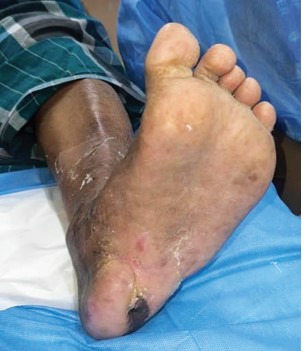
Background: Diabetic foot wounds may demonstrate delayed healing because of impaired tissue oxygenation, microvascular dysfunction, neuropathy, inflammation and impaired cellular responses. Oxygen is an important component of wound healing and is involved in cellular proliferation, collagen synthesis, angiogenesis and tissue remodeling.1–4 Topical oxygen therapy (TOT) has been investigated as an adjunct to conventional wound management, with clinical studies and systematic reviews suggesting potential benefits in diabetic foot ulcers.5–8 Warm oxygen therapy combines topical oxygen delivery with controlled local warming. Experimental and clinical studies have suggested that local warming may increase cutaneous blood flow and tissue perfusion, potentially enhancing the effects of topical oxygen therapy.9,10 Case Report:A 69-year-old male, with a diabetic foot wound of the left foot, presented with a persistent raw area approximately 3 months following split-thickness skin grafting. On evaluation, a residual raw area measuring approximately 5 × 5 mm was noted over the grafted area. The patient was managed with conventional wound care along with 10 sessions of topical warm oxygen therapy. Following treatment, clinical improvement of the wound was observed. Conclusion: This case demonstrates the potential role of topical warm oxygen therapy as an adjunct in the management of a small persistent raw area following skin grafting in a diabetic foot. The improvement observed in this patient is clinically encouraging; however, a single case cannot establish treatment efficacy. Further prospective studies are required to determine the role of warm oxygen therapy in postoperative diabetic wounds and areas of delayed graft healing.
References
- 1. Armstrong DG, Boulton AJM, Bus SA. Diabetic foot ulcers and their recurrence. N Engl J Med. 2017;376:2367–2375.
- 2. Schreml S, Szeimies RM, Prantl L, Karrer S, Landthaler M, Babilas P. Oxygen in acute and chronic wound healing. Br J Dermatol. 2010;163:257–268.
- 3. Sen CK. Wound healing essentials: let there be oxygen. Wound Repair Regen. 2009;17:1–18.
- 4. Frykberg RG, Banks J. Challenges in the treatment of chronic wounds. Adv Wound Care. 2015;4:560–582.
- 5. Carter MJ, Frykberg RG, Oropallo A, Sen CK. Efficacy of topical wound oxygen therapy in healing chronic diabetic foot ulcers: systematic review and meta-analysis. Adv Wound Care (New Rochelle). 2023;12:177–186. (PubMed Central (PMC)OBJ)
- 6. Gordillo GM, Sen CK. Evidence-based recommendations for topical oxygen therapy in chronic wounds. [Relevant topical oxygen literature].
- 7. Nataraj M, Maiya AG, Karkada G, et al. Application of topical oxygen therapy in healing dynamics of diabetic foot ulcers – a systematic review. Rev Diabet Stud. 2019;15:74–82. (PubMed Central (PMC)OBJ)
- 8. Updated systematic review and meta-analysis of topical oxygen therapy for diabetic foot ulcers. Seven randomized controlled trials involving 614 participants demonstrated a higher healing rate with topical oxygen therapy compared with controls. Diabetes Metab Res Rev. 2022. (PubMed Central (PMC)OBJ)
- 9. Joshi VS, et al. Systemic and local effects of warm oxygen exposure to the lower extremities in healthy volunteers. J Clin Diagn Res. 2017;11:CC01–CC03.
- 10. Anirudh V, Kamath DY, Ghosh S, Bhuvana KB, Sharma S, Maruthy K, Pais P, Xavier D. Topical controlled warm oxygen therapy delivered through a novel device (KADAM™) to treat diabetic foot ulcers: a randomized controlled, open, pilot trial.
- 11. Maiya AG, et al. Assessment of the efficacy of warm oxygen therapy on wound healing dynamics in diabetic rats – preclinical study. Bangalore Bioinnovation Centre/MAHE research study.
- 12. Topical wound oxygen therapy in the treatment of chronic diabetic foot ulcers: review of physiological and clinical evidence. Adv Wound Care. (PubMed Central (PMC)OBJ)
- 13. Nataraj M, Maiya AG, Karkada G, et al. Topical oxygen therapy and wound healing dynamics in diabetic foot ulcers: systematic review evidence. Rev Diabet Stud. 2019;15:74–82. (PubMed Central (PMC)OBJ)
- 14. Recent meta-analysis of topical oxygen therapy for chronic wounds demonstrating reduction in wound area and increased healing compared with standard care. (PubMed Central (PMC) OBJ)
Data Sharing Statement
There are no additional data available. All raw data and code are available upon request.
Funding
This research received no funding.
Author Contributions
All authors contributed significantly to the work and approve its publication.
Ethics Declaration
This article does not involve any human or animal subjects, and therefore does not require ethics approval.
Acknowledgements
We would like to express our gratitude to the patients, their families, and all those who have contributed to this study.
Conflicts of Interest
No conflicts of interest in this work.
About this article

Cite this article
M Vinaya Reddy, Amelia Lalthatluangi, Shanmuga Priya R et al. Topical Warm Oxygen Therapy for a Persistent Raw Area in a Diabetic Foot Following Split-Thickness Skin Grafting. Ind J Forensic Odontol 2025; 19(2): 64-69.
Licence:
Attribution-Non-commercial 4.0 International (CC BY-NC 4.0)This license enables reusers to distribute, remix, adapt, and build upon the material in any medium or format for noncommercial purposes only, and only so long as attribution is given to the creator.
| Received | Accepted | Published |
|---|---|---|
| September 23, 2026 | October 28, 2026 | December 30, 2026 |
DOI: https://doi.org/10.21088/jd.2582.3582.11226.4
Keywords
Diabetic footTopical oxygen therapyWarm oxygen therapyWound healingSkin graftSplit-thickness skin graftChronic woundSearch for Similar Articles
Similar Articles
- Skincare in Elderly: An Ignored Domain
- Early Adjunctive Use of Injectable Platelet-Rich Fibrin for Hypertrophic Scar Mo...
- Epidermolysis Bullosa: A Rare Skin Case
- Role of Topical Sucralfate in the Management of Pediatric Facial Burns: A Case R...
- Rethinking Anti-Aging Treatment Planning Through Biological Age Assessment: A Re...
Article Level Metrics
Last UpdatedMonday 23 November 2026, 01:42:24 (IST)
2065
Accesses
15
255
00
Citations
NA
NA
NA
Download citation
Article Keywords
Keyword Highlighting
Highlight selected keywords in the article text.
Timeline
| Received | September 23, 2026 |
| Accepted | October 28, 2026 |
| Published | December 30, 2026 |
licence
Attribution-Non-commercial 4.0 International (CC BY-NC 4.0)
This license enables reusers to distribute, remix, adapt, and build upon the material in any medium or format for noncommercial purposes only, and only so long as attribution is given to the creator.