Full Text (PDF)
Journal of Dermatology 11(2):p 60-63, July-December 2026. | DOI: https://doi.org/10.21088/jd.2582.3582.11226.3
Case Report
Epidermolysis Bullosa: A Rare Skin Case
Mahadev P.M., Chetan Nimbalkar, Somanath Ginni, Utkarsha R Dahake, Nivedita Rampure
Author Information
Licence:
Attribution-Non-commercial 4.0 International (CC BY-NC 4.0)This license enables reusers to distribute, remix, adapt, and build upon the material in any medium or format for noncommercial purposes only, and only so long as attribution is given to the creator.
Journal of Dermatology 11(2):p 60-63, July-December 2026. | DOI: https://doi.org/10.21088/jd.2582.3582.11226.3
How Cite This Article:
Mahadev P.M., Chetan Nimbalkar, Somanath Ginni et al. Epidermolysis Bullosa: A Rare Skin Case. RFP Jr of Drea 2026; 11(2): 60-63.Timeline
Received : September 08, 2026
Accepted : October 08, 2026
Published : December 30, 2026
Abstract
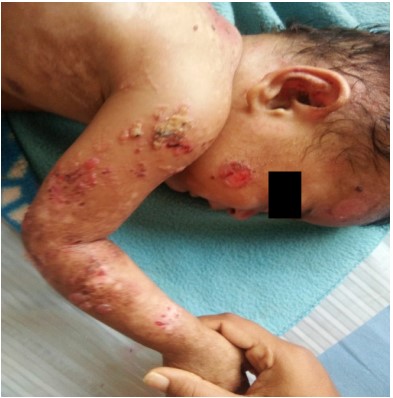
Epidermolysis bullosa (EB) is a rare inherited skin disorder in which the skin becomes very fragile and blisters develop spontaneously or even after minor trauma. It is mainly classified into three types: simplex, junctional and dystrophic, with varying severity and complications. The condition can affect the daily life of the child and may also create emotional and social stress for the child and parents. The present case is of a 3-year-old male child who developed fluidfilled blisters from the first day of life, initially over the lumbar region and later spreading to different parts of the body. The lesions were associated with severe itching, burning sensation, irritability and recurrent rupture with watery oozing. On examination, multiple bullous and ruptured lesions were observed over the back, chest, both knee, elbows and lower limbs. As there is no specific treatment to correct the underlying genetic defect, management mainly focuses on proper wound care, prevention of infection, avoiding trauma and providing symptomatic relief. This case highlights the importance of early recognition, proper skin care, parental counselling and regular follow-up to improve the quality of life of children with EB.
References
- 1. Stocker & dehners, paediatric pathology, 3rd edition, library of congress cataloguing in publication data, ISBN 978-0-7817-6669-2, the skin Epidermolysis bullosa, pg. no - 1112-1113
- 2. Ghai, essential paediatrics, 8th ed, CBS publishers & distributors new delhi, skin disorders epidermolysis bullosa, pg. no -676- 678
- 3. Arun c inamadar & sacchidananda, textbook of dermatology, jypee brothers’ medical publishers new delhi 1st ed, genodermatoses, epidermolysis bullosa pg. no -30-37
- 4. Arun c inamadar& sacchidananda, textbook of dermatology, jypee brother’s medical publishers new delhi 1st ed, genodermatoses, epidermolysis bullosa pg. no -30-37
- 5. Lucky AW, Pope E, Crawford S. Dystrophic Epidermolysis Bullosa. 2006 Aug 21 [Updated 2026 Aug 18]. In: Adam MP, Bick S, Mirza GM, et al., editors. GeneReviews® [Internet]. Seattle (WA): University of Washington, Seattle; 1993- 2026.
- 6. Has C, El Hachem M, Bučková H, Fischer P, Friedová M, Greco C, Nevoránková P, Salavastru C, Mellerio JE, Zambruno G, Bodemer C. Practical management of epidermolysis bullosa: consensus clinical position statement from the European Reference Network for Rare Skin Diseases. J Eur Acad Dermatol Venereol. 2021 Dec;35(12):2349-2360. doi: 10.1111/jdv.17629. Epub 2021 Sep 21. PMID: 34545960.
Data Sharing Statement
There are no additional data available. All raw data and code are available upon request.
Funding
This research received no funding.
Author Contributions
All authors contributed significantly to the work and approve its publication.
Ethics Declaration
This article does not involve any human or animal subjects, and therefore does not require ethics approval.
Acknowledgements
We would like to express our gratitude to the patients, their families, and all those who have contributed to this study.
Conflicts of Interest
No conflicts of interest in this work.
About this article

Cite this article
Mahadev P.M., Chetan Nimbalkar, Somanath Ginni et al. Epidermolysis Bullosa: A Rare Skin Case. RFP Jr of Drea 2026; 11(2): 60-63.
Licence:
Attribution-Non-commercial 4.0 International (CC BY-NC 4.0)This license enables reusers to distribute, remix, adapt, and build upon the material in any medium or format for noncommercial purposes only, and only so long as attribution is given to the creator.
| Received | Accepted | Published |
|---|---|---|
| September 08, 2026 | October 08, 2026 | December 30, 2026 |
DOI: https://doi.org/10.21088/jd.2582.3582.11226.3
Keywords
Epidermolysis bullosaBullous lesionsInherited skin disorderParent counsellingSearch for Similar Articles
Similar Articles
- Skincare in Elderly: An Ignored Domain
- Early Adjunctive Use of Injectable Platelet-Rich Fibrin for Hypertrophic Scar Mo...
- Topical Warm Oxygen Therapy for a Persistent Raw Area in a Diabetic Foot Followi...
- Role of Topical Sucralfate in the Management of Pediatric Facial Burns: A Case R...
- Rethinking Anti-Aging Treatment Planning Through Biological Age Assessment: A Re...
Article Level Metrics
Last UpdatedMonday 23 November 2026, 01:42:01 (IST)
2065
Accesses
13
255
00
Citations
NA
NA
NA
Download citation
Article Keywords
Keyword Highlighting
Highlight selected keywords in the article text.
Timeline
| Received | September 08, 2026 |
| Accepted | October 08, 2026 |
| Published | December 30, 2026 |
licence
Attribution-Non-commercial 4.0 International (CC BY-NC 4.0)
This license enables reusers to distribute, remix, adapt, and build upon the material in any medium or format for noncommercial purposes only, and only so long as attribution is given to the creator.