Full Text (PDF)
Journal of Psychiatric Nursing 14(1):p 13-19, Jan- April 2025. | DOI: https://doi.org/10.21088/jpn.2277.9035.14125.2
Original Article
This Study to assess the Knowledge and Attitude Regarding the Enuresis among the Mothers of School Age Children Residing at Rural Area
Author Information
Licence:
Attribution-Non-commercial 4.0 International (CC BY-NC 4.0)This license enables reusers to distribute, remix, adapt, and build upon the material in any medium or format for noncommercial purposes only, and only so long as attribution is given to the creator
Journal of Psychiatric Nursing 14(1):p 13-19, Jan- April 2025. | DOI: https://doi.org/10.21088/jpn.2277.9035.14125.2
How Cite This Article:
Muniyandi S., Vinodkumar Arali. This Study to assess the Knowledge and Attitude Regarding the Enuresis among the Mothers of School Age Children Residing at Rural Area. J Psychiatr Nurs. 2025; 14(1): 13-19.Timeline
Received : March 07, 2025
Accepted : April 13, 2025
Published : April 30, 2025
Abstract
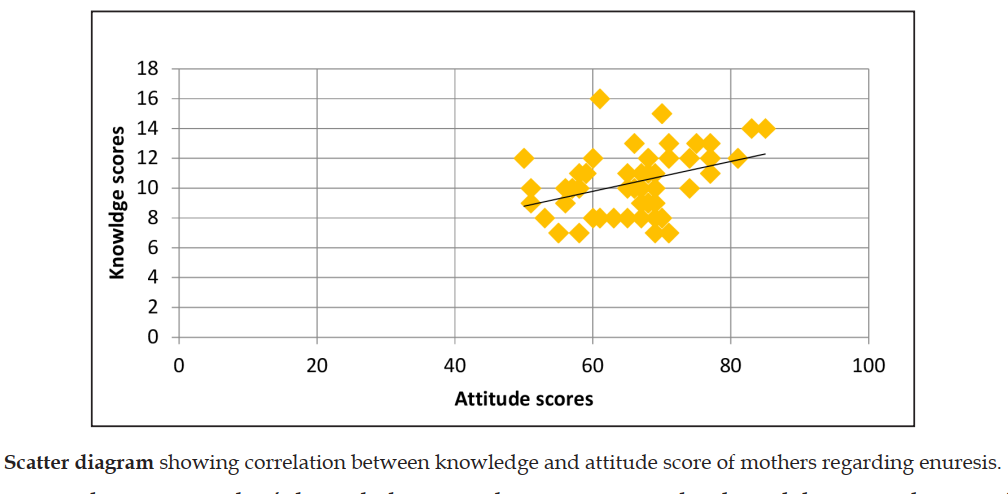
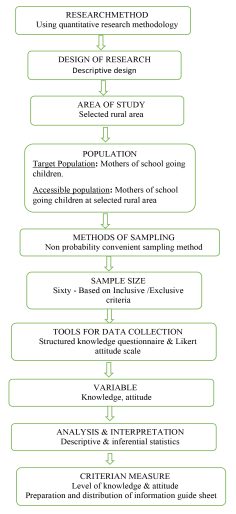
Enuresis is one of the major problems in children in developing countries like India. In India, an estimated 14% of children in 6-12 age groups have enuresis. Parents and family members are frequently stressed by a child’s bed wetting, soiled linens, and clothing causing additional laundry. If bed-wetting continues to exist even after the child is mature enough to remain dry in bed that turns into a problem. In such a situation parents must understand the causes behind the bed wetting and take appropriate measures to correct same. In every family, mothers are taking care of the child so it is necessary to study the knowledge and attitude of the mothers regarding the enuresis. This study was undertaken to assess the knowledge and attitude regarding enuresis among the mothers of school-age children residing in selected rural area. Objectives 1. To assess the knowledge of mothers regarding enuresis 2. To assess the attitude of mothers regarding enuresis 3. To find out the correlation between knowledge and attitude regarding enuresis among the mothers of school-age children. 4. To find out the association between the knowledge and attitude of mothers with their selected demographic variables 5. To prepare the information guide sheet and distribute it to the subjects. Research approach and design A descriptive survey approach with a nonexperimental design was used for 50 mothers of school-age children drawn through a purposive sampling technique in a selected village of Kanhan PHC. The conceptual framework for the study was developed from Rosenstoch and Becker’s health belief model. The hypothesis formulated that there will be a significant association between mothers’ knowledge and attitude with selected demographical variables. The content validity and reliability of the tools were established the pilot study was conducted using a structured interview technique. Knowledge and attitude of mothers are observed by administrating a structured knowledge questionnaire and a five-point Likert scale. Results: The collected data was analysed by using descriptive and inferential statistics. The study findings revealed that the majority of mothers (54%) had poor knowledge and 44% had an average level of knowledge regarding enuresis. In attitude score majority of the mothers (86%) had moderately favourable and 12% had favourable attitudes regarding enuresis. Association between knowledge and attitude scores of mothers with selected demographic variables are found in other ages x2(1) =7.621, p<0.05) and age of the child (x2(1) =5.062; p<0.05) respectively. It was also found that there is a positive correlation between the knowledge and attitude of mothers regarding enuresis. The ‘r’ value computed was 0.380 which indicates that there is a positive correlation between knowledge of mothers and their attitude. Recommendations: Based on the findings of the study, the following recommendations have been made for further study: • A study can be conducted on a larger sample in different settings.• A comparative study can be conducted between urban and rural mothers.• A study to assess the effectiveness of a structured teaching program regarding enuresis can be conducted. Conclusion: Based on the above findings of the study, recommendations were drawn for nursing service, administration, education, and research. The study concludes that the knowledge and attitude of mothers regarding enuresis among school-age children was average and moderately favourable.
References
- 1. David elkind. Toilet training, M.U. exention, GH6128 reviewed December 2004, Available URL Google.com.
- 2. Rushton. Nocturnsl enuresis, available URL duj.com
- 3. Nocturnal enuresis from Wikipedia. The free encyclopedia 9 Oct 2008 available URL Wikipedia.org
- 4. Haworth press online catalog. J of Family psychotherapy, vol 15; issue (3) pp. 1-2 available URLhaworth press.com
- 5. Laurie Barclay, Penny Maruta. Management of child hood enuresis reviewed 2008 URL Medascape.com
- 6. Schulpen T. The burden of nocturnal enuresis. ActaPædiatrica, 86: 981–984. j. 21 Jan 2008
- 7. Azhir A., Frajzadegan Z., Adibi A., Hedayatpoor B., Divband A. An epidemiological study of enuresis among primary school children: Isfahan Saudi; Med J 2006; 27(10): 1572-7. Available URL http www.pubmed.com
- 8. Erdogon, HaniffeAkkurt, Nazan K ErayYurtseven, Gunay Can. Prevelence and behavioural correlates of enuresis among young children URL:http:// WWW.pubmed.com
- 9. Joinson C., Heron J., Emond A., Butler R. Psychological problems in children with bedwetting and combined wetting. J. Paed psychology, 2007; 32(5): 605-16 available URL: http:// www.oxfordjournals.org
- 10. Dr. Scott Orme, Sanborn, Kimberly M. American Psychological Association Publication Manual, Fourth Edition University of Wisconsity Stout Menomonie, Wisconsin; Aug: 2002, p. 37.
- 11. Byrd R.S., Weitzman M., Lanpher N.E., Auinger P. Bedwetting in US children: epidemiology and related behavior problems. Peadiatric.1996 Sep; 98(3 pt 1): 414-9
- 12. Edgemen A., Akil I., Canda E., Ozyurt B.C., Eser E. Evaluation of quality of mothers of children with enuresis nocturna, Peadiatric Nephrol 2008: 23(1); 93-8 Available URL;http://www. medline.com
- 13. Hazza I., Tarawneh H. Primary Nocturnal Enuresis among school children in Jordan: Saudi J Kidney dis Transpl. 2008(13): 470-80 Available URL:http://WWW.sjkdt.org
- 14. Abdulmahdi A Hassan, Dr. Amir A. Hussain. Effects of the educational program upon parents knowledge of enuretic children. Urology and Nephrology: Vol(36); pp. 199-203
- 15. Iduoriyemwen N.J., Ibadin M.O., Abiodun P.O. Survey of child hood enuresis in the Ehor community; Nigeria J kidney Dis Tranpl. 2006: 17(2): 177-82 Available http://www.medline.com
- 16. Butler R.J., Golding J., Heron J. Nocturnal enuresis: A survey of parentral coping strategies; 200531(6): 659-67 available URL:http://www.pubmed.com
- 17. Youseff K.A., Basaleem H.O., Bin Yahiya M.T. Epidemiology of nocturnal enuresis in basic school children in Aden governorate, Yemen. Saudi j kidney distranpl. 2011 Jan: 22(1) : 167-73.
- 18. Ozkan K.U., Garipardic M., Toktamis A., Karabiber H., Sahinkanat T. Enuresis, prevalence and accompanying factors in school children: a questionnaire study from southeast Anatolia .urolint 2004: 73(2): 149-55.
- 19. Gunesa, Gunes G., Acik Y., Akilli A. The epidimeology and factors associated with nocturnal enuresis among boarding and daytime school children. In south east of turkey. BMC public health 2009 Sep; 22 (9) 357.
- 20. SecilOzkan, ElifDurukan, Elvan Iseri, SerhetGurocak, IsioMaral, M. Ali Bumin Prevalence and risk factor of monosymptomatic nocturnal enuresis in Turkish children original article: 2010, 26(2): 200-205.
Data Sharing Statement
There are no additional data available
Funding
This research received no funding
Author Contributions
All authors contributed significantly to the work and approve its publication
Ethics Declaration
This article does not involve any human or animal subjects, and therefore does not require ethics approval
Acknowledgements
Information Not Provided
Conflicts of Interest
No conflicts of interest in this work
About this article

Cite this article
Muniyandi S., Vinodkumar Arali. This Study to assess the Knowledge and Attitude Regarding the Enuresis among the Mothers of School Age Children Residing at Rural Area. J Psychiatr Nurs. 2025; 14(1): 13-19.
Licence:
Attribution-Non-commercial 4.0 International (CC BY-NC 4.0)This license enables reusers to distribute, remix, adapt, and build upon the material in any medium or format for noncommercial purposes only, and only so long as attribution is given to the creator
| Received | Accepted | Published |
|---|---|---|
| March 07, 2025 | April 13, 2025 | April 30, 2025 |
DOI: https://doi.org/10.21088/jpn.2277.9035.14125.2
Keywords
KnowledgeAttitudeEnuresisMothersSchool Age ChildrenRural AreaSearch for Similar Articles
Similar Articles
- Ketamine Therapy in Psychiatry: A Comprehensive Review
- A Study to assess the Mobile Phone Dependence Level among Students of Selected I...
- Effectiveness of Assertive Training Program on Job Stress among Nurses Working i...
- Ketamine Therapy in Psychiatry: A Comprehensive Review
- Effectiveness of Psychoeducation on Knowledge of Extrapyramidal Symptoms among C...
Article Level Metrics
Last UpdatedThursday 30 July 2026, 02:47:28 (IST)
1051
Accesses
21
126
00
Citations
NA
NA
NA
Download citation
Article Keywords
Keyword Highlighting
Highlight selected keywords in the article text.
Timeline
| Received | March 07, 2025 |
| Accepted | April 13, 2025 |
| Published | April 30, 2025 |
licence
Attribution-Non-commercial 4.0 International (CC BY-NC 4.0)
This license enables reusers to distribute, remix, adapt, and build upon the material in any medium or format for noncommercial purposes only, and only so long as attribution is given to the creator