Full Text (PDF)
Indian Journal of Obstetrics and Gynecology 12(4):p 185-188, October-December 2024. | DOI: https://doi.org/10.21088/ijog.2321.1636.12424.7
Case Report
Spinal Schwannoma in Third Trimester of Pregnancy: A Rare yet Challenging Case
Rajani Upadhyaya, Rajvi Hans, Shripad Hebbar, Kavisha Bhat, Divyashree Bhat
Author Information
Licence:
Attribution-Non-commercial 4.0 International (CC BY-NC 4.0)This license enables reusers to distribute, remix, adapt, and build upon the material in any medium or format for noncommercial purposes only, and only so long as attribution is given to the creator.
Indian Journal of Obstetrics and Gynecology 12(4):p 185-188, October-December 2024. | DOI: https://doi.org/10.21088/ijog.2321.1636.12424.7
How Cite This Article:
Rajvi Hans, Rajani Upadhyaya, Shripad Hebbar et al., Spinal Schwannoma in Third Trimester of Pregnancy: A Rare yet Challenging Case. Indian J Obstet Gynecol. 2024;12(4):185-188.Timeline
Received : November 18, 2024
Accepted : December 27, 2024
Published : December 30, 2024
Abstract
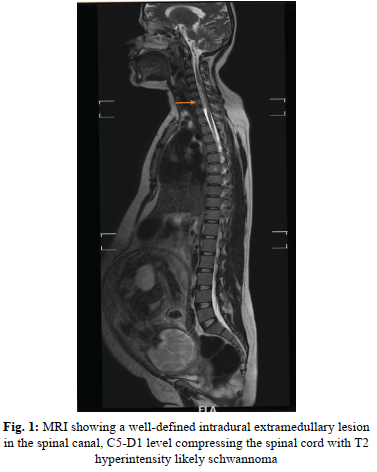
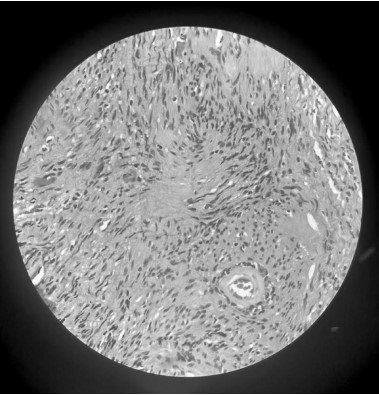
Introduction: Spinal schwannomas during pregnancy are exceedingly rare, with most cases occurring as pregnancy-related spinal tumors (PRST). These tumors can appear or become symptomatic within a year of pregnancy. Few reports exist of third-trimester diagnoses, and their management presents unique challenges, including balancing maternal-fetal safety during diagnosis and intervention. Case Presentation: We present the case of a 35-year-old woman at 36 weeks of gestation (G2P1L1) who developed acute bilateral lower limb weakness, rapidly progressing to involve the upper limbs. Neurological examination revealed absent reflexes and sensory loss below T12. MRI without contrast identified an intradural extramedullary lesion, likely a schwannoma, at the C5-D1 level compressing the spinal cord. An emergent lower segment cesarean section (LSCS) was performed, followed by successful tumour resection via C4-D1 laminotomy. Histopathology confirmed ancient schwannoma. Postoperative recovery was gradual, with significant neurological improvement after three months. Discussion: The diagnosis of spinal tumours during pregnancy is often delayed due to symptom overlap with common pregnancy-related conditions. Surgical timing remains a contentious issue, but the literature supports intervention under general anaesthesia as safe during pregnancy when neurological symptoms are rapidly progressing. Our case demonstrates the successful use of a multidisciplinary approach involving obstetricians, anaesthetists, neurosurgeons, and neonatologists to manage maternal and fetal outcomes. Conclusion: Spinal schwannomas in pregnancy, though rare, require early diagnosis and a multidisciplinary treatment approach to optimise maternal and fetal outcomes. Timely surgical intervention can lead to favourable neurological recovery and safe delivery.
References
- 1. Wiyanjana KDF, Putra KK, Maliawan S, Gotra IM. Spinal Schwannoma as Pregnancy Related Spinal Tumor. Neurol Spinale Medico Chir [Internet]. 2020 Jan 6 [cited 2024 Sep 25];2(3). Available from: http://nsmc.indoscholar. com/index.php/nsmc/article/view/80
- 2. Han IH, Kuh SU, Kim JH, Chin DK, Kim KS, Yoon YS, et al. Clinical approach and surgical strategy for spinal diseases in pregnant women: a report of ten cases. Spine. 2008 Aug 1;33(17):E614-619.
- 3. Chen R, Xiao A, Xing L, You C, Liu J. A rare thoracic intraspinal schwannoma in twin pregnancy with aggravated clinical presence: A case report following CARE. Medicine (Baltimore). 2017 Mar;96(11):e6327.
- 4. Kawaguchi K, Akeda K, Takegami N, Kurata T, Toriyabe K, Ikeda T, et al. Cervical schwannoma in the early stage of pregnancy: a case report. BMC Surg. 2020 Dec;20(1):245.
- 5. Meng T, Yin H, Li Z, Li B, Zhou W, Wang J, et al. Therapeutic strategy and outcome of spine tumors in pregnancy: a report of 21 cases and literature review. Spine. 2015 Feb 1;40(3):E146 153.
- 6. Nossek E, Ekstein M, Rimon E, Kupferminc MJ, Ram Z. Neurosurgery and pregnancy. Acta Neurochir (Wien). 2011 Sep;153(9):1727–35.
Data Sharing Statement
There are no additional data available. All raw data and code are available upon request
Funding
This research received no funding.
Author Contributions
All authors contributed significantly to the work and approve its publication.
Ethics Declaration
This article does not involve any human or animal subjects, and therefore does not require ethics approval
Acknowledgements
We would like to express our gratitude to the patients, their families, and all those who have contributed to this study
Conflicts of Interest
No conflicts of interest in this work.
About this article

Cite this article
Rajvi Hans, Rajani Upadhyaya, Shripad Hebbar et al., Spinal Schwannoma in Third Trimester of Pregnancy: A Rare yet Challenging Case. Indian J Obstet Gynecol. 2024;12(4):185-188.
Licence:
Attribution-Non-commercial 4.0 International (CC BY-NC 4.0)This license enables reusers to distribute, remix, adapt, and build upon the material in any medium or format for noncommercial purposes only, and only so long as attribution is given to the creator.
| Received | Accepted | Published |
|---|---|---|
| November 18, 2024 | December 27, 2024 | December 30, 2024 |
DOI: https://doi.org/10.21088/ijog.2321.1636.12424.7
Keywords
Spinal schwannomaSearch for Similar Articles
Similar Articles
- Fibromyoma: A Clinical Dilemma
- Optimizing Obstetric Care: A Review of Indications and Outcomes for First-Time C...
- A Rare Case of Geriatric Endometrial Adenocarcinoma Presenting with Nonpuerperal...
- Relationship between Hypothyroidism and Gestational Diabetes Mellitus: A Prospec...
- Influence of Maternal Anthropometry and Hemoglobin on Neonatal Anthropometry
Article Level Metrics
Last UpdatedWednesday 09 September 2026, 18:50:21 (IST)
3515
Accesses
10
590
00
Citations
NA
NA
NA
Download citation
Article Keywords
Keyword Highlighting
Highlight selected keywords in the article text.
Timeline
| Received | November 18, 2024 |
| Accepted | December 27, 2024 |
| Published | December 30, 2024 |
licence
Attribution-Non-commercial 4.0 International (CC BY-NC 4.0)
This license enables reusers to distribute, remix, adapt, and build upon the material in any medium or format for noncommercial purposes only, and only so long as attribution is given to the creator.