Full Text (PDF)
Indian Journal of Biology 10(1):p 9-15, January-June 2023. | DOI: https://doi.org/10.21088/ijb.2394.1391.10123.1
Original Article
Smaller Body Mass Influence Less Sensitive to Neonicotinoids of Honey Bee Apis Cerana Indica; Fab
P. Sethura null, R Padmavathi null
Author Information
Licence:
Attribution-Non-commercial 4.0 International (CC BY-NC 4.0)This license enables reusers to distribute, remix, adapt, and build upon the material in any medium or format for noncommercial purposes only, and only so long as attribution is given to the creator.
Indian Journal of Biology 10(1):p 9-15, January-June 2023. | DOI: https://doi.org/10.21088/ijb.2394.1391.10123.1
How Cite This Article:
Padmavathi R, Sethuraj P. Smaller body mass influence less sensitive to neonicotinoids of honey bee Apis cerana indica Fab. Indian J Biol. 2023;10(1):9-15.Timeline
Received : December 14, 2022
Accepted : January 15, 2023
Published : February 28, 2023
Abstract
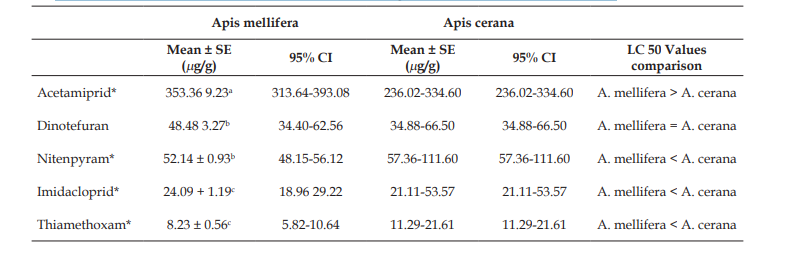
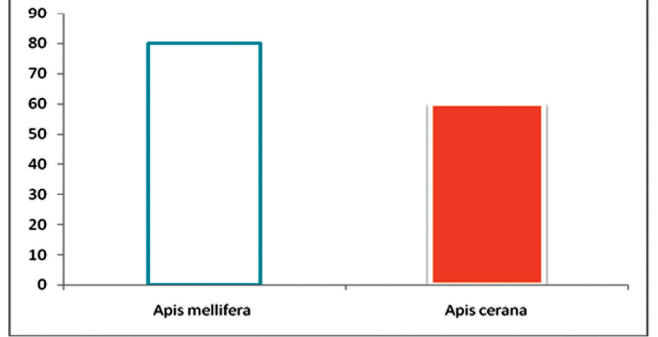
Multiple stressors and interactions between them may be responsible for the decline of global pollinators. Among them, exposure to neonicotinoids has been getting more attention and has been considered a main stressor. The Western honey bee (Apis mellifera L.) (Hymenoptera: Apidae) and the Indian indigenous honey bee (Apis cerana F.) (Hymenoptera: Apidae) are two managed honey bee species in India. These two species are widely used in beekeeping, and many wild A. cerana is widely spread in forests and contributes to the ecosystem. It is predicted that A. cerana is more sensitive to insecticides than A. mellifera due to their smaller mass. Here, we found that although the body mass of A. cerana is significantly lower than A. mellifera, the sensitivity of the two species to neonicotinoids are not associated with their body mass but depended on the chemical structure of neonicotinoids. To dinotefuran, the two species showed similar sensitivity. To acetamiprid, A. mellifera was less sensitive than A. cerana. However, to imidacloprid and thiamethoxam, A. mellifera was more sensitive than A. cerana. These results suggested that the sensitivity of honey bees to neonicotinoids is closely associated with the structure of pesticides, but not with the body mass of bees. It is also indicated that the hazards of pesticides to the different pollinators could not be inferred from one species to another.
References
- 1. Arena M, Sgolastra F. A metaanalysis comparing the sensitivity of bees to pesticides. Ecotoxicology. 2014;23:324–334.
- 2. Bass C, Denholm I, Williamson MS, Nauen R. The global status of insect resistance to neonicotinoid insecticides. Pestic Biochem Physiol. 2015;121:78-87.
- 3. Breeze TD, Bailey AP, Balcombe KG, Potts SG. Pollination services in the UK: how important are honeybees? Agr Ecosyst Environ. 2011;142:137-143.
- 4. Cresswell JE, Desneux N, vanEngelsdorp D. Dietary traces of neonicotinoid pesticides as a cause of population declines in honey bees: an evaluation by Hill's epidemiological criteria. Pest Manag Sci. 2012;68:819-827.
- 5. Danka RG, Rinderer TE, Hellmich RL, Collins AM. Comparative toxicities of four topically applied insecticides to Africanized and European honey bees (Hymenoptera: Apidae). J Econ Entomol. 1986;79:18-21.
- 6. Devillers J, Decourtye A, Budzinski H, Pham-Delègue MH, Cluzeau S, Maurin G. Comparative toxicity and hazards of pesticides to Apis and non-Apis bees: a chemometrical study. SAR QSAR Environ Res. 2003;14:389-403.
- 7. Fairbrother A, Purdy J, Anderson T, Fell R. Risks of neonicotinoid insecticides to honeybees. Environ Toxicol Chem. 2014;33:719-731.
- 8. Finney D. Probit analysis. London: Cambridge University Press; 1971.
- 9. Goulson D, Nicholls E, Botías C, Rotheray EL. Bee declines driven by combined stress from parasites, pesticides, and lack of flowers. Science. 2015;347:1255957.
- 10. Graystock P, Yates K, Darvill B, Goulson D, Hughes WO. Emerging dangers: deadly effects of an emergent parasite in a new pollinator host. J Invertebr Pathol. 2013;114:114-119.
- 11. Gregorc A, Evans JD, Scharf M, Ellis JD. Gene expression in honey bee (Apis mellifera) larvae exposed to pesticides and Varroa mites (Varroa destructor). J Insect Physiol. 2012;58:1042-1049.
- 12. Gupta PR, Chandel RS. Effects of diflubenzuron and penfluron on workers of Apis cerana indica F. and Apis mellifera L. Apidologie. 1995;26:3-10.
- 13. Huang Z. Pollen nutrition affects honey bee stress resistance. Terr Arthropod Rev. 2012;5:175-189.
- 14. Huang ZY, Robinson GE. Regulation of honey bee division of labor by colony age demography. Behav Ecol Sociobiol. 1996;39:147-158.
- 15. Ji R, Xie B, Yang G, Li D. From introduced species to invasive species- a case study on the Italian bee Apis mellifera L. Chin J Ecol. 2003;22:70-73.
- 16. Kessler S, Tiedeken EJ, Simcock KL, Derveau S, Mitchell J, Softley S, et al. Bees prefer foods containing neonicotinoid pesticides. Nature. 2015;521:74–76.
- 17. Klein AM, Vaissière BE, Cane JH, Steffan-Dewenter I, Cunningham SA, Kremen C, et al. Importance of pollinators in changing landscapes for world crops. Proc Biol Sci. 2007;274:303-313.
- 18. Laurino D, Manino A, Patetta A, Porporato M. Toxicity of neonicotinoid insecticides on different honey bee genotypes. B Insectol. 2013;66:119-126.
- 19. Laurino D, Manino A, Patetta A, Ansaldi M, Porporato M. Acute oral toxicity of neonicotinoids on different bee strains. J Zool. 2010;93:99-102.
- 20. Liao X, Liu J, Luo S, Wu J. Evaluation the toxicity of five pesticides to two species of bumblebees. Acta Agric Boreali-occidentalis Sin. 2013:191-195.
- 21. Luo S, An J, Chen J, Peng W, Wu J, Yang W. Evaluation the oral toxicity of four pyrethroids pesticides to Bombus hypocrita. Pesticide. 2009:909-911.
- 22. Manzoor M, Mathivanan V, Nabi Shah G, Mir GM, Selvisabhanayakam. Physico-chemical analysis of honey of Apis cerana indica and Apis mellifera from different regions of Anantnag district, Jammu & Kashmir. Int J Pharm Pharm Sci. 2013;5:635-638.
- 23. Matsuda K, Buckingham SD, Kleier D, Rauh JJ, Grauso M, Sattelle DB. Neonicotinoids: insecticides acting on insect nicotinic acetylcholine receptors. Trends Pharmacol Sci. 2001;22:573–580.
- 24. Moffat C, Buckland ST, Samson AJ, McArthur R, Chamosa Pino V, Bollan KA, et al. Neonicotinoids target distinct nicotinic acetylcholine receptors and neurons, leading to differential risks to bumblebees. Sci Rep. 2016;6:24764.
- 25. Mullin CA, Frazier M, Frazier JL, Ashcraft S, Simonds R, Vanengelsdorp D, et al. High levels of miticides and agrochemicals in North American apiaries: implications for honey bee health. PLoS One. 2010;5:e9754.
- 26. Pisa LW, Amaral-Rogers V, Belzunces LP, Bonmatin JM, Downs CA, Goulson D, et al. Effects of neonicotinoids and fipronil on non-target invertebrates. Environ Sci Pollut Res Int. 2015;22:68-102.
- 27. Pudasaini R, Thapa RB. Comparative foraging behavior of Apis cerana F. and Apis mellifera L. in rapeseed under cage condition in Chitwan, Nepal. IJASBT. 2014;2:483-487.
- 28. Reeves AM. Effects of pesticide exposures on the nutritional and immune health of the honey bee, Apis mellifera L. [dissertation]. Blacksburg (VA): Virginia Polytechnic Institute and State University; 2013.
- 29. Rinkevich FD, Margotta JW, Pittman JM, Danka RG, Tarver MR, Ottea JA, et al. Genetics, synergists, and age affect insecticide sensitivity of the honey bee, Apis mellifera. PLoS One. 2015;10:e0139841.
- 30. Robinson GE, Vargo EL. Juvenile hormone in adult eusocial Hymenoptera: gonadotropin and behavioral pacemaker. Arch Insect Biochem Physiol. 1997;35:559-583.
- 31. Rundlof M, Andersson GK, Bommarco R, Fries I, Hederstrom V, Herbertsson L, et al. Seed coating with a neonicotinoid insecticide negatively affects wild bees. Nature. 2015;521:77-80.
- 32. Ruttner F, Maul V. Experimental analysis of reproductive interspecies isolation of Apis mellifera L. and Apis cerana Fabr. Apidologie. 1983;14:309-327.
- 33. Sanchez-Bayo F, Goka K. Pesticide residues and bees-a risk assessment. PLoS One. 2014;9:e94482.
- 34. Scott JG. Cytochromes P450 and insecticide resistance. Insect Biochem Mol Biol. 1999;29:757-777.
- 35. Sharma D, Abrol DP. Contact toxicity of some insecticides to honeybee Apis mellifera (L.) and Apis cerana (F.). J Asia-Pac Entomol. 2005;8:113–115.
- 36. Stanley J, Sah K, Jain SK, Bhatt JC, Sushil SN. Evaluation of pesticide toxicity at their field recommended doses to honeybees, Apis cerana and A. mellifera through laboratory, semi-field and field studies. Chemosphere. 2015;119:668-674.
- 37. Steen JJMV. Method development for the determination of the contact LD50 of pesticides for bumble bees (Bombus terrestris L.). Apidologie. 1994;25:463-465.
- 38. Tan K, Yang S, Wang Z, Radloff SE, Oldroyd BP. Differences in foraging and broodnest temperature in the honey bees Apis cerana and Apis mellifera. Apidologie. 2012;43:618-623.
- 39. Thompson H. Extrapolation of acute toxicity across bee species. Integr Environ Assess Manag. 2016;12:622-626.
- 40. Vanbergen AJ, Baude M, Biesmeijer JC, Britton NF, Brown MJF, Brown M, et al. Threats to an ecosystem service: pressures on pollinators. Front Ecol Environ. 2013;11:251-259.
- 41. Vidau C, Diogon M, Aufauvre J, Fontbonne R, Viguès B, Brunet JL, et al. Exposure to sublethal doses of fipronil and thiacloprid highly increases mortality of honeybees previously infected by Nosema ceranae. PLoS One. 2011;6:e21550.
- 42. Wahl O, Ulm K. Influence of pollen feeding and physiological condition on pesticide sensitivity of the honey bee Apis mellifera carnica. Oecologia. 1983;59:106-128.
- 43. Wu J, Li J, Peng W, Hu F. Sensitivities of three bumblebee species to four pesticides applied commonly in greenhouses in Indian. Insect Sci. 2010;17:67-72.
- 44. Yang G. Harm of introducing the Western honeybee Apis mellifera L. to the Chinese honeybee Apis cerana F. and its ecological impact. Acta Entomol Sin. 2005;48:401-406.
Data Sharing Statement
There are no additional data available. All raw data and code are available upon request.
Funding
This research received no funding.
Author Contributions
Whether all authors contributed significantly to the work and approve its publication.
Ethics Declaration
This article does not involve any human or animal subjects, and therefore does not require ethics approval.
Acknowledgements
We would like to express our gratitude to the patients, their families, and all those who have contributed to this study.
Conflicts of Interest
The authors report no conflicts of interest in this work.
About this article

Cite this article
Padmavathi R, Sethuraj P. Smaller body mass influence less sensitive to neonicotinoids of honey bee Apis cerana indica Fab. Indian J Biol. 2023;10(1):9-15.
Licence:
Attribution-Non-commercial 4.0 International (CC BY-NC 4.0)This license enables reusers to distribute, remix, adapt, and build upon the material in any medium or format for noncommercial purposes only, and only so long as attribution is given to the creator.
| Received | Accepted | Published |
|---|---|---|
| December 14, 2022 | January 15, 2023 | February 28, 2023 |
DOI: https://doi.org/10.21088/ijb.2394.1391.10123.1
Keywords
Apis Mellifera LinnaeusApis Cerana FabriciusNeonicotinoidsOral Acute ToxicitySearch for Similar Articles
Similar Articles
- Medicinal Mushrooms: Potent Fungi for Diverse Human Health Benefits
- Honey for Nutrition and Health Benefits - Traditional and Modern Uses in Human D...
- Foraging Behaviour of Indian Honey Bee, Apis Cerana Indica Fab, (Apidae: Hymenop...
- Role of Curcumin in Wound Healing
- Characterization of Blood cells and Comparative Analyses of Hematological Profil...
Article Level Metrics
Last UpdatedWednesday 30 September 2026, 08:30:21 (IST)
2437
Accesses
26
344
00
Citations
NA
NA
NA
Download citation
Article Keywords
Keyword Highlighting
Highlight selected keywords in the article text.
Timeline
| Received | December 14, 2022 |
| Accepted | January 15, 2023 |
| Published | February 28, 2023 |
licence
Attribution-Non-commercial 4.0 International (CC BY-NC 4.0)
This license enables reusers to distribute, remix, adapt, and build upon the material in any medium or format for noncommercial purposes only, and only so long as attribution is given to the creator.