Full Text (PDF)
Journal of Global Medical Education and Research 5(2):p 45-47, July - December 2022. | DOI: NA
Original Article
Role of Tangential Excision and Skin Grafting in Scald Burns
Ravi Kumar Chittoria, Gnaneshvar Manivannan, Neljo Thomas
Author Information
Licence:
Attribution-Non-commercial 4.0 International (CC BY-NC 4.0)This license enables reusers to distribute, remix, adapt, and build upon the material in any medium or format for noncommercial purposes only, and only so long as attribution is given to the creator.
Journal of Global Medical Education and Research 5(2):p 45-47, July - December 2022. | DOI: NA
How Cite This Article:
Gnaneshvar Manivannan, Neljo Thomas, Ravi Kumar Chittoria/Role of Tangential Excision and Skin Grafting in Scald Burns/Journal of Global Medical Education and Research/2022;5 (2):45-47.Timeline
Received : July 25, 2022
Accepted : August 28, 2022
Published : December 25, 2022
Abstract
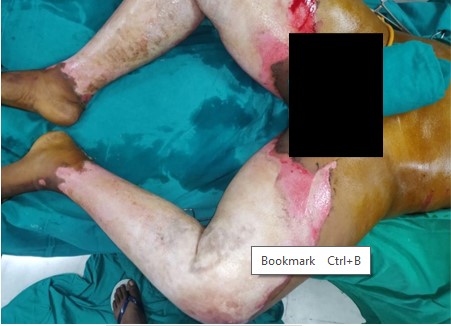
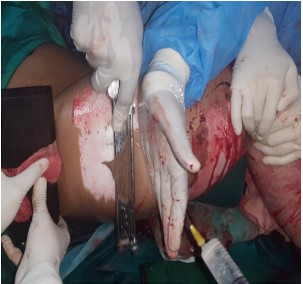
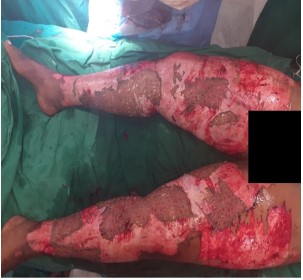
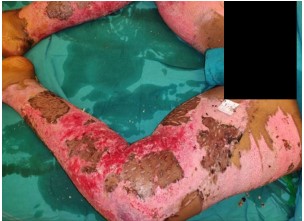
Scald burns are one of the most common types of burn injuries worldwide. Scalds are a form of thermal burns resulting from contact of the skin with moist heat or heated fluids such as boiling water or steam. Usually, in scald burns, the epidermis or a part of the dermis is mostly affected. Hence most scalds are considered first or second degree burns. The primary aim of the management of burns is to ensure adequate wound coverage. While wound irrigation, debridement, and local wound care may be sufficient for managing superficial burns (involving the epidermis and superficial dermal layer), deep burns (involving the deep dermal layer and other structures deeper to it) require tangential excision and skin grafting. If performed early it is associated with better outcomes in terms of reduced infection risk and hastened wound healing. In this article, we see how tangential excision and skin grafting improved the clinical outcome in a 42 year old female who presented with scald burns involving both her lower limbs, comprising about 30% of the body surface.
References
- 1. Gallaher JR, Mjuweni S, Shah M, Cairns BA, Charles AG. Timing of early excision and grafting following burn in sub-Saharan Africa. Burns. 2015 Sep;41(6):1353-9.
- 2. Goswami P, Sahu S, Singodia P, Kumar M, Tudu T, Kumar A, Sinha PK. Early Excision and Grafting in Burns: An Experience in a Tertiary Care Industrial Hospital of Eastern India. Indian J Plast Surg. 2019 Sep;52(3):337-342.
- 3. Edmondson SJ,Ali Jumabhoy I,Murray A, Time to start putting down the knife: A systematic review of burns excision tools of randomized and non-randomized trials. Burns: journal of the International Society for Burn Injuries. 2018 Nov.
- 4. M Prasanna 1, K Singh, P Kumar Burns 1994 Oct;20(5):446-50,10.1016/0305-4179(94)90040-x.
- 5. Williams FN, Lee JO (2018) Chemical burns. In: Herndon DN (Hrsg) Total burn care, 5. Aufl. Elsevier, S 408–413.
- 6. Yin S. Chemical and Common Burns in Children. Clinical Pediatrics. 2017;56(5_suppl):8S-12S.
Data Sharing Statement
There are no additional data available. All raw data and code are available upon request.
Funding
This research received no funding.
Author Contributions
All authors contributed significantly to the work and approve its publication.
Ethics Declaration
This article does not involve any human or animal subjects, and therefore does not require ethics approval.
Acknowledgements
We would like to express our gratitude to the patients, their families, and all those who have contributed to this study.
Conflicts of Interest
No conflicts of interest in this work.
About this article

Cite this article
Gnaneshvar Manivannan, Neljo Thomas, Ravi Kumar Chittoria/Role of Tangential Excision and Skin Grafting in Scald Burns/Journal of Global Medical Education and Research/2022;5 (2):45-47.
Licence:
Attribution-Non-commercial 4.0 International (CC BY-NC 4.0)This license enables reusers to distribute, remix, adapt, and build upon the material in any medium or format for noncommercial purposes only, and only so long as attribution is given to the creator.
| Received | Accepted | Published |
|---|---|---|
| July 25, 2022 | August 28, 2022 | December 25, 2022 |
DOI: NA
Keywords
Tangential excisionScaldsSkin graftingSearch for Similar Articles
Similar Articles
- A Diarrhoea Awareness Campaign to Improve the Knowledge among the Adolescents in...
- Management of Hypertension
- Cystoscopy Procedure: Nurses Role & Responsibility in Procedure Area
- Study on Blood Group and their Forensic Aspects
- Knowledge of Antenatal Mothers on Breastfeeding: A Descriptive CrossSectional St...
Article Level Metrics
Last UpdatedWednesday 09 September 2026, 16:41:41 (IST)
758
Accesses
2
114
00
Citations
NA
NA
NA
Download citation
Article Keywords
Keyword Highlighting
Highlight selected keywords in the article text.
Timeline
| Received | July 25, 2022 |
| Accepted | August 28, 2022 |
| Published | December 25, 2022 |
licence
Attribution-Non-commercial 4.0 International (CC BY-NC 4.0)
This license enables reusers to distribute, remix, adapt, and build upon the material in any medium or format for noncommercial purposes only, and only so long as attribution is given to the creator.