Full Text (PDF)
Indian Journal of Biology 9(1):p 9-11, January-June 2022. | DOI: https://doi.org/10.21088/ijb.2394.1391.9122.1
Original Article
Role of Tangential Excision and Skin Grafting in Chemical Burns
Ravi Kumar Chittoria, P Barath Kumar Singh
Author Information
Licence:
Attribution-Non-commercial 4.0 International (CC BY-NC 4.0)This license enables reusers to distribute, remix, adapt, and build upon the material in any medium or format for noncommercial purposes only, and only so long as attribution is given to the creator.
Indian Journal of Biology 9(1):p 9-11, January-June 2022. | DOI: https://doi.org/10.21088/ijb.2394.1391.9122.1
How Cite This Article:
P Barath Kumar Singh, Ravi Kumar Chittoria/Role of Tangential Excision and Skin Grafting in Chemical Burns/Indian J Biol 2022; 9(1):9–11.Timeline
Received : March 16, 2022
Accepted : May 20, 2022
Published : June 20, 2022
Abstract
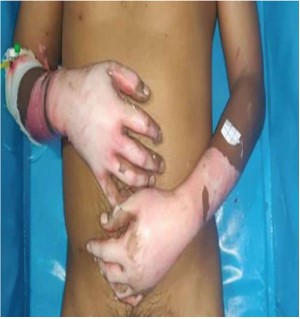
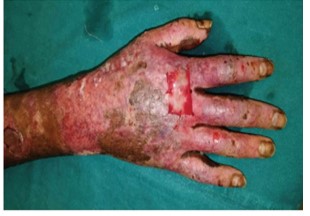
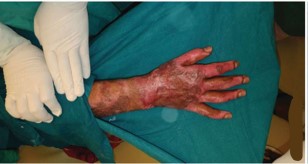
Chemical Burns most commonly occurs in the industrial workers. Chemicals can injure the cells by exothermic reaction on the surface of the skin, which can also cause the thermal burns. Both acidic and alkali chemical burns are common in industrial workers. Chemical burns are treated by copious irrigation with water, hemodynamic stabilisation and other various methods. The aim of this article is to study the usefulness of the tangential excision and skin grafting in chemical burns.
References
- 1. Williams FN, Lee JO (2018) Chemical burns. In: Herndon DN (Hrsg) Total burn care, 5. Aufl. Elsevier, S 408–413
- 2. Yin S. Chemical and Common Burns in Children. Clinical Pediatrics. 2017;56(5_suppl):8S-12S.
- 3. Richards A, Dafydd H. Key Notes on Plastic Surgery. Chichester, UK: John Wiley & Sons, Ltd; 2014.
- 4. Sawhney, CP, Kaushish, R. Acid and alkali burns: considerations in management. Burns. 1989;15:132-134
- 5. Curreri PW, Asch MJ, Pruitt BA: The treatment of chemical burns: specialized diagnostic, therapeutic, and prognostic considerations. J Trauma 1970; 10: 634–642
- 6. Sheridan RL, Ryan CM, Quinby WC Jr et al: Emergency management of major hydrofluoric acid exposures. [review] Burns 1995; 21: 62–63
- 7. Pruitt BA Jr: Chemical injuries: epidemiology, classification and pathophysiology. Presented at the annual meeting of the American Burn Association, Las Vegas, Nev, Mar. 17, 1990.
- 8. Wolfort FG, DeMeester T, Knorr N et al: Surgical management of cutaneous lye burns. SurgGynecolObstet 1970; 131: 873–876
Data Sharing Statement
There are no additional data available. All raw data and code are available upon request.
Funding
This research received no funding.
Author Contributions
All authors contributed significantly to the work and approve its publication.
Ethics Declaration
This article does not involve any human or animal subjects, and therefore does not require ethics approval.
Acknowledgements
We would like to express our gratitude to the patients, their families, and all those who have contributed to this study.
Conflicts of Interest
No conflicts of interest in this work.
About this article

Cite this article
P Barath Kumar Singh, Ravi Kumar Chittoria/Role of Tangential Excision and Skin Grafting in Chemical Burns/Indian J Biol 2022; 9(1):9–11.
Licence:
Attribution-Non-commercial 4.0 International (CC BY-NC 4.0)This license enables reusers to distribute, remix, adapt, and build upon the material in any medium or format for noncommercial purposes only, and only so long as attribution is given to the creator.
| Received | Accepted | Published |
|---|---|---|
| March 16, 2022 | May 20, 2022 | June 20, 2022 |
DOI: https://doi.org/10.21088/ijb.2394.1391.9122.1
Keywords
Tangential excisionSkin graftingChemical burnsSearch for Similar Articles
Similar Articles
- Medicinal Mushrooms: Potent Fungi for Diverse Human Health Benefits
- Honey for Nutrition and Health Benefits - Traditional and Modern Uses in Human D...
- Foraging Behaviour of Indian Honey Bee, Apis Cerana Indica Fab, (Apidae: Hymenop...
- Role of Curcumin in Wound Healing
- Characterization of Blood cells and Comparative Analyses of Hematological Profil...
Article Level Metrics
Last UpdatedWednesday 30 September 2026, 08:29:45 (IST)
2436
Accesses
22
344
00
Citations
NA
NA
NA
Download citation
Article Keywords
Keyword Highlighting
Highlight selected keywords in the article text.
Timeline
| Received | March 16, 2022 |
| Accepted | May 20, 2022 |
| Published | June 20, 2022 |
licence
Attribution-Non-commercial 4.0 International (CC BY-NC 4.0)
This license enables reusers to distribute, remix, adapt, and build upon the material in any medium or format for noncommercial purposes only, and only so long as attribution is given to the creator.