Full Text (PDF)
Indian Journal of Forensic Odontology 17(1):p 21-26, January – June 2024. | DOI: https://doi.org/10.21088/ijfo.0974.505X.17124.4
Original Article
Role of Mandibular Morphologic Parameter in Identification of Gender: A CBCT Study
Seema Gupta, Manish Sharma, Arun S Dodamani
Author Information
Licence:
Attribution-Non-commercial 4.0 International (CC BY-NC 4.0)This license
enables reusers to distribute, remix, adapt, and build upon the material in any
medium or format for noncommercial purposes only, and only so long as
attribution is given to the creator.
Indian Journal of Forensic Odontology 17(1):p 21-26, January – June 2024. | DOI: https://doi.org/10.21088/ijfo.0974.505X.17124.4
How Cite This Article:
Manish Sharma, Arun S Dodamani, Seema Gupta Role of Mandibular Morphologic Parameter in Identification of Gender- A CBCT Study. Ind J Forensic Odontol 2024;17(1):21–26Timeline
Received : March 22, 2024
Accepted : May 14, 2024
Published : June 25, 2024
Abstract
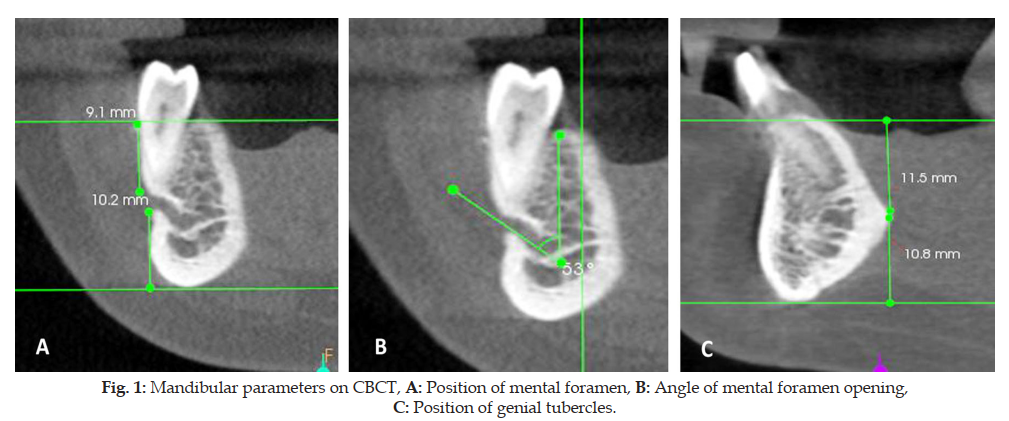
Introduction: Accurate sex identification from skeletal remains is critical in forensic anthropology and dentistry. This study explored sexual dimorphism in mandibular morphological parameters, focusing on the positions of the mental foramen and genial tubercles. Materials and Methods: Conducted at the Department of Oral Pathology, JMF ACPM Dental College, this study analyzed cone beam computed tomography (CBCT) records of 52 patients (26 males, 26 females) collected during 2020-2024. Ethical clearance was obtained, and informed consent was obtained. Measurements included the vertical position and angle of the mental foramen, and the position of the genial tubercles. Reliability was ensured through repeated measurements by two independent observers. Results: Significant differences were observed between males and females. Males had a greater distance from the lower margin to the center of the mental foramen (mean 7.84 ± 1.84 mm vs. 6.51 ± 1.21 mm, p = 0.003) and a larger angle of the mental foramen (mean 55.00° ± 12.50° vs. 46.00° ± 8.90°, p = 0.004). The position of the genial tubercles was more inferior in males, with a significant difference in the distance from the upper margin (mean 12.34 ± 3.45 mm vs. 10.81 ± 1.45 mm, p = 0.042). Discussion: The results demonstrated significant sexual dimorphism in mandibular parameters. Males exhibited larger and more robust mandibular features, likely influenced by hormonal and muscular differences. Conclusion: This study confirms that mandibular morphological characteristics exhibit significant sexual dimorphism, aiding forensic gender determination within the Indian population. Future studies should expand the sa mple size and include diverse populations for broader applicability.
References
- 1. Loth, S.R., & Henneberg, M. Mandibular ramus flexure: A new morphologic indicator of sexual dimorphism in the human skeleton. American Journal of Physical Anthropology. 1996;99(3):473-485.
- 2. Arthanari A, Senthilkumar A, Ramalingam K, Prathap L, Ravindran V. Exploring age and gender identification through mandibular parameters using orthopantomography: An
- 3. Chawla A, Balachandran R, Sharma S, Kumar V, Logani A. Morphological evaluation of mental foramen using cone-beam computed tomography: A retrospective observational study. Endodontology. 2023;35(4):331-337. doi:10.4103/endo.endo_236_22.
- 4. Chanda S, Manoj R, Santosh V, Shetty A, Waghmare M, Bhutani H. Mental foramen morphometrics on cone-beam computed tomography determines sexual dimorphism.
- 5. Ferreira Barbosa DA, Mesquita LR, Kurita LM, et al. Morphometric aspects and proposal of a new classification of genial tubercles in cone-beam computed tomography in a Brazilian population. J Oral Biol Craniofac Res. 2023;13(1):13-18. doi:10.1016/j.jobcr.2022.09.016.
- 6. Indira AP, Markande A, David MP. Mandibular ramus: An indicator for sex determination - A digital radiographic study. J Forensic Dent Sci. 2012;4(2):58-62. doi:10.4103/0975-1475.109885.
- 7. Franklin D, O’Higgins P, Oxnard CE. Sexual dimorphism in the mandible of indigenous South Africans: A geometric morphometric approach. South African J Sci. 2008;104:101-106.
- 8. Kristanto R, Astuti ER, Utomo DH, Amiatun Ruth MSM. CBCT-3D anthropometric measurement of mandibular bone to sex determination in Surabaya Indonesia: A pilot study. Indian J Forensic Med Toxicol. 2021;15(3):2591-2597. doi:10.37506/ijfmt.v15i3.15696.
- 9. Jain A, Sharma P, John S, Gupta S, Dewan R. Significance of evaluating mandibular parameters for the identification of an individual. International Journal of Research in Medical Sciences. 2024;12(2):498-502. doi: 10.18203/2320-6012.ijrms2024021.
- 10. Esfehani M, Ghasemi M, Katiraee A, et al. Forensic gender determination by using mandibular morphometric indices an Iranian population: A panoramic radiographic cross-sectional study. J Imaging. 2023;9(2). doi:10.3390/jimaging9020040
- 11. Akhlaghi M, Khalighi Z, Vasigh S, Yousefinejad V. Sex determination using mandibular anthropometric parameters in subadult Iranian samples. J Forensic Leg Med. 2014;22:150-153. doi:10.1016/j.jflm.2013.12.006
- 12. Tassoker M, Akin D, Aydin Kabakci AD, Sener S. Comparison of cone-beam computed tomography and panoramic radiography for mandibular morphometry. Folia Morphol
- 13. Aoun G, ElOuta A, Kafrouny N, Berberi A. Assessment of the mental foramen location in a sample of fully dentate Lebanese adults using cone-beam computed tomography technology. Acta Inform Med. 2017;25(4):259. doi:10.5455/aim.2017.25.259-262
- 14. Lim MY, Lim WW, Rajan S, Nambiar P, Ngeow WC. Age-related changes in the location of the mandibular and mental foramen in children with Mongoloid skeletal pattern. Eur Arch Paediatr Dent. 2015;16(5):397-407. doi:10.1007/ s40368-015-0184-x
- 15. Palinkas M, Nassar MSP, Cecílio FA, et al. Age and gender influence on maximal bite force and masticatory muscles thickness. Arch Oral Biol. 2010;55(10):797-802. doi:10.1016/j.archoralbio.2010.06.016
- 16. Champagne R, Vutukuri R, Kim CY, Tubbs RS, Iwanaga J. A comprehensive review of the mental spine. Anat Cell Biol. 2024;57(1):1-6. doi:10.5115/acb.23.220
- 17. Kolsuz ME, Orhan K, Bilecenoglu B, Sakul BU, Ozturk A. Evaluation of genial tubercle anatomy using cone beam computed tomography. J Oral Sci. 2015;57(2):151-156. doi:10.2334/josnusd.57.151
- 18. 18. KimHJ, LeeJH, KimHJ, KimSK,KimHW. Sexrelated differences in the dimensions and symmetry of the mental and genial spines of the mandible in Koreans. Anatomy & Cell Biology. 2015;48(2):139-144. doi:10.5115/acb.2015.48.2.139
Data Sharing Statement
There are no additional data available. All raw data and code are available upon request.
Funding
This research received no funding.
Author Contributions
All authors contributed significantly to the work and approve its publiation.
Ethics Declaration
This article does not involve any human or animal subjects, and therefore does not require ethics approval.
Acknowledgements
We would like to express our gratitude to the patients, their families, and all those who have contributed to this study.
Conflicts of Interest
No conflicts of interest in this work.
About this article

Cite this article
Manish Sharma, Arun S Dodamani, Seema Gupta Role of Mandibular Morphologic Parameter in Identification of Gender- A CBCT Study. Ind J Forensic Odontol 2024;17(1):21–26
Licence:
Attribution-Non-commercial 4.0 International (CC BY-NC 4.0)This license
enables reusers to distribute, remix, adapt, and build upon the material in any
medium or format for noncommercial purposes only, and only so long as
attribution is given to the creator.
| Received | Accepted | Published |
|---|---|---|
| March 22, 2024 | May 14, 2024 | June 25, 2024 |
DOI: https://doi.org/10.21088/ijfo.0974.505X.17124.4
Keywords
Mental foramen; Genial tubercle; Cone beam computed tomography; Gender; Forensic.Mental foramenGenial tubercleCone beam computed tomographyGenderForensicSearch for Similar Articles
Similar Articles
- Forensics in Orthodontics: A Narrative Review
- Forensic Identification Through CBCT Evaluation of Secondary Dentin, Root Canal...
- Reliability and Accuracy of Palatal Rugoscopy as a Tool for Gender Identificati...
- Training Indian Undergraduate Students in Dental Charting and Radiographic Comp...
- Use of Saliva Biomarkers and DNA Epigenetics in Forensic Identification: A Narr...
Article Level Metrics
Last UpdatedSaturday 17 October 2026, 10:43:30 (IST)
1937
Accesses
9
267
00
Citations
NA
NA
NA
Download citation
Article Keywords
Keyword Highlighting
Highlight selected keywords in the article text.
Timeline
| Received | March 22, 2024 |
| Accepted | May 14, 2024 |
| Published | June 25, 2024 |
licence
Attribution-Non-commercial 4.0 International (CC BY-NC 4.0)
This license
enables reusers to distribute, remix, adapt, and build upon the material in any
medium or format for noncommercial purposes only, and only so long as
attribution is given to the creator.