Full Text (PDF)
International Physiology 12(1):p 19-22, January-April 2024. | DOI: https://doi.org/10.21088/ip.2347.1506.12124.3
Case Report
Role of Low-level Laser Therapy in Pediatric Scald Burn
Ravi Kumar Chittoria, Dhira Shobith Munipati, Barath Kumar Singh P
Author Information
Licence:
Attribution-Non-commercial 4.0 International (CC BY-NC 4.0)This license enables reusers to distribute, remix, adapt, and build upon the material in any medium or format for noncommercial purposes only, and only so long as attribution is given to the creator.
International Physiology 12(1):p 19-22, January-April 2024. | DOI: https://doi.org/10.21088/ip.2347.1506.12124.3
How Cite This Article:
Dhira Shobith Munipati, Ravi Kumar Chittoria, Barath Kumar Singh P. Role of Low-lebal Laser Theraphy (LLLT) in Pediatric Scald Burn. Int.Phy.2024;12(1):19–22.Timeline
Received : January 12, 2024
Accepted : February 28, 2024
Published : April 27, 2024
Abstract
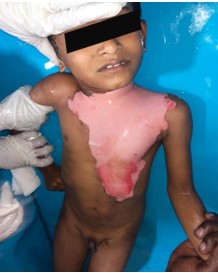
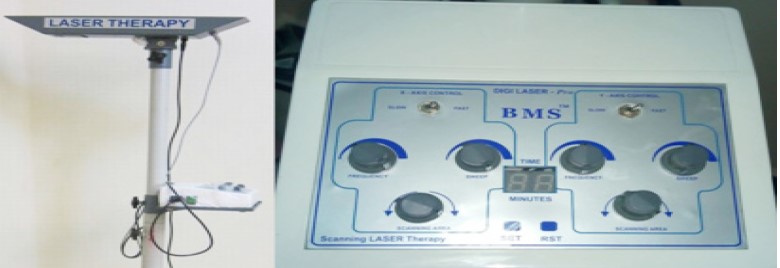
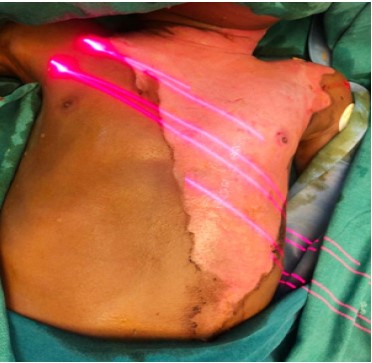
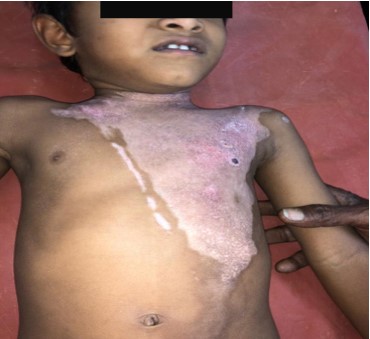
Burns and related injuries are common causes of deaths and disability. The highest incidences of burn cases occur in children and adults. In children less than 2 years of age, contact with hot surfaces and scald burns are the most common presentation to the hospital. The practice of cooking at ground level or sleeping with a burning lamp are some of the causes. Early management of this type of burns results in better outcomes. In this case we describe the role of low-level laser therapy (LLLT) as an adjuvant in the management of paediatric thermal burns.
References
- 1. Gupta JL, Makhija LK, Bajaj SP. National programme for prevention of burn injuries. Indian journal of plastic surgery. 2010 Sep;43(Suppl): S6.
- 2. Misra, et al. Facial burn scars-psychology and quality of life. Indian Journal of Burns. 2012 Dec; 20(1):57-61.
- 3. Sarabhai S, Tiwari VK, Goel A, Gupta LC. Wound Healing in Burns. In: Sarabhai S, editor. Principles and Practice of Burn Care. Delhi: Jaypee. 2010: 51-68.
- 4. Kwan P, Desmouliere A, Tredget EE. Molecular and Cellular basis of Hypertrophic Scarring. In: Herndon DN, editor. Total Burn Care. 5th ed. Edinburgh: Elsevier; 2018: 455-465.
- 5. McLaughlin, Branski LK, Norbury WB, Bache SE, et. al. Laser for Burn Scar Treatment. In: Herndon DN, editor. Total Burn Care. 5th ed. Edinburgh: Elsevier; 2018: 648-654.
- 6. Parrett BM, Donelan MB. Pulsed dye laser in burn scars: current concepts and future directions. Burns. 2010;36: 443-449.
- 7. Chittoria R.K., Kumar S.H. (2018) Low-Level Laser Therapy (LLLT) in Wound Healing. In. Recent Clinical Techniques, Results, and Research in Wounds. Springer; 2018, Cham.
- 8. Mester E, Hazay L, Fenyo M, Kertész I, Toth N, Jàrànyi Z et al. The biostimulating effect of laser beam. In: Waidelich W, editor. Optoelectronics in Medicine. Berlin: Springer; 1982: 146-152.
- 9. Posten W, Wrone DA, Dover JS, Arndt KA, Silapunt S, Alam M. Low-level laser therapy for wound healing: mechanism and efficacy.Dermatol Surg. 2005 Mar; 31 (3):334–40.
- 10. Farivar S, Malekshahabi T, Shiari R. Biological Effects of Low-Level Laser Therapy. J Lasers Med Sci. 2014 spring;5(2):58-62.
- 11. Andrade F, Rosana C, Manoel F. Effects of lowlevel laser therapy on wound healing. Rev. Col. Bras. Cir. 2014 Apr; 41(2):129-133.
- 12. Gaida K, Koller R, Isler C, Aytekin O, Awami MA, Meissl G, Frey M. Low Level Laser Therapy—a conservative approach to the burn scar? Burns. 2004 Jun; 30(4):362–367.
Data Sharing Statement
There are no additional data available. All raw data and code are available upon request.
Funding
This research received no funding.
Author Contributions
All authors contributed significantly to the work and approve its publication.
Ethics Declaration
This article does not involve any human or animal subjects, and therefore does not require ethics approval.
Acknowledgements
We would like to express our gratitude to the patients, their families, and all those who have contributed to this study.
Conflicts of Interest
No conflicts of interest in this work.
About this article

Cite this article
Dhira Shobith Munipati, Ravi Kumar Chittoria, Barath Kumar Singh P. Role of Low-lebal Laser Theraphy (LLLT) in Pediatric Scald Burn. Int.Phy.2024;12(1):19–22.
Licence:
Attribution-Non-commercial 4.0 International (CC BY-NC 4.0)This license enables reusers to distribute, remix, adapt, and build upon the material in any medium or format for noncommercial purposes only, and only so long as attribution is given to the creator.
| Received | Accepted | Published |
|---|---|---|
| January 12, 2024 | February 28, 2024 | April 27, 2024 |
DOI: https://doi.org/10.21088/ip.2347.1506.12124.3
Keywords
LLLT; Burn; Injuries; Graft; Scald burn.LLLTBurnInjuriesGraftScald burnSearch for Similar Articles
Similar Articles
- Mechanisms of Myocardial Damage and Structural Remodeling Caused by Doxorubicin-...
- Impact of Sleep Deprivation on Human Physiology: A Review
- The Effect of a Brief Heart Rate Variability Biofeedback Session on Salivary Cor...
- Impact of Vitamin D Supplementation in Enhancing Pulmonary Function in Adults wi...
- Mona Bedi - Editiorial
Article Level Metrics
Last UpdatedSunday 27 September 2026, 06:48:10 (IST)
1960
Accesses
23
194
00
Citations
NA
NA
NA
Download citation
Article Keywords
Keyword Highlighting
Highlight selected keywords in the article text.
Timeline
| Received | January 12, 2024 |
| Accepted | February 28, 2024 |
| Published | April 27, 2024 |
licence
Attribution-Non-commercial 4.0 International (CC BY-NC 4.0)
This license enables reusers to distribute, remix, adapt, and build upon the material in any medium or format for noncommercial purposes only, and only so long as attribution is given to the creator.