Full Text (PDF)
International Physiology 10(3):p 83-87, September-December 2022. | DOI: https://doi.org/10.21088/ip.2347.1506.10322.1
Original Article
Role of Hybrid Reconstructive Ladder in Amputated stump
Ravi Kumar Chittoria, Barath Kumar
Author Information
Licence:
Attribution-Non-commercial 4.0 International (CC BY-NC 4.0)This license enables reusers to distribute, remix, adapt, and build upon the material in any medium or format for noncommercial purposes only, and only so long as attribution is given to the creator.
International Physiology 10(3):p 83-87, September-December 2022. | DOI: https://doi.org/10.21088/ip.2347.1506.10322.1
How Cite This Article:
Barath Kumar, Ravi Kumar Chittoria/Role of Hybrid Reconstructive Ladder in Amputated stump/International Physiology.2022;10(3):83–87.Timeline
Received : August 16, 2022
Accepted : September 05, 2022
Published : December 30, 2022
Abstract
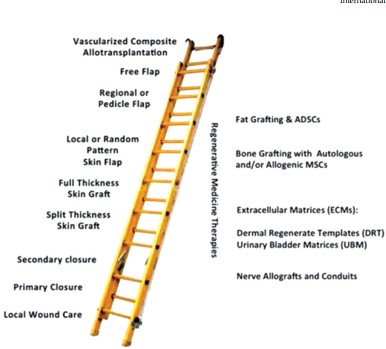
Amputations are caused by the trauma, diabetic foot infection, gas gangrene. Multidisciplinary team has effectively adapted advanced reconstructive techniques merged with regenerative medicine modalities to improve outcomes non healing amputated stumps. These treatments combine traditional reconstruction measures with regenerative medicine applications and has been termed ‘Hybrid reconstruction ladder’. This review article gives an overview about hybrid reconstruction ladder in management of non healing ulcer in the amputated stump.
References
- 1. Mathes SJ, Nahai F. Reconstructive Surgery: Principles, Anatomy & Technique. Vol. 2. New York: Churchill Livingstone; St. Louis: Quality Medical; 1997.
- 2. Gottlieb LJ, Krieger LM. From the reconstructive ladder to the reconstructive elevator. PlastReconstr Surg. 1994;93:1503– 1504.
- 3. Wong CJ, Niranjan N. Reconstructive stages as an alternative to the reconstructive ladder. PlastReconstr Surg. 2008;121: 362e–363e.
- 4. Erba P, Ogawa R, Vyas R, Orgill D. The reconstructive matrix: A new paradigm in reconstructive plastic surgery. PlastReconstr Surg. 2010;126:492–298
- 5. Mohapatra, Devi Prasad M.Ch.; Thiruvoth, FrijiMeethale M.Ch. Reconstruction 2.0: Restructuring the Reconstructive Ladder, Plastic and Reconstructive Surgery: March 2021–Volume 147–Issue 3–p 572e-573e.
- 6. Vedder NB. Wei FC, Mardini S, eds. Problem analysis in reconstructive surgery: Reconstructive ladders, elevators, and surgical judgment. In: Flaps and Reconstructive Surgery. 2017:2nd ed. Toronto: Elsevier; 1–5.
- 7. Turner NJ, Badylak SF. Biologic scaffolds for musculotendinous tissue repair. Eur. Cell Mater. 25, 130–143 (2013).
- 8. Tenenhaus M, Rennekampff HO. Surgical advances in burn and reconstructive plastic surgery: new and emerging technologies. Clin. Plast. Surg. 39(4), 435–
- 9. Saurabgupta et al. Effect of Low Level Laser Therapy (Lllt) On The Severity Of Post-Burn Immature Scars: A Randomized Control Study. International Journal of Clinical And Diagnostic Research Volume 8, Issue 1, Jan-Feb 2020.
- 10. Anitua E, Pino A, Orive G. Opening new horizons in regenerative dermatology using platelet-based autologous therapies. Int J Dermatol, 2017;56:247–251.
- 11. Maeda K, Sasaki Y. An experience of hen-egg membraneas a biological dressing. Burns 1981;8:313- 6.
- 12. Leach RM. Biochemistry of the organic matrix of theeggshell. Poult Sci 1982;61:2040-7.
- 13. Bateman SD. Topical haemoglobin spray for diabetic foot ulceration. Br J Nurs. 2015;24:S24–9.
Data Sharing Statement
There are no additional data available. All raw data and code are available upon request.
Funding
This research received no funding.
Author Contributions
All authors contributed significantly to the work and approve its publication.
Ethics Declaration
This article does not involve any human or animal subjects, and therefore does not require ethics approval.
Acknowledgements
We would like to express our gratitude to the patients, their families, and all those who have contributed to this study.
Conflicts of Interest
No conflicts of interest in this work.
About this article

Cite this article
Barath Kumar, Ravi Kumar Chittoria/Role of Hybrid Reconstructive Ladder in Amputated stump/International Physiology.2022;10(3):83–87.
Licence:
Attribution-Non-commercial 4.0 International (CC BY-NC 4.0)This license enables reusers to distribute, remix, adapt, and build upon the material in any medium or format for noncommercial purposes only, and only so long as attribution is given to the creator.
| Received | Accepted | Published |
|---|---|---|
| August 16, 2022 | September 05, 2022 | December 30, 2022 |
DOI: https://doi.org/10.21088/ip.2347.1506.10322.1
Keywords
Amputation stump; Hybrid reconstruction ladder.Amputation stumpHybrid reconstruction ladderSearch for Similar Articles
Similar Articles
- Mechanisms of Myocardial Damage and Structural Remodeling Caused by Doxorubicin-...
- Impact of Sleep Deprivation on Human Physiology: A Review
- The Effect of a Brief Heart Rate Variability Biofeedback Session on Salivary Cor...
- Impact of Vitamin D Supplementation in Enhancing Pulmonary Function in Adults wi...
- Mona Bedi - Editiorial
Article Level Metrics
Last UpdatedMonday 28 September 2026, 09:38:25 (IST)
1980
Accesses
18
194
00
Citations
NA
NA
NA
Download citation
Article Keywords
Keyword Highlighting
Highlight selected keywords in the article text.
Timeline
| Received | August 16, 2022 |
| Accepted | September 05, 2022 |
| Published | December 30, 2022 |
licence
Attribution-Non-commercial 4.0 International (CC BY-NC 4.0)
This license enables reusers to distribute, remix, adapt, and build upon the material in any medium or format for noncommercial purposes only, and only so long as attribution is given to the creator.