Full Text (PDF)
Indian Journal of Biology 11(1):p 31-41, January - June 2024. | DOI: https://doi.org/10.21088/ijb.2394.1391.11124.4
Original Article
Role of Different N/P Ratios of some Manures and Phosphate Fertilizer on Bacterial Enzyme and Algal Growth as Eutrophication Control Strategy
Susmita Lahiri, S. Dey, S. Paul, R. Majumder, S.K. Bag, A.K. Panigrah
Author Information
Licence:
Attribution-Non-commercial 4.0 International (CC BY-NC 4.0)This license enables reusers to distribute, remix, adapt, and build upon the material in any medium or format for noncommercial purposes only, and only so long as attribution is given to the creator.
Indian Journal of Biology 11(1):p 31-41, January - June 2024. | DOI: https://doi.org/10.21088/ijb.2394.1391.11124.4
How Cite This Article:
Lahiri S, Dey S, Paul S, et al. Role of Different N/P Ratios of some Manures and Phosphate Fertilizer on Bacterial Enzyme and Algal Growth as Eutrophication Control Strategy. Indian J Biol. 2024;11(1):31-41.Timeline
Received : May 02, 2024
Accepted : June 04, 2024
Published : June 09, 2024
Abstract
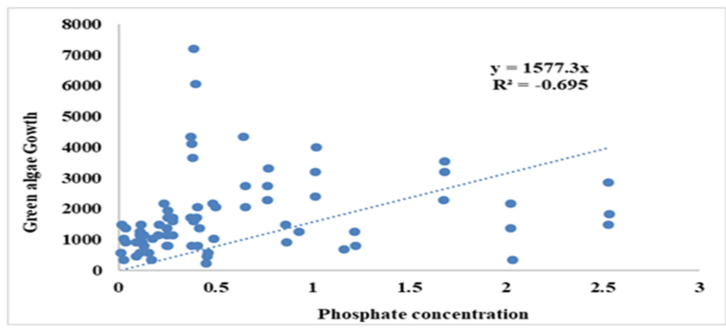
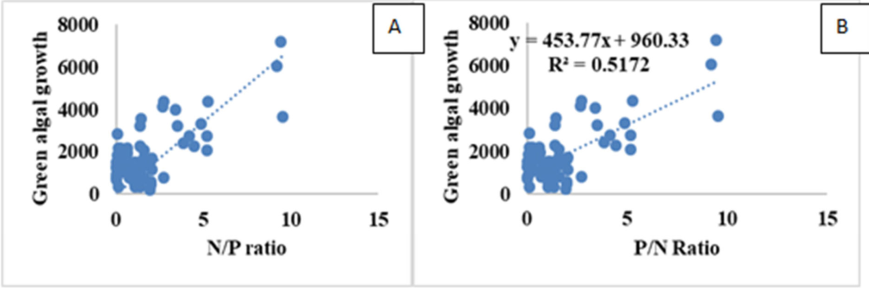
The growth responses of green algae and blue green algae were estimated in small simulated eutrophic systems receiving either high N/P ratios maintained with some commonly used manures like Badam Oil Cake (BOC), Mustard Oil Cake (MOC), mixture of BOC and MOC (MIX) or high P/N ratios created by Single Super Phosphate (SSP). Prior to the main experiment a pilot study was carried out with different manures and fertilizers with algal rich pond water to select the suitable N/P ratios of the manures for the main experiment. Based on the results of the primary productivity of the pilot studies, treatments with varying N/P ratios of 60:1(BOC), 50:1(MOC) and 40:1(MIX) were set up in the main experiment along with N/P ratios of 1:20 and 1:40 with SSP. In both the experiments, pond water rich in mixed algal population was added to each jar. The bacterial enzyme activity in the MOC treatment played an important role as a driving factor ensuring the role of microbial heterotrophic pathway in controlling harmful algal bloom. The role of N/P ratio in shifting the food chain from blue green algae to benign algal food chain, i.e. green algae is evident from a better positive correlation between the N/P ratio with green algal growth rather than the Microcystis sp. bloom. So, the effects of N/P ratios of Badam Oil Cake (60:1), Mustard Oil Cake (50:1) and Mix (Badam Oil Cake + Mustard Oil cake) showed favourable conditions for the growth of green algae thus controlling the major eutrophication syndrome.
References
- 1. APHA (American Public Health Association) (2021). Standard Methods for the Examination of Water and Wastewater. 23rd Edition, American Public Health Association/American Water Works Association/Water Environment Federation, Washington DC.
- 2. Cao X; Zhou Y; Wang Z and Song C (2016). The contribution of attached bacteria to Microcystis bloom: evidence from field investigation and microcosm experiment. Geomicrobiology Journal, 33(7): 1-11.
- 3. Carpenter SR; Caraco NF; Correll DL; Howrath RW Sharpley AN and Smith VH (1998). Nonpoint pollution of surface waters with phosphorus and nitrogen. Ecological Application, 8(3): 559-568.
- 4. Chislock MF; Doster E; Zitomer RA and Wilson AE (2013). Eutrophication: causes, consequences, and controls in aquatic ecosystems. Nature Education Knowledge, 4 (4): 1-8.
- 5. Ganf GG (1974). Rates of oxygen uptake by the planktonic community of a shallow, equatorial lake (Lake George, Uganda). Oecologia 15(1): 17-32.
- 6. Harper DW (1992). Eutrophication of freshwaters, Springer, Chapman & Hall.
- 7. Ho HI; Park CH; Yoo KE; Kim NY and Hwang SJ. (2024). Survival and development strategies of cyanobacteria through akinete formation and germination in the life cycle. Water, 16(5):1-22.
- 8. Hwang SJ (2020). Eutrophication ad Ecological health risk. International Research of Environmental Research and Public Health, 17(17):1-6.
- 9. Le C; Zha Y; Li Y; Sun D; Lu H and Yin B (2010). Eutrophication of lake waters in China: cost, causes, and control. Environmental Management, 45: 662-668.
- 10. Liu J; Chen Y; Li M; Liu B; Lui X; Wu Z; Cai Y; Xu J and Wang J (2019). Water -level fluctuations are key for phytoplankton taxonomic communities and functional groups in Poyang lake. Ecological Indicators, 104: 470-478.
- 11. Moal ML; Pannard A; Brient L; Richard B; Chorin; Mineaud E; Wiegand (2021). Is the cyanobacterial bloom composition shifting due to climate forcing or nutrient changes? Example of a shallow eutrophic reservoir. Toxins, 13(5): 1-20.
- 12. Piehler MF; Dyble J; Moisander PH; Chapman AD; Hendrickson J and Paerl HW (2009). Interactions between nitrogen dynamics and the phytoplankton community in Lake George, Florida, USA. Lake and Reservoir Management, 25(1): 1-14.
- 13. Pliński M and Jóźwiak T (1999). Temperature and N: P ratio as factors causing blooms of blue-green algae in the Gulf of Gdańsk. Oceanologia, 41 (1): 73-80.
- 14. Schindler DW (1974). Eutrophication and recovery in experimental lakes: implications for lake management. Science, 184(4139): 897-899.
- 15. Shi L; Huang Y; Zhang M; Yu Y; Lu Y and Kong F (2017). Bacterial community dynamics and functional variation during the long term decomposition of cyanobacterial bloom in-vitro. Science of the Total Environment, 598: 77-86.
- 16. Smith, VH. (1983). Low nitrogen to phosphorus ratios favor dominance by blue-green algae in lake phytoplankton. Science, 221(4611):669-671.
- 17. Verspagen JM; Snelder EO; Visser PM; Jöhnk KD; Ibelings BW; Mur LR and Huisman JEF (2005). Benthic–pelagic coupling in the population dynamics of the harmful cyanobacterium Microcystis. Freshwater Biology, 50(5):854-867.
- 18. Wang H; Qu G; Gan Y; Zhang Z and Wang, T (2022). Elimination of Microcystis aeruginosa in water via dielectric barrier discharge plasma: Efficacy, mechanism and toxin release. Journal of Hazardous Materials, 422: 1-10.
- 19. Wang S; Yang S; Zuo J; Hu C; Song L; Gan N and Chen, P (2021). Simultaneous removal of the freshwater bloom forming cyanobacterium Microcystis and cyanotoxin microcystins via combined use of algicidal bacterial filtrate and the Microcystin degrading enzymatic agent MlrA. Microorganism, 9(8):1-17.
- 20. Wood SA; Prentice MJ; Smith K and Hamilton, DP (2010). Low dissolved inorganic nitrogen and increased heterocyte frequency: precursors to Anabaena planktonica blooms in a temperate, eutrophic reservoir. Journal of Plankton Research, 32(9): 1315-1325.
- 21. Zhou Y; Wang J; Bai X and Li W (2022). Effect of algal blooms outbreak and decline on phosphorus migration in Lake Taihu, China. Environmental Pollution, 296: 118761.
Data Sharing Statement
There are no additional data available.
Funding
This research received no funding.
Author Contributions
All authors contributed significantly to the work and approve its publication.
Ethics Declaration
This article does not involve any human or animal subjects, and therefore does not require ethics approval.
Acknowledgements
The present study was carried out with a partial funding support of Department of Science and Technology, Govt. of West Bengal and Personal Research Grant of University of Kalyani.
Conflicts of Interest
The authors report no conflicts of interest in this work.
About this article

Cite this article
Lahiri S, Dey S, Paul S, et al. Role of Different N/P Ratios of some Manures and Phosphate Fertilizer on Bacterial Enzyme and Algal Growth as Eutrophication Control Strategy. Indian J Biol. 2024;11(1):31-41.
Licence:
Attribution-Non-commercial 4.0 International (CC BY-NC 4.0)This license enables reusers to distribute, remix, adapt, and build upon the material in any medium or format for noncommercial purposes only, and only so long as attribution is given to the creator.
| Received | Accepted | Published |
|---|---|---|
| May 02, 2024 | June 04, 2024 | June 09, 2024 |
DOI: https://doi.org/10.21088/ijb.2394.1391.11124.4
Keywords
EutrophicationN/P ratioGreen AlgaeBlue-green AlgaeOrganic ManuresFertilizerSearch for Similar Articles
Similar Articles
- Medicinal Mushrooms: Potent Fungi for Diverse Human Health Benefits
- Honey for Nutrition and Health Benefits - Traditional and Modern Uses in Human D...
- Foraging Behaviour of Indian Honey Bee, Apis Cerana Indica Fab, (Apidae: Hymenop...
- Role of Curcumin in Wound Healing
- Characterization of Blood cells and Comparative Analyses of Hematological Profil...
Article Level Metrics
Last UpdatedWednesday 30 September 2026, 08:30:14 (IST)
2436
Accesses
10
344
00
Citations
NA
NA
NA
Download citation
Article Keywords
Keyword Highlighting
Highlight selected keywords in the article text.
Timeline
| Received | May 02, 2024 |
| Accepted | June 04, 2024 |
| Published | June 09, 2024 |
licence
Attribution-Non-commercial 4.0 International (CC BY-NC 4.0)
This license enables reusers to distribute, remix, adapt, and build upon the material in any medium or format for noncommercial purposes only, and only so long as attribution is given to the creator.