Full Text (PDF)
Indian Journal of Medical and Health Sciences 9(2):p 41-44, July-December 2022. | DOI: https://doi.org/10.21088/ijmhs.2347.9981.9222.1
Original Article
Role of Cyclic Negative Pressure Wound Therapy in Thermal Burns
Ravi Kumar Chittoria, Barath Kumar Singh P
Author Information
Licence:
Attribution-Non-commercial 4.0 International (CC BY-NC 4.0)This license
enables reusers to distribute, remix, adapt, and build upon the material in any
medium or format for noncommercial purposes only, and only so long as
attribution is given to the creator.
Indian Journal of Medical and Health Sciences 9(2):p 41-44, July-December 2022. | DOI: https://doi.org/10.21088/ijmhs.2347.9981.9222.1
How Cite This Article:
Barath Kumar Singh P, Ravi Kumar Chittoria/Role of Cyclic Negative Pressure Wound Therapy in Thermal Burns / Indian Journal of Medical & Health Sciences. 2022;9(2):41–44.Timeline
Received : July 29, 2022
Accepted : August 30, 2022
Published : December 30, 2022
Abstract
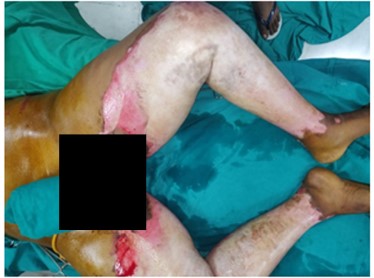
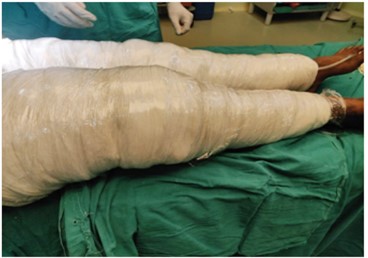
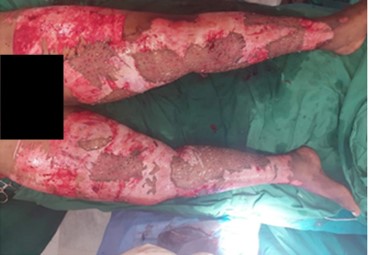
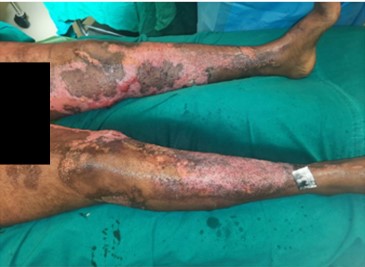
Thermal Burns are a major cause of morbidity. They cause both time and financial burden on the patient and caregiver. Over the years, there has been drastic improvement in modalities used in treatment of Thermal Burns. The recent treatment options include use of negative pressure wound therapy. We would like to share our experience in the management of Thermal burns with Cyclic NPWT. A common treatment for both acute and chronic wounds is negative pressure wound therapy. NPWT is recommended for a range of difficult wounds, and certain research support its usage in specific burn care procedures. Even though more study is required to fully understand the advantages for burns, NPWT has shown promise as a dressing that supports skin grafts, encourages the integration of bilaminate dermal substitutes, encourages the re-epithelialization of skin graft donor sites, and may even lessen the zone of stasis. Based on indication/application, this article analyses the literature on NPWT in burns and discusses our experience with modified NPWT for major burns.
References
- 1. Kamolz LP, Andel H, Haslik W, Winter W, Meissl G, Frey M. Use of subatmospheric pressure therapy to prevent burn wound progression in human: first experiences. Burns 2004;30:253–8.
- 2. Argenta LC, Morykwas MJ. Vacuum assisted closure: a new method for wound control and treatment: clinical experience. Ann PlastSurg 1997;38:563–76.
- 3. Morykwas MJ, Argenta LC, Shelton Brown EI, McGuirt W. Vacuum assisted closure: a new method for wound control and treatment: animal studies and basic foundation. Ann PlastSurg 1997;38:553–62.
- 4. Venturi ML, Attinger CE, Mesbahi AN, Hess CL, Graw KS. Mechanisms and clinical applications of the vacuum assisted closure (VAC) device: a review. Am J Clin Dermatol 2005;6:18.
- 5. Blackburn JH, Boemi L, Hall WW, Jeffords K, Hauck RM, Banducci DR, Graham WP. Negative pressure dressings as a bolster for skin grafts. Ann PlastSurg 1998;40:453–7.
- 6. Scherer LA, Shiver S, Chang M, Meredith JW, Owings JT. The vacuum assisted closure device: a method of securing skin grafts and improving graft survival. Arch Surg 2002;137:930–4.
Data Sharing Statement
There are no additional data available. All raw data and code are available upon request.
Funding
This research received no funding.
Author Contributions
All authors contributed significantly to the work and approve its publication.
Ethics Declaration
This article does not involve any human or animal subjects, and therefore does not require ethics approval.
Acknowledgements
We would like to express our gratitude to the patients, their families, and all those who have contributed to this study.
Conflicts of Interest
No conflicts of interest in this work.
About this article

Cite this article
Barath Kumar Singh P, Ravi Kumar Chittoria/Role of Cyclic Negative Pressure Wound Therapy in Thermal Burns / Indian Journal of Medical & Health Sciences. 2022;9(2):41–44.
Licence:
Attribution-Non-commercial 4.0 International (CC BY-NC 4.0)This license
enables reusers to distribute, remix, adapt, and build upon the material in any
medium or format for noncommercial purposes only, and only so long as
attribution is given to the creator.
| Received | Accepted | Published |
|---|---|---|
| July 29, 2022 | August 30, 2022 | December 30, 2022 |
DOI: https://doi.org/10.21088/ijmhs.2347.9981.9222.1
Keywords
Cyclic Negative Pressure Wound TherapyThermal BurnsWoundsSearch for Similar Articles
Similar Articles
- Wound Assessment using a Smartphone-based Application: Imitomeasure in Pressure...
- Emerging Pandemic and Silent Killer – Non Aloholic Fatty Liver Disease: A Compr...
- Prenatal and Postnatal Healthcare in Odisha
- Assessment of Diabetic Foot Ulcers: A Review
- IBS – Irritable Bowel Syndrome – Management through Comprehensive Non-Pharmacolo...
Article Level Metrics
Last UpdatedTuesday 08 September 2026, 01:53:41 (IST)
1394
Accesses
22
326
00
Citations
NA
NA
NA
Download citation
Article Keywords
Keyword Highlighting
Highlight selected keywords in the article text.
Timeline
| Received | July 29, 2022 |
| Accepted | August 30, 2022 |
| Published | December 30, 2022 |
licence
Attribution-Non-commercial 4.0 International (CC BY-NC 4.0)
This license
enables reusers to distribute, remix, adapt, and build upon the material in any
medium or format for noncommercial purposes only, and only so long as
attribution is given to the creator.