Full Text (PDF)
International Journal of Practical Nursing 12(1):p 25-32, January - April 2024. | DOI: https://doi.org/10.21088/ijpn.2347.7083.12124.4
Original Article
Resilience and Self Efficacy among Nurses Working in COVID & Non COVID Dedicated Hospitals in India: A Comparative Study
Author Information
Licence:
Attribution-Non-commercial 4.0 International (CC BY-NC 4.0)This license enables reusers to distribute, remix, adapt, and build upon the material in any medium or format for noncommercial purposes only, and only so long as attribution is given to the creator.
International Journal of Practical Nursing 12(1):p 25-32, January - April 2024. | DOI: https://doi.org/10.21088/ijpn.2347.7083.12124.4
How Cite This Article:
Anjali Sancha, Neha Nidhi. Resilience and Self Efficacy Among Nurses Working in COVID & Non COVID Dedicated Hospitals in India: A Comparative Study. Int J Practical Nurs. 2024; 12(1):25-32.Timeline
Received : March 21, 2024
Accepted : April 02, 2024
Published : April 30, 2024
Abstract
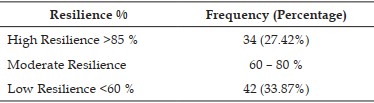
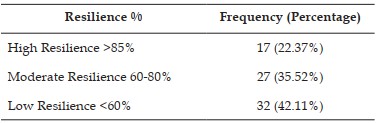
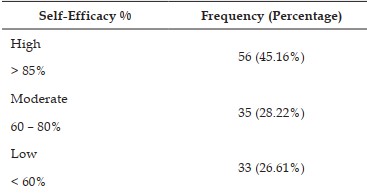
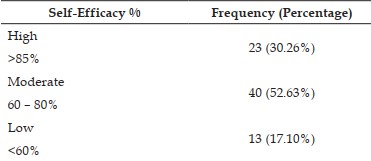
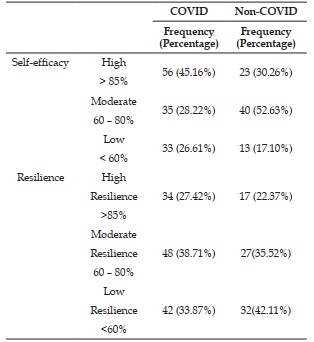
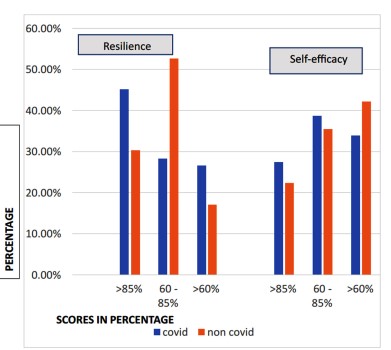
Introduction: Resilience and self-efficacy are important factors in predicting nurses' willingness to take care of patient with emerging infectious disease.15-16 Resilience is defined as the ability to face adverse situations while remaining focused and optimist for the future. This attribute is considered vital for clinical nurses who are continually confronted with competing priorities and a complex health care system. Self-efficacy reflects a sense of confidence in individual’s capacity to achieve tasks.7 It refers to the iraction, level of motivation and psychological state.8 The selfefficacy of nurses is correlated with mental health, resilience and job burnout.9-11 This pandemic has exerted a significant strain on the health care system worldwide. The workload, risks of infection, uncertainty, stigmatization and lack of resources and accessibility has jeopardized the psychological wellbeing of health care workers.17-19 Nurses experienced significant stress and psychological difficulties.20 Objectives: The aim is to assess and compare the resilience, & self-efficacy among nurses who worked in dedicated COVID hospital vs non-COVID hospitals. Design and Methods: It’s a comparative, Non-experimental research design study in which data was collected from 220 participate by convenience sampling technique from online survey via google form by using socio demographic variables and Resilience Scale and self-efficacy scale. The content validity revealed that tool was valid, and reliability was found within acceptable range. Data analysis was done by using descriptive and inferential statistics. Results: Resilience is high in nurses (27.42%) who have worked in COVID dedicated hospital than nurses (22.37%) who have worked in Non-COVID dedicated hospital; Self-efficacy is high in nurses (45.16%) who have worked in COVID dedicated hospitals than that of nurses (30.26%) who have worked in Non -COVID dedicated hospitals. Discussion: Result indicates the vitality of self-efficacy and resilience among nurses. During the outbreak of SARS-CoV-2, health-care workers with low self-efficacy experienced higher fear. Poor mental health outcomes among nurses warrants the need to implement practice psychological interventions to clear the collapse of the healthcare system in responding to the pandemic and in particular all possible efforts should be undertaken to mitigate the risk factor. Healthcare organizations should provide the support to the nurse with sufficient flexibility, and greater investment in the addressing the global shortage of nurses should be given priority in national health policy.
References
- 1. Cucinotta D, Vanelli M. WHO Declares COVID-19 a Pandemic. Acta Biomed. 2020 Mar 19;91(1):157-160. doi: 10.23750/abm.v91i1.9397. PMID: 32191675; PMCID: PMC7569573.
- 2. Xu X, Chen P, Wang J, et al. Evolution of the novel coronavirus from the ongoing Wuhan outbreak and modeling of its spike protein for risk of human transmission. Sci China Life Sci. 2020;63(3):457–460. doi: 10.1007/s11427-020-1637-5.
- 3. Jun, J. , Tucker, S. , & Melnyk, B. M. (2020). Clinician mental health and well beingduring global healthcare crises: Evidence learned from prior epidemics for COVID 19 Pandemic. Worldviews on Evidence Based Nursing, 17(3), 182–184. 10.1111/ wvn.12439.
- 4. Yörük, S., & Güler, D. (2020). The relationship between psychological resilience, burnout, stress, and sociodemographic factors with depression in nurses and midwivesduring the COVID 19 pandemic: A cross sectional study in Turkey. Perspectives in Psychiatric Care, 57(1), 390–398. 10.1111/ppc.12659
- 5. Maben J, Bridges J. COVID-19: Supporting nurses’ psychological and mental health. J Clin Nurs. 2020 Aug;29(15-16):2742-2750. doi: 10.1111/jocn.15307. Epub 2020 Jun 2. PMID: 32320509; PMCID: PMC7264545.
- 6. Sun, N., Wei, L., Shi, S., Jiao, D., Song, R. , Ma, L., Wang, H., Wang, C., Wang, Z., You, Y., Liu, S., & Wang, H. (2020). A qualitative study on the psychological experience of caregivers of COVID 19 patients. American Journal of Infection Control, 48(6), 592–598. 10.1016/j.ajic.2020.03.018
- 7. Wakim, N. (2014). Occupational stressors, stress perception levels, and coping stylesof medical surgical RNs: A generational perspective. The Journal of Nursing Administration, 44(12), 632–639. 10.1097/NNA.0000000000000140
- 8. Hart, P. L., Brannan, J. D., & De Chesnay, M. (2014). Resilience in nurses: An integrative review. Journal of Nursing Management, 22(6), 720–734
- 9. Huang, L., Wang, Y., Liu, J., Ye, P., Cheng, B., Xu, H. , … Ning, G. (2020). Factors associated with resilience among medical staff in radiology departments duringthe outbreak of 2019 novel coronavirus disease (COVID 19): A cross sectional study. Medical Science Monitor, 26, e925669– 925661. 10.12659/MSM.925669
- 10. Labrague, L. J., & De Los Santos, J. A. A. (2020). COVID 19 anxiety among front line nurses: Predictive role of organisational support, personal resilience and social support. Journal of Nursing Management, 28(7), 1653–1661. 10.1111/jonm.13121
- 11. Yörük, S., & Güler, D. (2020). The relationship between psychological resilience, burnout, stress, and sociodemographic factors with depression in nurses and midwivesduring the COVID 19 pandemic: A cross sectional study in Turkey. Perspectives in Psychiatric Care, 57(1), 390–398. 10.1111/ppc.
- 12. Bandura A. Self-efficacy: toward a unifying theory of behavioral change. Psychol Rev. 1977;84:191-215.
- 13. Hsieh YH, Wang HH, Ma SC. The mediating role of self-efficacy in the relationshipbetween workplace bullying, mental health and an intention to leave among nurses in Taiwan. Int J Occup Med Environ Health. 2019;32(2):245-254.
- 14. Yu F, Raphael D, Mackay L, Smith M, King A. Personal and work-related factors associated with nurse resilience: a systematic review. Int J Nurs Stud. 2019;93:129-140.
- 15. Consiglio C, Borgogni L, Vecchione M, Maslach C. Self-efficacy, perceptions of context, and burnout: a multilevel study on nurses. La Medicina del lavoro. 2014;105(4):255-268.
- 16. Schwarzer R, Mueller J, Greenglass E. Assessment of perceived general self- efficacy on the internet: data collection in cyberspace. Anxiety Stress Copin. 1999;12(2):145-161.
- 17. Wang CK, Hu ZF, Liu Y. The reliability and validity of general self-efficacy scale. Chinese J Appl Psychol. 2001;7(1):37-40.
- 18. Ho SMY, Kwong-Lo RSY, Mak CWY, Wong JS. Fear of severe acute respiratorysyndrome (SARS) among health care workers. J Consult Clin Psychol. 2005;73(2):344-349.
- 19. Lee J, Kang SK. Factors influencing nurses’ intention to care for patients with emerging infectious diseases: application of the theory of planned behavior. Nurs Health Sci. 2020;22:82-90.
- 20. Natan MB, Zilberstein S, Alaev D. Willingness of future nursing workforce to report for duty during an avian influenza pandemic. Res Theory Nurs Pract. 2015;29(4):266-275.
- 21. Feist, J., C. Feist, and P. Cipriano. 2020. Stigma Compounds the Consequences of Clinician Burnout During COVID-19: A Call to Action to Break the Culture of Silence. NAM Perspectives. Commentary, National Academy of Medicine, Washington, DC. https://doi.org/10.31478/202008b
- 22. Ren C, Zhou D, Fan Y, Li B, Zhang W, Shen Y, Yu S, Jiang L, Yu F, Duan Y, Peng D, Cheng X, Wu L, Wu C, Ye D. Prevalence and influencing factors of anxiety and depression symptoms among surgical nurses during COVID-19 pandemic: A large-scale cross-sectional study. Nurs Open. 2022 Jan;9(1):752- 764. doi: 10.1002/nop2.1127. Epub 2021 Nov 16. PMID: 34784442; PMCID: PMC8661822.
- 23. Xu H, Stjernswärd S, Glasdam S. Psychosocial experiences of frontline nurses working in hospitalbased settings during the COVID-19 pandemic - A qualitative systematic review. Int J Nurs Stud Adv. 2021 Nov;3:100037. doi: 10.1016/j.ijnsa.2021.100037. Epub 2021 Jul 17. PMID: 34308373; PMCID: PMC8285218.
- 24. Burstyn I, Holt K. A Cross-Sectional Survey of the Workplace Factors Contributing to Symptoms of Anxiety and Depression Among Nurses and Physicians During the FirstWave of COVID-19 Pandemic in Two US Healthcare Systems. Ann Work Expo Health. 2022 Mar 15;66(3):312-333. doi: 10.1093/annweh/wxab085. PMID: 34590682; PMCID: PMC8500032.
- 25. Nowicki GJ, Ślusarska B, Tucholska K, Naylor K, Chrzan-Rodak A, Niedorys B. The Severity of Traumatic Stress Associated with COVID-19 Pandemic, Perception ofSupport, Sense of Security, and Sense of Meaning in Life among Nurses: Research Protocol and Preliminary Results from Poland. Int J Environ Res Public Health. 2020 Sep 7;17(18):6491. doi: 10.3390/ijerph17186491. PMID: 32906590; PMCID: PMC7559728.
- 26. Sperling D. Ethical dilemmas, perceived risk, and motivation among nurses duringthe COVID-19 pandemic. Nurs Ethics. 2021 Feb;28(1):9-22. doi: 10.1177/0969733020956376. Epub 2020 Oct 1. PMID: 33000673; PMCID: PMC7533465.
- 27. Sperling D. Nurses’ challenges, concerns and unfair requirements during the COVID-19 outbreak. Nurs Ethics. 2021 Nov-Dec;28(7-8):1096-1110. doi: 10.1177/09697330211005175. Epub 2021 May 4. PMID: 33942658; PMCID: PMC8641031.
- 28. Cho KH, Kim B. The Psychological Responses of Nurses Caring for COVID-19 Patients: A Q Methodological Approach. Int J Environ Res Public Health. 2021 Mar 31;18(7):3605. doi: 10.3390/ijerph18073605. PMID: 33807138; PMCID: PMC8037924.
- 29. Ali SAA, Diab SSEM, Elmahallawy EK. Exploring the Psychological Stress, Anxiety Factors, and Coping Mechanisms of Critical Care Unit Nurses During the COVID-19 Outbreak in Saudi Arabia. Front Public Health. 2021 Nov 26;9:767517. doi: 10.3389/fpubh.2021.767517. PMID: 34900913; PMCID: PMC8661107.
- 30. Tamrakar P, Pant SB, Acharya SP. Anxiety and depression among nurses in COVID and NonCOVID intensive care units. Nurs Crit Care. 2021 Sep 28:10.1111/nicc.12685. doi: 10.1111/nicc.12685. Epub ahead of print. PMID:34580949; PMCID: PMC8662271.
- 31. Liu Y, Long Y, Cheng Y, Guo Q, Yang L, Lin Y, Cao Y, Ye L, Jiang Y, Li K, TianK, A X, Sun C, Zhang F, Song X, Liao G, Huang J, Du L. Psychological Impact of theCOVID-19 Outbreak on Nurses in China: A Nationwide Survey During the Outbreak. Front Psychiatry. 2020 Dec 11;11:598712. doi: 10.3389/ fpsyt.2020.598712. PMID: 33362609; PMCID: PMC7759517.
- 32. Nourollahi-Darabad M, Afshari D, Chinisaz N. Psychosocial Factors Associated With Resilience Among Iranian Nurses During COVID-19 Outbreak. Front Public Health. 2021 Aug 4;9:714971. doi: 10.3389/fpubh.2021.714971. Erratum in: FrontPublic Health. 2021 Sep 30;9:772559. PMID: 34422753; PMCID: PMC8373242.
- 33. Jose S, Dhandapani M, Cyriac MC. Burnout and Resilience among Frontline Nursesduring COVID-19 Pandemic: A Cross-sectional Study in the Emergency Department of a Tertiary Care Center, North India. Indian J Crit Care Med. 2020 Nov;24(11):1081-1088. doi: 10.5005/jpjournals-10071-23667. PMID: 33384515; PMCID: PMC7751034.
- 34. Jamebozorgi MH, Karamoozian A, Bardsiri TI, Sheikhbardsiri H. Nurses Burnout, Resilience, and Its Association With Socio-Demographic Factors During COVID-19 Pandemic. Front Psychiatry. 2022 Jan 14;12:803506. doi: 10.3389/fpsyt.2021.803506. PMID: 35095618; PMCID: PMC8795765.
- 35. Hou T, Yin Q, Xu Y, Gao J, Bin L, Li H, Cai W, Liu Y, Dong W, Deng G, Ni C. The Mediating Role of Perceived Social Support Between Resilience and Anxiety 1 Year After the COVID-19 Pandemic: Disparity Between High-Risk and Low-Risk Nurses in China. Front Psychiatry. 2021 May 24;12:666789. doi: 10.3389/fpsyt.2021.666789. PMID: 34108897; PMCID: PMC8180566.
- 36. Hoşgör H, Yaman M. Investigation of the relationship between psychological resilience and job performance in Turkish nurses during the COVID-19 pandemic in terms of descriptive characteristics. J Nurs Manag. 2022 Jan;30(1):44-52. doi: 10.1111/jonm.13477. Epub 2021 Nov 10. PMID: 34595787; PMCID: PMC8646929.
- 37. Doo EY, Kim M, Lee S, Lee SY, Lee KY. Influence of anxiety and resilience on depression among hospital nurses: A comparison of nurses working with confirmed andsuspected patients in the COVID-19 and Non-COVID-19 units. J Clin Nurs. 2021 Jul;30(13-14):1990-2000. doi: 10.1111/ jocn.15752. Epub 2021 Mar 23. PMID: 33756003; PMCID: PMC8251069
- 38. Alameddine M, Clinton M, Bou-Karroum K, Richa N, Doumit MAA. Factors Associated With the Resilience of Nurses During the COVID-19 Pandemic. Worldviews Evid Based Nurs. 2021 Dec;18(6):320-331. doi: 10.1111/wvn.12544.Epub 2021 Nov 5. PMID: 34738308; PMCID: PMC8661653.
- 39. Jo S, Kurt S, Bennett JA, Mayer K, Pituch KA, Simpson V, Skibiski J, Takagi E, Karaaslan MM, Ozluk B, Reifsnider E. Nurses’ resilience in the face of coronavirus (COVID-19): An international view. Nurs Health Sci. 2021 Sep;23(3):646-657. doi: 10.1111/nhs.12863. Epub 2021 Jul 20. PMID: 34169629; PMCID: PMC8447204.
- 40. Yang R, Ke Q, Chan SW, Liu Y, Lin H, Li W, Zhu J. A cross-sectional examinationof the relationship between nurses’ experiences of skin lesions and anxiety and depression during the COVID-19 pandemic: Exploring the mediating role of fear and resilience. J Nurs Manag. 2022 Apr 17:10.1111/ jonm.13638. doi: 10.1111/jonm.13638.Epub ahead of print. PMID: 35434883; PMCID: PMC9115287.
- 41. Labrague LJ, De Los Santos JAA. COVID-19 anxiety among front-line nurses: Predictive role of organisational support, personal resilience and social support. J NursManag. 2020 Oct;28(7):1653- 1661. doi: 10.1111/jonm.13121. Epub 2020 Aug 21. PMID: 32770780; PMCID: PMC7436313.
- 42. Jiang W, Yuan Y, Zhang L. Self-Efficacy and Research Capacity of Clinical Nursesin China. J Contin Educ Nurs. 2019 Nov 1;50(11):509-516. doi: 10.3928/00220124- 20191015-07. PMID: 31644812.
- 43. Shahrour G, Dardas LA. Acute stress disorder, coping self-efficacy and subsequent psychological distress among nurses amid COVID-19. J Nurs Manag. 2020 Oct;28(7):1686- 1695. doi: 10.1111/jonm.13124. Epub 2020 Aug 30. PMID: 32767827;PMCID: PMC7436502.
- 44. Simonetti V, Durante A, Ambrosca R, Arcadi P, Graziano G, Pucciarelli G, Simeone S, Vellone E, Alvaro R, Cicolini G. Anxiety, sleep disorders and self-efficacyamong nurses during COVID-19 pandemic: A large cross-sectional study. J Clin Nurs.2021 May;30(9- 10):1360-1371. doi: 10.1111/ jocn.15685. Epub 2021 Feb 15. PMID: 33534934; PMCID: PMC8012992.
- 45. Garcia AS, Carotta CL, Brown R, Da Rosa P, Pravecek B, Carson P. Parenting stress, selfefficacy and COVID-19 health risks as predictors of general stress among nurses. Int J Nurs Pract. 2021 Dec;27(6):e13009. doi: 10.1111/ijn.13009. Epub 2021 Aug 17. PMID: 34402555; PMCID: PMC8420594.
- 46. Kim JS, Kim J, Gelegjamts D. Knowledge, attitude and self-efficacy towards palliative care among nurses in Mongolia: A cross-sectional descriptive study. PLoS One. 2020 Jul 23;15(7):e0236390. doi: 10.1371/journal.pone.0236390. PMID: 32702007; PMCID: PMC7377
- 47. Soudagar S, Rambod M, Beheshtipour N. Factors associated with nurses’ self-efficacy in clinical setting in Iran, 2013. Iran J Nurs Midwifery Res. 2015 Mar-Apr;20(2):226-31. PMID: 25878701; PMCID: PMC4387648.
- 48. Mo Y, Deng L, Zhang L, Lang Q, Pang H, Liao C, Wang N, Tao P, Huang H. Anxiety of Nurses to support Wuhan in fighting against COVID-19 Epidemic and its Correlation With Work Stress and Self-efficacy. J Clin Nurs. 2021 Feb;30(3-4):397- 405. doi: 10.1111/jocn.15549. Epub 2020 Nov 22. PMID: 33141987.
- 49. Zheng, Z. H., Luo, Z. C., Zhang, Y., Chan, W., Li, J. Q., Pang, J., Jia, Y. L., & Tang, J. (2020). Hospice care self-efficacy among clinical medical staff working in thecoronavirus disease 2019 (COVID-19) isolation wards of designated hospitals: a cross-sectional study. BMC palliative care, 19(1), 188.
- 50. Abu Sharour L, Bani Salameh A, Suleiman K, Subih M, El-Hneiti M, Al-HusaamiM, Al . Dameery K, Al Omari O. Nurses’ Self-Efficacy, Confidence and Interaction With Patients With COVID-19: A Cross-Sectional Study. Disaster Med Public Health Prep. 2021 Jan 7:1-5. doi: 10.1017/dmp.2021.1. Epub ahead of print. Erratum in: Disaster Med Public Health Prep. 2021 Aug 18;:1. PMID: 33407968; PMCID: PMC8007953.
- 51. Molero Jurado MDM, Pérez-Fuentes MDC, Oropesa Ruiz NF, Simón Márquez MDM, Gázquez Linares JJ. Self-Efficacy and Emotional Intelligence as Predictors of Perceived Stress in Nursing Professionals. Medicina (Kaunas). 2019 Jun 1;55(6):237. doi: 10.3390/medicina55060237. PMID: 31159453; PMCID: PMC6630601W
Data Sharing Statement
There are no additional data available. All raw data and code are available upon request.
Funding
This research received no funding.
Author Contributions
All authors contributed significantly to the work and approve its publication.
Ethics Declaration
This article does not involve any human or animal subjects, and therefore does not require ethics approval.
Acknowledgements
We would like to express our gratitude to the patients, their families, and all those who have contributed to this study.
Conflicts of Interest
No conflicts of interest in this work.
About this article

Cite this article
Anjali Sancha, Neha Nidhi. Resilience and Self Efficacy Among Nurses Working in COVID & Non COVID Dedicated Hospitals in India: A Comparative Study. Int J Practical Nurs. 2024; 12(1):25-32.
Licence:
Attribution-Non-commercial 4.0 International (CC BY-NC 4.0)This license enables reusers to distribute, remix, adapt, and build upon the material in any medium or format for noncommercial purposes only, and only so long as attribution is given to the creator.
| Received | Accepted | Published |
|---|---|---|
| March 21, 2024 | April 02, 2024 | April 30, 2024 |
DOI: https://doi.org/10.21088/ijpn.2347.7083.12124.4
Keywords
ResilienceSelf-EfficiencyCOVID Vs Non-COVIDNursesInfection PreventionHealthcareSearch for Similar Articles
Similar Articles
- From Artificial Limbs to Intelligent Limbs: Advances in Sensory-Enabled Prosthet...
- Pilot Study to Evaluate the Effectiveness of Novel Designed Nebulizer (NDN) on P...
- Periodic Review of Benchmarks Contributing to Reduction of Healthcare Associated...
- Forensic Nursing
- Women Empowerment in Rural Community
Article Level Metrics
Last UpdatedTuesday 22 September 2026, 12:33:36 (IST)
1405
Accesses
4
195
00
Citations
NA
NA
NA
Download citation
Article Keywords
Keyword Highlighting
Highlight selected keywords in the article text.
Timeline
| Received | March 21, 2024 |
| Accepted | April 02, 2024 |
| Published | April 30, 2024 |
licence
Attribution-Non-commercial 4.0 International (CC BY-NC 4.0)
This license enables reusers to distribute, remix, adapt, and build upon the material in any medium or format for noncommercial purposes only, and only so long as attribution is given to the creator.