Full Text (PDF)
RFP Indian Journal of Medical Psychiatry 8(1):p 27-33, Jan-June 2025. | DOI: https://doi.org/10.21088/ijmp.2395.311X.11225.3
Original Article
Relationship Between Mmitral Valve Prolapse and Panic Disorder
Suprakash Chaudhury, Charanjit Singh
Author Information
Licence:
Attribution-Non-commercial 4.0 International (CC BY-NC 4.0)This license
enables reusers to distribute, remix, adapt, and build upon the material in any
medium or format for noncommercial purposes only, and only so long as
attribution is given to the creator.
RFP Indian Journal of Medical Psychiatry 8(1):p 27-33, Jan-June 2025. | DOI: https://doi.org/10.21088/ijmp.2395.311X.11225.3
How Cite This Article:
Suprakash Chaudhury, Charanjit Singh. Relationship between mitral valve prolapse and Panic Disorder. RFP Ind Jr of Med Psy. 2025; 8(1): 27-33.Timeline
Received : January 20, 2025
Accepted : March 06, 2025
Published : June 20, 2025
Abstract
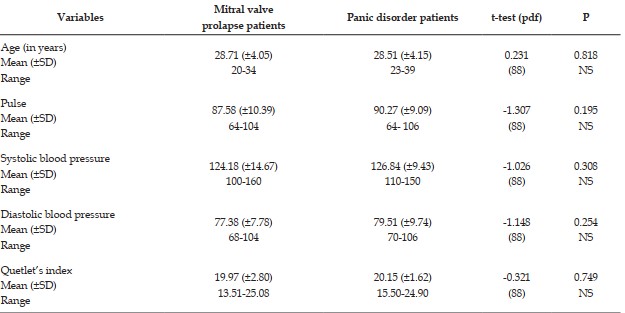
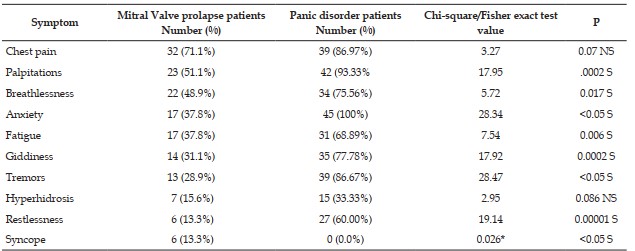
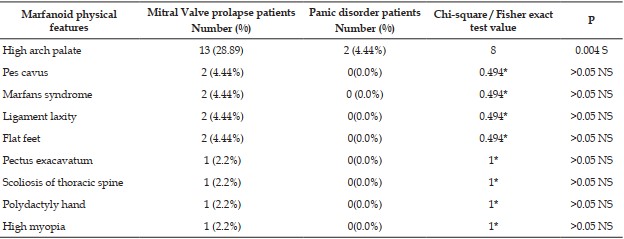
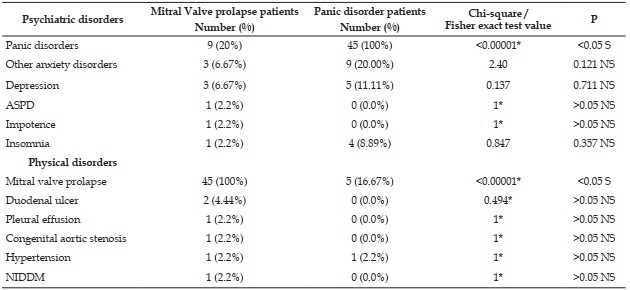
Aim: The present study assessed the relationship between mitral valve prolapse and panic disorder. Methods: This prospective study included 45 patients with echocardiographic diagnosis of mitral valve prolapse (MVP) and an equal number of age and sexmatched patients with panic disorder. All subjects underwent evaluation by a cardiologist with echocardiography and psychiatric evaluation by a psychiatrist. Results: Nine (20%) of the MVP patients had PD. Among the PD patients, 5 (16.67%) had asymptomatic MVP. These were significantly higher than in the general population. Abnormal body habitus occurred in 45.8% of patients. The association between thin body habitus and MVP was supported. Prolapse of AML only was associated with less severe symptoms. Conclusion: The high prevalence of panic disorder in MVP patients and of MVP in panic disorder patients is consistent with earlier studies. Panic disorder associated with MVP is no different from uncomplicated panic disorder and responds as well to antidepressants.
References
- 1. Tural U, Iosifescu DV. The Prevalence of Mitral Valve Prolapse in Panic Disorder: A MetaAnalysis. Psychosomatics,2019; 60 (4):393-401.
- 2. Freed LA, Levy D, Levine RA, et al. Prevalence and clinical outcome of mitral-valve prolapse. N Engl J Med 1999; 341:1–7.
- 3. Filho AS, Maciel BC, Martín-Santos R, Romano MM, Crippa JA: Does the association between mitral valve prolapse and panic disorder really exist? Primary Care Companion J Clin Psychiatry 2008; 10:38–47.
- 4. Tamam L, Ozpoyraz N, San M, Bozkurt A: Association between idiopathic mitral valve prolapse and panic disorder. Croat Med J 2000; 41:410–416.
- 5. Filho AS, Maciel BC, Romano MM, et al.: Mitral valve prolapse and anxiety disorders. Br J Psychiatry 2011; 199: 247–248.
- 6. Lung FW, Cheng CT, Chang WT, Shu BC. Anxiety and mood disorder in young males with mitral valve prolapse. J Multidiscip Healthc. 2008 Oct 1;1:89-92. doi: 10.2147/jmdh.
- 7. WHO. The ICD-10 Classification of Mental and Behavioural Disorders: Diagnostic Criteria for Research. Geneva: World Health Organization; 1993.
- 8. Libby, P., Bonow, R.O., Mann, D.L., Zipes, D.P. (2008). Braunwald’s Heart Disease: A Textbook of Cardiovascular Medicine, 8th ed. Philadelphia: Saunders Elsevier.
- 9. Avierinos JF, Gersh BJ, Melton LJ, et al. Natural history of asymptomatic mitral valve prolapse in the community. Circulation 2002; 106:1355.
- 10. Boudoulas H, Wooley CF: Floppy mitral valve/Mitral valve prolapse: Sudden death. In: Boudoulas H, Wooley CF, ed. Mitral Valve: Floppy Mitral Valve, Mitral Valve Prolapse,
- 11. Chaudhary, R., Srivastava, S.S., Goel, V.K., Mitra, A., Agrawal, R. (1993). A clinical, electrocardiographic, and echocardiographic study of MVP. JAPI 41, 829.
- 12. Shah PM. Mitral valve prolapse. In: Parmley WW, Chatterjee K, eds – Cardiology. New York: Lippincott Raven 1997.
- 13. Slovut DP, Lurie KG. A potential mechanism for mitral valve prolapse syndrome. J Cardiovasc Electrophysiol 1998; 9: 100-2.
- 14. Inaoka M, Kurimoto Y. (1997). Mitral valvuloplasty for the repair of mitral valve prolapsed due to tendon rupture of the posterior leaflet in a father and son: case reports. Nippon Kyobu Geka Gakkai Zasshi, 45, 905-8.
- 15. França, H.H. (2000). An interpretation - Mitral Valve Prolapse Syndrome. Archives Brazil Cardiology 74; 456-458.
- 16. Kumar, U.K. & Sahasranam,K.V. (1991). Mitral valve prolapse syndrome and associated thoracic skeletal abnormalities. JAPI, 39, 536-539.
- 17. Garcia, C. J., Asso, E., Alda, M, Andres, EM., Sobradiel, N.( 2010). Association between joint hypermobility syndrome and panic disorder: a case-control study. Psychosomatics, 51, 55-61.
- 18. Zwanzger, P., Baghai, T., Schule, C., Rupprecht, R. (2000). Treatment of mitral valve prolapse and panic disorder with metoprolol. World J Biol Psychiatry. 1, 124-5.
- 19. Bachmann S, Muller-Werdan U, Huber M, Kasel M, Werdan K, Schmidt H: Positive impact of the b-blocker celiprolol on panic, anxiety, and cardiovascular parameters in
- 20. Narayanan K, Uy-Evanado A, Teodorescu C, et al. Mitral valve prolapse and sudden cardiac arrest in the community. Heart Rhythm 2016; 13:498–503 40. Spartalis M, Tzatzaki E, Spartalis E, et al.: Mitral valve prolapse: an underestimated cause of sudden cardiac death - a current review of the literature. J Thorac Dis 2017; 9:5390–5398.
Data Sharing Statement
There are no additional data available. All raw data and code are available upon request.
Funding
This research received no funding.
Author Contributions
All authors contributed significantly to the work and approve its publication.
Ethics Declaration
This article does not involve any human or animal subjects, and therefore does not require ethics approval.
Acknowledgements
We would like to express our gratitude to the patients, their families, and all those who have contributed to this study.
Conflicts of Interest
No conflicts of interest in this work.
About this article

Cite this article
Suprakash Chaudhury, Charanjit Singh. Relationship between mitral valve prolapse and Panic Disorder. RFP Ind Jr of Med Psy. 2025; 8(1): 27-33.
Licence:
Attribution-Non-commercial 4.0 International (CC BY-NC 4.0)This license
enables reusers to distribute, remix, adapt, and build upon the material in any
medium or format for noncommercial purposes only, and only so long as
attribution is given to the creator.
| Received | Accepted | Published |
|---|---|---|
| January 20, 2025 | March 06, 2025 | June 20, 2025 |
DOI: https://doi.org/10.21088/ijmp.2395.311X.11225.3
Keywords
Comorbidity in cardiac disordersAnxietyDepressionEchocardiographyPrevalencePsychopathologySearch for Similar Articles
Similar Articles
- Late-Onset Mania in a 73-Year-Old Male: A Case Report
- Internet Derived Information Obstruction Treatment (IDIOT) Syndrome and its Impa...
- Multivariable Regression Analysis of Depression, Anxiety and Stress in Male Alco...
- A Study to Evaluate the Effectiveness of Supportive Psychotherapy among the Elde...
- A Cross Sectional Study of Nursing Students Attitudes Towards People Living with...
Article Level Metrics
Last UpdatedTuesday 08 September 2026, 14:36:51 (IST)
903
Accesses
12
155
00
Citations
NA
NA
NA
Download citation
Article Keywords
Keyword Highlighting
Highlight selected keywords in the article text.
Timeline
| Received | January 20, 2025 |
| Accepted | March 06, 2025 |
| Published | June 20, 2025 |
licence
Attribution-Non-commercial 4.0 International (CC BY-NC 4.0)
This license
enables reusers to distribute, remix, adapt, and build upon the material in any
medium or format for noncommercial purposes only, and only so long as
attribution is given to the creator.