Full Text (PDF)
International Journal of Neurology and Neurosurgery 17(1):p 11-16, Jan -April 2025. | DOI: 10.21088/ijnns.0975.0223.17125.2
Original Article
Proportion and Pattern of Selective Micronutrient and Macronutrient Deficiency in Traumatic Brain Injury Patients admitted in Neurosurgery ICU
Ina Bahl, Surendra Saini, Deepika Gehlot
Author Information
Licence:
Attribution-Non-commercial 4.0 International (CC BY-NC 4.0)This license enables reusers to distribute, remix, adapt, and build upon the material in any medium or format for noncommercial purposes only, and only so long as attribution is given to the creator.
International Journal of Neurology and Neurosurgery 17(1):p 11-16, Jan -April 2025. | DOI: 10.21088/ijnns.0975.0223.17125.2
How Cite This Article:
Surendra Saini, Ina Bahl, Deepika Gehlot. Proportion and Pattern of Selective Micronutrient and Macronutrient Deficiency in Traumatic Brain Injury Patients admitted in Neurosurgery ICU. International Journal of Neurology and Neurosurgery. 2025; 17(1): 11-16.
Timeline
Received : February 18, 2025
Accepted : March 29, 2025
Published : April 30, 2025
Abstract
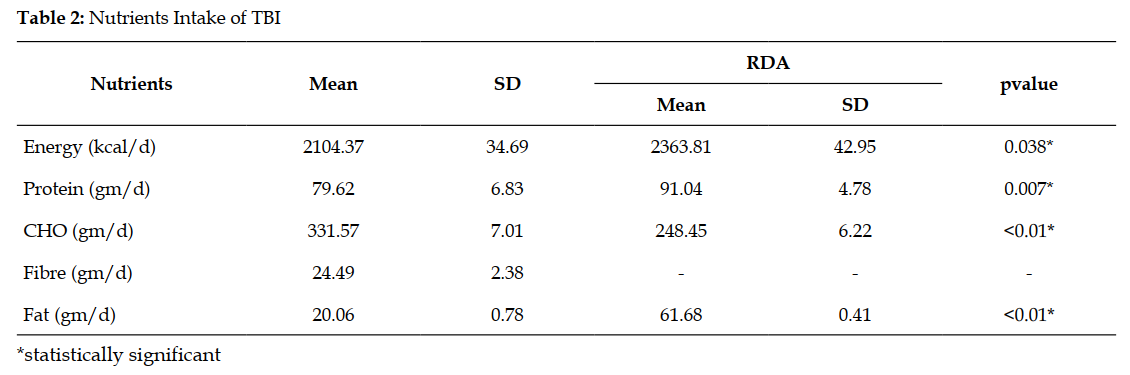
Background: Traumatic brain injury (TBI) often leads to changes in body composition, including the loss of lean body mass, which increases the risk of adverse clinical outcomes such as infections, prolonged ICU stays, and higher mortality rates. These complications may be exacerbated if there is a deficiency of crucial micronutrients and macronutrients. Methods: This prospective observational study was performed in the Department of Neurosurgery, SMS Medical College, Jaipur, between July 2021 and March 2022. We recruited 200 TBI patients aged 15 to 80 years who had a post-resuscitation Glasgow Coma Scale (GCS) score of 3–8 (severe TBI). The “Malnutrition Universal Screening Tool” (MUST) was used to categorize nutritional status, while serum levels of electrolytes (sodium, potassium, calcium, phosphate, and vitamin B12) were measured. Data were collected at admission and at various intervals (24 hours, weekly) based on the study protocol. Statistical analysis was performed using SPSS 22.00. Results: Among the 200 participants, 68.5% were male. Age distribution showed that 62% were 31–45 years old, with a predominant etiology of road traffic accidents (69.5%). TBI severity categorization yielded mild in 26%, moderate in 30.5%, and severe in 43.5% of cases. Daily energy, protein, carbohydrate, and fat intake were significantly lower than recommended dietary allowances (p < 0.05). Macronutrient inadequacy for energy, protein, carbohydrates, and fiber was reported in 93.5%, 69%, 4.5%, and 71.5% of patients, respectively. Sodium levels were significantly associated with TBI severity, and mean calcium levels were lower in severe TBI cases, whereas potassium and phosphate showed no significant correlation with severity (p > 0.05). Conclusion: Identifying and correcting malnutrition (including both macroand micronutrient deficiencies) upon admission may reduce complications in TBI. Appropriate nutritional interventions, coupled with close monitoring of electrolytes, have the potential to improve outcomes in this population.
References
- 1. Barker LA, Gout BS, Crowe TC. Hospital malnutrition: prevalence, identification and impact on patients and the healthcare system. Int J Environ Res Publ Health. 2011;8:514-527.
- 2. Cook AM, Peppard A, Magnuson B. Nutrition considerations in traumatic braininjury.
- 3. Costello L-AS, Lithander FE, Gruen RL, et al. Nutrition therapy in the optimization of health outcomes in adult patients with moderate to severe traumaticbrain injury: findings from a scoping review. Injury. 2014;45:1834-1841.
- 4. Daradkeh G. Nutritional Status and M Unit in the State of Qatar. International Journal of Current Research. 2016:8(12): 42963-68.
- 5. Denes Z. The influence of severe malnutrition on rehabilitation in patients with severe head injury. DisabilRehabil. 2004:26: 1163-1165.
- 6. Dhandapani SS, Manju D, Sharma BS, Mahapatra AK. Clinical malnutrition in severe traumatic brain injury: factors associated and outcome at 6 months. Indian Journal of
- 7. Diaz- Parejo P, Stahl N, Xu W, et al. Cerebral energy metabolism during transienthyperglycemia in patients with severe brain trauma. Intensive Care Med. 2003;29:544- 550.
- 8. Henderson S, Moore N, Lee E, Witham MD. Do the malnutrition universal screening tool (MUST) and Birmingham nutrition risk (BNR) score predict mortality inolder hospitalized patients? BMC Geriatr.2008: 10:26.
- 9. Kang MC, Kim JH, Ryu SW, et al. Prevalence of malnutrition in hospitalizedpatients: a multicenter cross-sectional study. J Kor Med Sci. 2018;33:e10.;
- 10. Kondrup J, Allison SP, Elia M, Vellas B, Plauth M. ESPENguidelines for nutrition screening
- 11. Krakau K, Hansson A, Karlsson T, de Boussard CN, Tengvar C, Borg J. Nutritional treatment of patients with severe traumatic brain injury during the first six months afterinjury.
- 12. Kurtz P, Rocha EEM. Nutrition Therapy, Glucose Control, and Brain Metabolism in Traumatic Brain Injury: A Multimodal Monitoring Approach. Front. Neurosci. 2020;14:190.;
- 13. Lenz A, Franklin GA, Cheadle WG. Systemic inammation after trauma. Injury. 2007:38:1336- 1345.;
- 14. Masha’al D. The Change in Nutritional Status in Traumatic Brain Injury Patients: A Retrospective Descriptive Study. 2016.;
- 15. Mayer AR, Quinn DK, Master CL. The spectrum of mild traumatic brain injury: a review. Neurology. 2017;89:623-632;
- 16. Morley JE. Nutrition and the brain. ClinGeriatr Med. 2010;26:89–98.; Neurotrauma. 2007; 4(01):35-9.; NutrClinPract. 2008:23:608-620.;
- 17. Sabour H, Javidan AN, Vafa MR, Shidfar F, Nazari M, Saberi H, et al. Calorie and macronutrients intake in people with spinal cord injuries: an analysis by sex and injury related variables. Nutrition. 2012:28(2):143-7.;
- 18. Stratton RJ, Green CJ, Elia M. Disease-Related Malnutrition: an Evidence Based Approach to Treatment, 1st edn. 2003, Nutriticia Healthcare S.A, CABI Publishing, CAB International, Wallingford UK, 113–56.;
- 19. Tomey KM, Chen DM, Wang X, Braunschweig CL. Dietary intake and nutritional status of urban community–dwelling men with paraplegia. Arch Phys Med Rehabil., 2005:86:664–71.
Data Sharing Statement
There are no additional data available. All raw data and code are available upon request.
Funding
This research received no funding.
Author Contributions
All authors contributed significantly to the work and approve its publication.
Ethics Declaration
This article does not involve any human or animal subjects, and therefore does not require ethics approval.
Acknowledgements
We would like to express our gratitude to the patients, their families, and all those who have contributed to this study.
Conflicts of Interest
No conflicts of interest.
About this article

Cite this article
Surendra Saini, Ina Bahl, Deepika Gehlot. Proportion and Pattern of Selective Micronutrient and Macronutrient Deficiency in Traumatic Brain Injury Patients admitted in Neurosurgery ICU. International Journal of Neurology and Neurosurgery. 2025; 17(1): 11-16.
Licence:
Attribution-Non-commercial 4.0 International (CC BY-NC 4.0)This license enables reusers to distribute, remix, adapt, and build upon the material in any medium or format for noncommercial purposes only, and only so long as attribution is given to the creator.
| Received | Accepted | Published |
|---|---|---|
| February 18, 2025 | March 29, 2025 | April 30, 2025 |
DOI: 10.21088/ijnns.0975.0223.17125.2
Keywords
Traumatic brain injury • Micronutrient • Macronutrient • ICU • Malnutrition • Glasgow coma scaleSearch for Similar Articles
Similar Articles
- Intramedullary Capillary Hemangioma of Conus Medullaris: Case Report and Review...
- Atypical Miller Fisher Syndrome
- Therapeutic Potential of Passiflora incarnata in the Management of Neurological...
- Central or Axial Atlantoaxial Dislocation: Redefining Instability at the Craniov...
- Assessment of Neurocognitive Functions in Post-Acute Stroke Patients Undergoing...
Article Level Metrics
Last UpdatedTuesday 29 September 2026, 08:42:59 (IST)
2210
Accesses
21
272
00
Citations
NA
NA
NA
Download citation
Article Keywords
Keyword Highlighting
Highlight selected keywords in the article text.
Timeline
| Received | February 18, 2025 |
| Accepted | March 29, 2025 |
| Published | April 30, 2025 |
licence
Attribution-Non-commercial 4.0 International (CC BY-NC 4.0)
This license enables reusers to distribute, remix, adapt, and build upon the material in any medium or format for noncommercial purposes only, and only so long as attribution is given to the creator.