Full Text (PDF)
RFP Indian Journal of Medical Psychiatry 7(2):p 79-82, July - Dec 2024. | DOI: n.a
Case Report
Pathological Laughter as a Manifestation of Left Frontal and Right Pons Stroke
Hemendra Singh, Asmita Mukund Toro, Lahari R.
Author Information
Licence:
Attribution-Non-commercial 4.0 International (CC BY-NC 4.0)This license enables reusers to distribute, remix, adapt, and build upon the material in any medium or format for noncommercial purposes only, and only so long as attribution is given to the creator
RFP Indian Journal of Medical Psychiatry 7(2):p 79-82, July - Dec 2024. | DOI: n.a
How Cite This Article:
Asmita Mukund Toro, Hemendra Singh, Lahari R, Pathological Laughter as a Manifestation of Left Frontal and Right Pons Stroke. RFP Ind Jr of Med Psy. 2024;7(2):79–82.Timeline
Received : October 04, 2024
Accepted : November 15, 2024
Published : December 30, 2024
Abstract
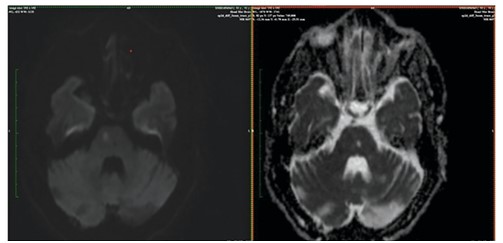
Background: Pathological laughter is a disorder of emotional expression characterized by bouts of uncontrollable laughter with no motivating factor. It is seen in various neurological disorders such as Post Traumatic Brain injury, Post stroke, Multiple sclerosis, Amyotrophic lateral sclerosis, etc. Case Summary: Here, we present a case of a 46 year old male who presented with pathological laughter to the psychiatry outpatient department following acute infarct in the left frontal and right pons area of the brain. Discussion: Our patient had developed pathological laughter subsequently after right pons and left frontal infarct as pseudobulbar affect. Our case report is unique as both the voluntary and involuntary pathways mediating laughter are involved. Conclusion: Hence, our case may be indicative of possible role of combination of antipsychotics and antidepressants, which warrants further research.
References
- 1. Parvizi J., Anderson S.W., Martin C.O., Damasio H., Damasio A.R. Pathological laughter and crying: a link to the cerebellum. Brain. 2001 Sep; 124 (Pt 9):1708-19. doi: 10.1093/brain/124.9.1708. PMID: 11522574
- 2. Starkstein S.E., Migliorelli R., Tesón A., Petracca G., Chemerinsky E., Manes F., Leiguarda R. Prevalence and clinical correlates of pathological affective display in Alzheimer’s disease. J NeurolNeurosurg Psychiatry. 1995 Jul; 59(1): 55-60.doi:10.1136/jnnp.59.1.55. PMID: 7608711; PMCID: PMC1073602.
- 3. Minden S.L., Schiffer R.B. Affective disorders in multiple sclerosis. Review and recommendations for clinical research. Arch Neurol. 1990 Jan; 47(1):98-104.doi: 10.1001/ archneur.1990.00530010124031. PMID: 2403790.
- 4. Arciniegas D.B., Wortzel H.S. Emotional and behavioral dyscontrol after traumatic brain injury. PsychiatrClin North Am. 2014 Mar; 37(1): 31-53.doi: 10.1016/j.psc.2013.12.001. PMID: 24529422.
- 5. House A., Dennis M., Molyneux A., Warlow C, Hawton K. (1989) Emotionalism after stroke. BMJ 298: 991-994.
- 6. Bingelien, Arina & Shapiro, Colin & Sockalingam, Sanjeev & Hawa, Raed. (2016). Pathological Laughing and Crying Post-stroke: Liaison Psychiatrist Beware Clinical Case. Journal of Neuropsychiatry. 2. 12-13. 10.4172/ Neuropsychiatry. 1000112.
- 7. Provine, R.R. (1996). Contagious yawning and laughter: Significance for sensory feature detection, motor pattern generation, imitation, and the evolution of social behaviour. In C.M. Heyes & B.G. Galef, Jr. (Eds.), Social learning in animals: The roots of culture (pp. 179–208). Academic Press
- 8. Tsutsumi S., Yasumoto Y., Ito M. Pathological laughter caused by frontal glioblastoma: case report. Neurol Med Chir (Tokyo). 2008 Jul; 48(7):307-10. doi: 10.2176/nmc.48.307. PMID: 18654050
- 9. Kerr C.W., Bishop G.A. Topographical organization in the origin of serotonergic projections to the different regions of the cat cerebellar cortex. J Comp Neurol 1991; 304: 50215
- 10. Grethe Andersen, Karsten Vestergaard, Jens O Riis. Citalopram for post-stroke pathological crying. Lancet. 1993; 342:837-9.
- 11. Burns A., Russell E, Stratton-Powell H, Tyrell P.,O.’ Neill P., Baldwin R. Sertraline in strokeassociated lability of mood. Int J Geriatr Psychiatry. 1999 Aug; 14(8):681-5. PMID: 10489659
- 12. Brown K.W., Sloan R.L, Pentland B. Fluoxetine as a treatment for posts.troke emotionalism. Acta Psych Scand. 1998; 98:455-8.
- 13. Schiffer R.B., Herndon R.M., Rudick R.A. Treatment of pathologic laughing and weeping with amitriptyline. N Engl J Med. 1985 Jun 6; 312(23):1480-2. doi: 10.1056/ NEJM198506063122303. PMID: 3887172
- 14. Smith A.G., Montealegre-Orjuela M., Douglas J.E., Jenkins E.A. Venlafaxine for pathological crying after stroke. J Clin Psychiatry. 2003;64(6):731–2.
- 15. Kim S.W., Shin I.S., Kim J.M., Lim S.Y., Yang SJ, Yoon JS. Mirtazapine treatment for pathological laughter and crying after stroke. ClinNuropharmacol. 2005; 28(5):249-51.
- 16. Brooks B.R., Thisted R.A., Appel SH, Bradley WG, Olney R.K., Berg J.E., et al: AVP-923 ALS Study Group. Treatment of pseudobulbar affect in ALS with dextromethorphan/quinidine: a randomized trial. Neurology. 2004;63(8):1364-70
- 17. Pathological Laughter Associated With Cerebral Lupus: A Case Report. ASEAN Journal of Psychiatry, Vol. 18 (1), January - June 2017
- 18. Wortzel H.S., Oster T.J., Anderson C.A., et al. Pathological laughing and crying: epidemiology, pathophysiology, and treatment. CNS Drugs 2008; 22:531Y545.
- 19. Chen, Yu-Ren M.D.*; Huang, Ya-Ping M.D.†; Lin, Shan-Ju MD†; Kuan, Tsao-Hsiang M.D.†; Lin, Chin-Hsien M.D.‡. Effectiveness of Quetiapine for Poststroke Pathological Laughing: Case Report and Review of the Literature. Clinical Neuropharmacology 33(6):p 319-322, November 2010. | DOI: 10.1097/WNF.0b013e3181f6bfbe
Data Sharing Statement
There are no additional data available. All raw data and code are available upon request.
Funding
This research received no funding.
Author Contributions
All authors contributed significantly to the work and approve its publication
Ethics Declaration
This article does not involve any human or animal subjects, and therefore does not require ethics approval
Acknowledgements
We would like to express our gratitude to the patients, their families, and all those who have contributed to this study
Conflicts of Interest
No conflicts of interest in this work
About this article

Cite this article
Asmita Mukund Toro, Hemendra Singh, Lahari R, Pathological Laughter as a Manifestation of Left Frontal and Right Pons Stroke. RFP Ind Jr of Med Psy. 2024;7(2):79–82.
Licence:
Attribution-Non-commercial 4.0 International (CC BY-NC 4.0)This license enables reusers to distribute, remix, adapt, and build upon the material in any medium or format for noncommercial purposes only, and only so long as attribution is given to the creator
| Received | Accepted | Published |
|---|---|---|
| October 04, 2024 | November 15, 2024 | December 30, 2024 |
DOI: n.a
Keywords
Pathological laughterSearch for Similar Articles
Article Level Metrics
Last UpdatedWednesday 21 October 2026, 08:19:24 (IST)
1331
Accesses
21
243
00
Citations
NA
NA
NA
Download citation
Article Keywords
Keyword Highlighting
Highlight selected keywords in the article text.
Timeline
| Received | October 04, 2024 |
| Accepted | November 15, 2024 |
| Published | December 30, 2024 |
licence
Attribution-Non-commercial 4.0 International (CC BY-NC 4.0)
This license enables reusers to distribute, remix, adapt, and build upon the material in any medium or format for noncommercial purposes only, and only so long as attribution is given to the creator