Full Text (PDF)
Indian Journal of Preventive Medicine 13(2):p 49-54, July-Dec 2025. | DOI: 10.21088/ijpm.2321.5917.13225.2
Original Article
Mindful Eating for Restorative Sleep: A Community-Based Approach to Sleep Hygiene Improvement
Author Information
Licence:
Attribution-Non-commercial 4.0 International (CC BY-NC 4.0)This license enables reusers to distribute, remix, adapt, and build upon the material in any medium or format for noncommercial purposes only, and only so long as attribution is given to the creator.
Indian Journal of Preventive Medicine 13(2):p 49-54, July-Dec 2025. | DOI: 10.21088/ijpm.2321.5917.13225.2
How Cite This Article:
Bayaskar S. Mindful Eating for Restorative Sleep: A Community-Based Approach to Sleep Hygiene Improvement. J Prev Med. 2025;13(2):49-54.Timeline
Received : September 01, 2025
Accepted : October 06, 2025
Published : December 20, 2025
Abstract
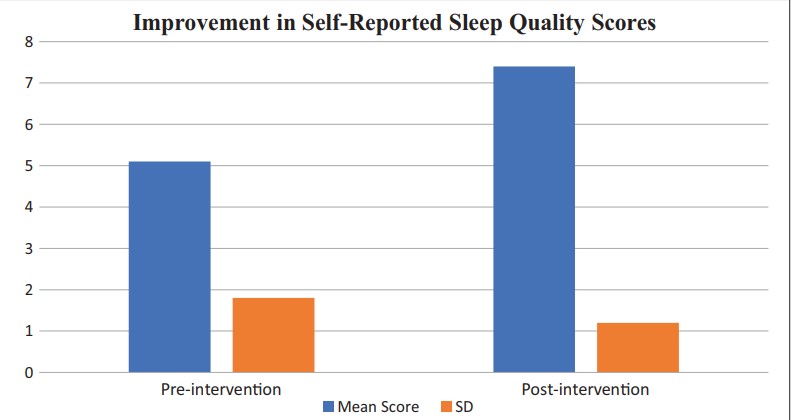
Background: Poor sleep quality is a growing public health concern, with dietary behaviors playing a crucial role in regulating circadian rhythms and overall restfulness. Mindful eating, a practice emphasizing awareness and intentionality in food choices, has shown potential in improving sleep outcomes. Objective: To explore the perceptions, experiences, and behavioral changes associated with a community-based mindful eating intervention on sleep quality among adults aged 18–45 years. Methods: A qualitative study was conducted with 35 participants (18 male, 17 female) using in-depth interviews. The intervention included a four-week community program on mindful eating principles, meal timing, and caffeine/ sugar reduction strategies. Pre and post-intervention interviews captured behavioral changes, perceived improvements in sleep, and barriers. Results: Thematic analysis revealed increased awareness of diet-sleep connections, with participants describing reduced sleep onset latency, fewer nocturnal awakenings, and enhanced overall sleep quality. Key themes included shifts toward avoiding late-night sugary foods, reduced pre-sleep anxiety, and greater adherence through community support. Conclusion: Community-based mindful eating interventions can significantly enhance sleep quality and efficiency. Public health programs should integrate dietary awareness campaigns to address modifiable lifestyle determinants of poor sleep.
References
- 1. Afaghi, A., O’Connor, H., & Chow, C. M. (2007). High-glycemic-index carbohydrate meals shorten sleep onset. The American Journal of Clinical Nutrition, 85(2), 426–430. https:// doi.org/10.1093/ajcn/85.2.426.
- 2. Alruwaili, N.W., Alqahtani, N., Alanazi, M.H. et al. (2023). The effect of nutrition and physical activity on sleep quality among adults: a scoping review. Sleep Science and Practice, 7, 8. https://doi.org/10.1186/s41606-023-00090-4.
- 3. Alvarado-García, P.A.A., Soto-Vásquez, M.R., Infantes Gomez, F.M., Guzman Rodriguez, N.M., & Castro-Paniagua, W.G. (2025). Effect of a mindfulness program on stress, anxiety, depression, sleep quality, social support, and life satisfaction: a quasi-experimental study in college students. Frontiers in Psychology, 16, 1508934. https://doi.org/10.3389/fpsyg. 2025.1508934.
- 4. Ateş, K.S., Bakırhan, H., & Kalkan, I. (2024). Mental health and sleep quality: are intuitive eating, hedonic hunger and diet quality, determinants? a cross-sectional study. Malawi Medical Journal, 36(2), 80–89. https://dx.doi. org/10.4314/mmj.v36i2.4.
- 5. Cheung, L., & Cunningham, S. (2017). Mindfulness-based programs and public health. American Journal of Public Health, 107(6), 889–891. https://doi.org/10.2105/ AJPH.2017.303769.
- 6. Grandner, M. A., & Jackson, N. (2013). Sleep and nutrition: The role of diet in sleep regulation and dysfunction. Current Opinion in Clinical Nutrition & Metabolic Care, 16(6), 693–698. https://doi.org/10.1097/ MCO.0b013e328365d8e6.
- 7. Hülsheger, U. R., et al. (2014). Benefits of mindfulness at work: The role of mindfulness in sleep quality. Journal of Occupational Health Psychology, 19(4), 490–502. https://doi. org/10.1037/a0037184.
- 8. Irish, L. A., et al. (2015). The role of sleep hygiene in promoting public health. Sleep Health, 1(1), 24–28. https://doi.org/10.1016/j. sleh.2014.12.001.
- 9. Kristeller, J. L., & Wolever, R. Q. (2011). Mindfulness-based eating awareness training for treating binge eating disorder. Mindfulness, 2(3), 174–182. https://doi.org/10.1007/ s12671-011-0058-3.
- 10. Lo, J. C., Ong, J. L., Leong, R. L., Gooley, J. J., & Chee, M. W. (2016). Cognitive performance, sleepiness, and mood in partially sleep deprived adolescents: The need for sleep study. Sleep, 39(3), 687–698. https://doi.org/10.5665/ sleep.5552.
- 11. Mason, A. E., et al. (2016). A randomized controlled trial of a mindfulness-based intervention for insomnia. Sleep, 39(3), 549–559. https://doi.org/10.5665/sleep.5558.
- 12. Peuhkuri, K., Sihvola, N., & Korpela, R. (2012). Diet promotes sleep duration and quality. Nutrition Research, 32(5), 309–319. https://doi. org/10.1016/j.nutres.2012.03.009.
- 13. St-Onge, M. P., Mikic, A., & Pietrolungo, C. E. (2016). Effects of diet on sleep quality. Advances in Nutrition, 7(5), 938–949. https:// doi.org/10.3945/an.116.012336
Data Sharing Statement
There are no additional data available.
Funding
This research received no funding.
Author Contributions
All authors contributed significantly to the work and approve its publication.
Ethics Declaration
Ethical clearance for the study was obtained from the relevant institutional ethics committee. All participants were provided
with information sheets explaining the study’s objectives, confidentiality measures, and their rights to withdraw at any stage. Written informed consent was obtained prior to participation. Data were anonymized during transcription to protect participant identity.
Acknowledgements
Information not provide.
Conflicts of Interest
The authors report no conflicts of interest in this work.
About this article

Cite this article
Bayaskar S. Mindful Eating for Restorative Sleep: A Community-Based Approach to Sleep Hygiene Improvement. J Prev Med. 2025;13(2):49-54.
Licence:
Attribution-Non-commercial 4.0 International (CC BY-NC 4.0)This license enables reusers to distribute, remix, adapt, and build upon the material in any medium or format for noncommercial purposes only, and only so long as attribution is given to the creator.
| Received | Accepted | Published |
|---|---|---|
| September 01, 2025 | October 06, 2025 | December 20, 2025 |
DOI: 10.21088/ijpm.2321.5917.13225.2
Keywords
Mindful EatingSleep HygieneCircadian RhythmDietPublic HealthSearch for Similar Articles
Similar Articles
- Recent Advances in Diabetes and Obesity Management
- Rhinosporidiosis in A 10-Year-Old Child: A Case Report Highlighting the Environm...
- Forensic Implications of Clinically Significant Diseases: From Sudden Cardiac De...
- Utilizing AI for Identifying and Addressing Health Disparities in Communities: A...
- The Importance of Super Oxidised Solution in the Management of Thermal Burn Wou...
Article Level Metrics
Last UpdatedWednesday 17 June 2026, 07:36:02 (IST)
569
Accesses
28
144
00
Citations
NA
NA
NA
Download citation
Article Keywords
Keyword Highlighting
Highlight selected keywords in the article text.
Timeline
| Received | September 01, 2025 |
| Accepted | October 06, 2025 |
| Published | December 20, 2025 |
licence
Attribution-Non-commercial 4.0 International (CC BY-NC 4.0)
This license enables reusers to distribute, remix, adapt, and build upon the material in any medium or format for noncommercial purposes only, and only so long as attribution is given to the creator.