Full Text (PDF)
Journal of Cardiovascular Medicine and Surgery 8(2):p 47-52, APRIL-JUNE 2022. | DOI: https://doi.org/10.21088/jcms.2454.7123.8222.5
Original Article
Management of Venous Ulcer: Our Experience
Ravi Kumar Chittoria, Debolina Pal, Neljo Thomas
Author Information
Licence:
Attribution-Non-commercial 4.0 International (CC BY-NC 4.0)This license enables reusers to distribute, remix, adapt, and build upon the material in any medium or format for noncommercial purposes only, and only so long as attribution is given to the creator.
Journal of Cardiovascular Medicine and Surgery 8(2):p 47-52, APRIL-JUNE 2022. | DOI: https://doi.org/10.21088/jcms.2454.7123.8222.5
How Cite This Article:
Debolina Pal, Neljo Thomas, Ravi Kumar Chittoria/Management of Venous Ulcer: Our Experience/J Cardiovasc Med Surg.2022;8(2): 47-52.Timeline
Received : April 09, 2022
Accepted : May 22, 2022
Published : June 30, 2022
Abstract
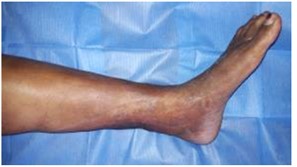
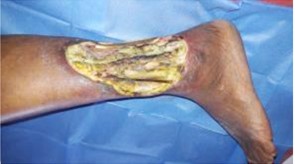
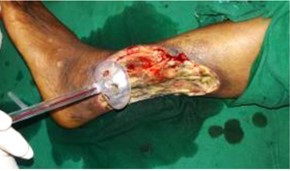
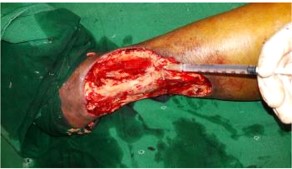
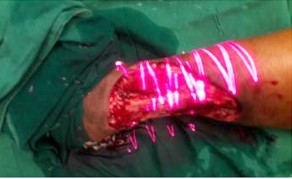
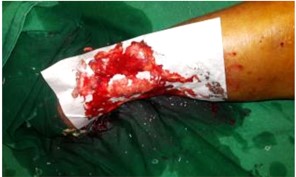
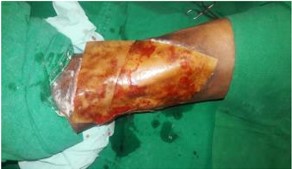
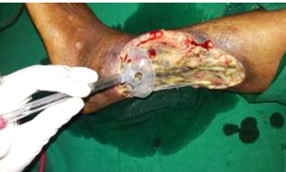
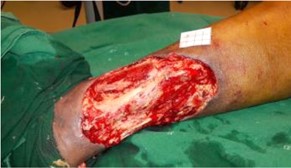
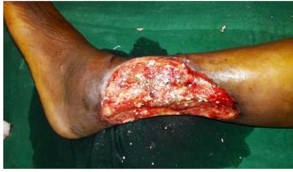
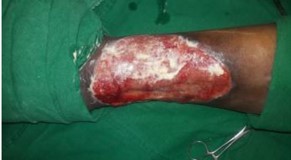
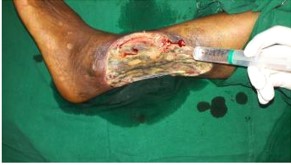
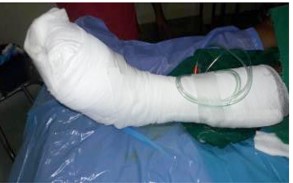
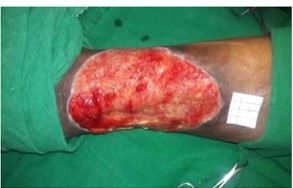
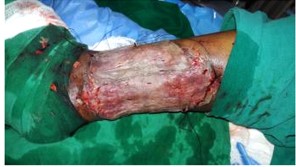
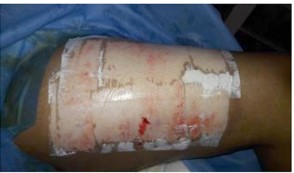
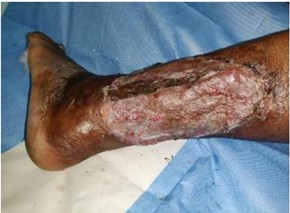
Venous ulcers are common chronic leg ulcers that do not heal despite optimum wound-care practises. Pain and chronic/recurrent nature of venousulcer, poor quality of life, and poor outcome have significant negative impact on health, psyche and social life. Hence there is a need for exploration of effective techniques for healing of venous ulcers. In this article we report the manner in which we have explored various methods for augmentation of healing of venous ulcer such as hemoglobin spray, insulin therapy, vitamin D granule therapy, prolotherapy, low level laser therapy for wound bed preparation, heterografting with collagen and biosilk, hydrojet debridement, sucralfate therapy, RONPWT and finally split thickness skin grafting.
References
- 1. Briggs M, Nelson EA. Topical agents or dressings for pain in venous leg ulcers. Cochrane Database Syst Rev. 2003;1:CD001177.
- 2. Nelzén O, Bergqvist D, Lindhagen A. Long-term prognosis for patients with chronic leg ulcers: a prospective cohort study. Eur J VascEndovasc Surg. 1997;13(5):500-508.
- 3. Samson RH, Showalter DP. Stockings and the prevention of recurrent venous ulcers. Dermatol Surg. 1996;22(4):373-376.
- 4. Abbade LP, Lastória S. Venous ulcer: epidemiology, physiopathology, diagnosis and treatment. Int J Dermatol. 2005;44(6):449-456.
- 5. Callam MJ, Ruckley CV, Harper DR, Dale JJ. Chronic ulceration of the leg: extent of the problem and provision of care. Br Med J (Clin Res Ed). 1985;290(6485):1855-1856.
- 6. Ruckley CV. Socioeconomic impact of chronic venous insufficiency and leg ulcers. Angiology. 1997;48(1):67-69.
- 7. Avci P, Gupta A, Sadasivam M, Vecchio D, Pam Z, Pam N, Hamblin MR. Low-level laser (light) therapy (LLLT) in skin: stimulating, healing, restoring. InSeminars in cutaneous medicine and surgery 2013 Mar (Vol. 32, No. 1, p. 41). NIH Public Access.
- 8. Winfeld B. Topical oxygen and hyperbaric oxygen therapy use and healing rates in diabetic foot ulcers. Wounds. 2014;26:E39–47. [Google Scholar]
- 9. Flanagan M. The physiology of wound healing. J Wound Care. 2000;9:299–300. [PubMed] [Google Scholar]
- 10. Schreml S, Szeimies RM, Prantl L, Karrer S, Landthaler M, Babilas P. Oxygen in acute and chronic wound healing. Br J Dermatol. 2010;163:257– 68. [PubMed] [Google Scholar]
- 11. Hunt SD, Elg F. Clinical effectiveness of hemoglobin spray (Granulox®) as adjunctive therapy in the treatment of chronic diabetic foot ulcers. Diabet Foot Ankle. 2016;7:33101. Published 2016 Nov 7. doi:10.3402/dfa.v7.33101
- 12. Lubart R, Wollman Y, Friedmann H, Rochkind S, Laulicht I. Effects of visible and near infrared lasers on cell cultures. J PhotochemPhotobiol B. 1992;12(3):305–310. [PubMed] [Google Scholar]
- 13. Wu W, Naim JO, Lanzafame RJ. The effect of laser irrafiation on the release of bFGF from 3T3 fibroblasts. PhotochemPhotobiol. 1994;59(2):167– 170. [PubMed] [Google Scholar]
- 14. Vinck EM, Cagnie BJ, Cornelissen MJ, Declercq HA, Cambier DC. Increased fibroblast proliferation induced by light emitting diode and low power laser irradiation. Lasers Med Sci. 2003;18(2):95–99. [PubMed] [Google Scholar]
- 15. Frigo L, Fávero GM, Lima HJ, Maria DA, Bjordal JM, et al. Low-level laser irradiation (InGaAlP-660 nm) increases fibroblast cell proliferation and reduces cell death in a dose-dependent manner. Photomed Laser Surg. 2010;28(Suppl 1):S151–S156. [PubMed] [Google Scholar]
- 16. Basso FG, Oliveira CF, Kurachi C, Hebling J, Costa CA. Biostimulatory effect of low-level laser therapy on keratinocytes in vitro. Lasers Med Sci. 2013;28(2):367–374. [PubMed] [Google Scholar]
- 17. Szymanska J, Goralczyk K, Klawe JJ, Lukowicz M, Michalska M, et al. Phototherapy with low-level laser influences the proliferation of endothelial cells and vascular endothelial growth factor and transforming growth factor-beta secretion. J PhysiolPharmacol. 2013;64(3):387–391.
- 18. Moore P, Ridgway TD, Higbee RG, Howard EW, Lucroy MD. Effect of wavelength on low-intensity laser irradiation-stimulated cell proliferation in vitro. Lasers Surg Med. 2005;36(1):8–12.
- 19. Agaiby AD, Ghali LR, Wilson R, Dyson M. Laser modulation of angiogenic factor production by T-lymphocytes. Lasers Surg Med. 2000;26(4):357– 363.
- 20. Siadat AH, Isseroff RR. Prolotherapy: Potential for the Treatment of Chronic Wounds? Adv Wound Care (New Rochelle). 2019 Apr 1;8(4):160-167. doi: 10.1089/wound.2018.0866. Epub 2019 Apr 3. PMID: 31646060; PMCID: PMC6804793.
- 21. Tumino G, Masuelli L, Bei R, Simonelli L, Santoro A, Francipane S. Topical treatment of chronic venous ulcers with sucralfate: a placebo controlled randomized study. Int J Mol Med. 2008 Jul;22(1):17- 23. PMID: 18575771.
- 22. Sureshbabu A, Okajima H, Yamanaka D, Shastri S, Tonner E, Rae C, et al. IGFBP-5 induces epithelial and fibroblast responses consistent with the fibrotic response. BiochemSoc Trans 2009;37:882-5.
- 23. Van Etten, E., & Mathieu, C. (2005). Immunoregulation by 1,25-dihydroxyvitamin D3: Basic concepts. The Journal of Steroid Biochemistry and Molecular Biology, 97, 93–101.
- 24. Helming, L., Böse, J., Ehrchen, J., Schiebe, S., Frahm, T., &Geffers, R. (2005). 1α, 25-dihydroxyvitamin D3 is a potent suppressor of interferon γ-mediated macrophage activation. Blood, 106, 4351–4358
- 25. Pittas, A. G., Lau, J., Hu, F. B., & Dawson-Hughes, B. (2007). The role of vitamin D and calcium in type 2 diabetes. A systematic review and metaanalysis. The Journal of Clinical Endocrinology and Metabolism, 92, 2017–2029.
- 26. Schutz GS, Sibbald RG, Falanga V, et al. Wound bed preparation: a systemic approach to wound management. Wound Repair Regen. 2003;11(Suppl 1):S1-28.
- 27. Granick MS, Tran BNN, Alvarez OM. Latest advances in wound debridement techniques. SurgTechnol Int. 2020;36:37-40.
- 28. Li Z, Guo S, Yao F, Zhang Y, Li T. Increased ratio of serum matrix metalloproteinase-9 against TIMP-1 predicts poor wound healing in diabetic foot ulcers. J Diabetes Complications. 2013;27(4):380-2.
- 29. Yang C, Zhu P, Yan L, Chen L, Meng R, Lao G. Dynamic changes in matrix metalloproteinase 9 and tissue inhibitor of metalloproteinase 1 levels during wound healing in diabetic rats. J Am Podiatr Med Assoc. 2009;99(6):489-96.
Data Sharing Statement
There are no additional data available. All raw data and code are available upon request.
Funding
This research received no funding.
Author Contributions
All authors contributed significantly to the work and approve its publication.
Ethics Declaration
This article does not involve any human or animal subjects, and therefore does not require ethics approval.
Acknowledgements
We would like to express our gratitude to the patients, their families, and all those who have contributed to this study.
Conflicts of Interest
No conflicts of interest in this work.
About this article

Cite this article
Debolina Pal, Neljo Thomas, Ravi Kumar Chittoria/Management of Venous Ulcer: Our Experience/J Cardiovasc Med Surg.2022;8(2): 47-52.
Licence:
Attribution-Non-commercial 4.0 International (CC BY-NC 4.0)This license enables reusers to distribute, remix, adapt, and build upon the material in any medium or format for noncommercial purposes only, and only so long as attribution is given to the creator.
| Received | Accepted | Published |
|---|---|---|
| April 09, 2022 | May 22, 2022 | June 30, 2022 |
DOI: https://doi.org/10.21088/jcms.2454.7123.8222.5
Keywords
Venous ulcerAPRPLLLTSearch for Similar Articles
Similar Articles
- Cardioembolic Stroke as an Initial Presentation of Carney's Complex: A Case Repo...
- Simultaneous Atrioventricular Valve Repair Compelling Creation of Unconventional...
- Iatrogenic Right Radial Arteriovenous Fistula Post Percutaneous Coronary Interve...
- Revascularization in Chronic Coronary Disease: A Comparison between AHA/ACC (202...
- Improvement in Qualitative Indices with Novel Therapy of Nicorandil in Patients...
Article Level Metrics
Last UpdatedMonday 28 September 2026, 16:17:18 (IST)
1823
Accesses
9
242
00
Citations
NA
NA
NA
Download citation
Article Keywords
Keyword Highlighting
Highlight selected keywords in the article text.
Timeline
| Received | April 09, 2022 |
| Accepted | May 22, 2022 |
| Published | June 30, 2022 |
licence
Attribution-Non-commercial 4.0 International (CC BY-NC 4.0)
This license enables reusers to distribute, remix, adapt, and build upon the material in any medium or format for noncommercial purposes only, and only so long as attribution is given to the creator.