Full Text (PDF)
Indian Journal of Ancient Medicine and Yoga 16(2):p 91-95, April–June 2023. | DOI: https://doi.org/10.21088/ijamy.0974.6986.16223.5
Case Report
Management of Pilonidal Sinus by Ayurvedic Treatment Modalities
Patel Pragati S., Sonani Snehal R., T.S. Dudhamal
Author Information
Licence:
Attribution-Non-commercial 4.0 International (CC BY-NC 4.0)This license enables reusers to distribute, remix, adapt, and build upon the material in any medium or format for noncommercial purposes only, and only so long as attribution is given to the creator.
Indian Journal of Ancient Medicine and Yoga 16(2):p 91-95, April–June 2023. | DOI: https://doi.org/10.21088/ijamy.0974.6986.16223.5
How Cite This Article:
Patel Pragati S., Sonani Snehal R., T.S. Dudhamal/Management of Pilonidal Sinus by Ayurvedic Treatment Modalities/Indian J of Ancient & Yoga. 2023;16(2): 91–95.Timeline
Received : April 30, 2023
Accepted : June 12, 2023
Published : June 30, 2023
Abstract
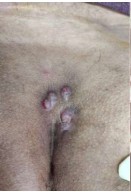
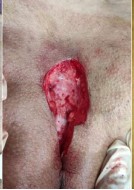
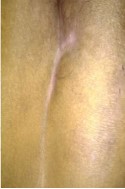
Pilonidal sinus can be correlated with Shalyajanya Nadivrana by Acharya Sushruta according to its pathophysiology and etiology. It is commonly seen in young age people in 2nd and 3rd decades and more prevalent in heavy motorvehicle drivers. Excision of Pilonidal sinus tract is the best choice of treatment for pilonidal sinus till date but the condition often reoccurs due to the failure in identifying and draining all the sinuses or residual hair in the cavity or low quality post-operative care This study includes, A case of 22 years old male patient having complaint of Pain and swelling in the lower back region (Natal cleft) along with on and off pus discharge from that swelling for the past two years, which was treated with Chedana (excision) of Nadi-vrana (Sinus tract) followed by proper post-operative care i.e. Vranasodhana with Panchvalkal Kwath and Vrana Ropana with Local application of Yastimadhu Malhara. The wound was completely healed within 60 days and follow up was taken for next 4 months and there was no recurrence was found during 4 months follow up periods.
References
- 1. Kaviraj Shastri A.D., sushrut Samhita in Ayurveda Tatva Sandipika, Chaukhambha Sanskrit sansthan, Nidansthanam Adhyaysu. Ni.10/11-14, pg no. 348.
- 2. Kaviraj Shastri A.D., sushrut Samhita in Ayurveda Tatva Sandipika, Chaukhambha Sanskrit sansthan, Chikitsasthanam Adhyaysu. chi. 17, pg no 99.
- 3. A concise textbook of surgery, Somen Das,7th edition, p1102.
- 4. Devid E. Beck, steven D. Wexner, Janice F. Rafferty, Gordon and Nivatvongs’ Principles and practice of surgery for the colon, Rectum, and Anus 4th edition, Page no.209-219.
- 5. Yogesh Badve, Review study of Potential wound healing properties of Panchvalkal, International Journal of Ayurveda and Pharma research.2019;7(8):53-57.
- 6. Acharya Priyavat Sharma, Dravyaguna Part I, Ed. 3rd, Chaukhambha Bharti Academy, Varansi, 2006, pg no.664-670.
- 7. Gajarmal et. al. UJAHM 2014,02(04): Page no 6-9.
- 8. K. Shobha Bhat, B.N. Vishwesh, A clinical study on the efficacy of Panchvalkal cream in Vranasodhanaw.s.r to its action on microbial load and wound infection, AYU.2014 Apr-Jun; 35(2), Page no.135-140.
- 9. Shobhit Kumar, Binod Bihari Dora. A critical appraisal on Phytochemical constituents and Therapuetic effect of Yashtimadhu (Glycyrrhizaglabra). Reseach & review : Journal of Medical science and technology. 2017; 6(3): 6-10p.
- 10. Gupta VK, Fatima A, Faridi U, et al. Antimicrobial potential of Glycyrrhizaglabra Roots.J ethnopharmacol.Mar 5, 2008; 116(2), Page no. 377-380.
Data Sharing Statement
There are no additional data available. All raw data and code are available upon request.
Funding
ITRA, Jamnagar.
Author Contributions
All authors contributed significantly to the work and approve its publication.
Ethics Declaration
This article does not involve any human or animal subjects, and therefore does not require ethics approval.
Acknowledgements
Prof. Anup Thakar, Director, ITRA, Jamnagar for providing all facilities in the department to conduct the research.
Conflicts of Interest
No conflicts of interest in this work.
About this article

Cite this article
Patel Pragati S., Sonani Snehal R., T.S. Dudhamal/Management of Pilonidal Sinus by Ayurvedic Treatment Modalities/Indian J of Ancient & Yoga. 2023;16(2): 91–95.
Licence:
Attribution-Non-commercial 4.0 International (CC BY-NC 4.0)This license enables reusers to distribute, remix, adapt, and build upon the material in any medium or format for noncommercial purposes only, and only so long as attribution is given to the creator.
| Received | Accepted | Published |
|---|---|---|
| April 30, 2023 | June 12, 2023 | June 30, 2023 |
DOI: https://doi.org/10.21088/ijamy.0974.6986.16223.5
Keywords
Pilonidal sinusShalyajanyanadivranaPanchvalkal KwathYashtimadhu MalharaChedanaExcisionSearch for Similar Articles
Similar Articles
- Role of Aloe-vera as a Regenerative Agent
- Clinical Study in the Management of Essential Hypertension with Pranayam, Suryan...
- A Systematic Review Report on Impact of Yoga Practices on Immune Response with S...
- Performance in the Trail making Test following High Frequency Yoga Breathing and...
- A Study of the Outcomes of a Yoga Prana Vidya Wellness Healing camp conducted at...
Article Level Metrics
Last UpdatedSunday 29 November 2026, 08:25:56 (IST)
7431
Accesses
11
1126
00
Citations
NA
NA
NA
Download citation
Article Keywords
Keyword Highlighting
Highlight selected keywords in the article text.
Timeline
| Received | April 30, 2023 |
| Accepted | June 12, 2023 |
| Published | June 30, 2023 |
licence
Attribution-Non-commercial 4.0 International (CC BY-NC 4.0)
This license enables reusers to distribute, remix, adapt, and build upon the material in any medium or format for noncommercial purposes only, and only so long as attribution is given to the creator.