Full Text (PDF)
International Journal of Neurology and Neurosurgery 17(3):p 199-210, Sept. Dec. 2025. | DOI: 10.21088/ijnns.0975.0223.17325.1
Original Article
Integrative Computational Analysis of Dopaminergic Pathways in Mobile Addiction and Decoding the Therapeutic Efficacy of Musa Acuminata
Prachi Srivastava, Priyanshi Srivastava, Shrijal Singh, Rekha Sharma
Author Information
Licence:
Attribution-Non-commercial 4.0 International (CC BY-NC 4.0)This license enables reusers to distribute, remix, adapt, and build upon the material in any medium or format for noncommercial purposes only, and only so long as attribution is given to the creator.
International Journal of Neurology and Neurosurgery 17(3):p 199-210, Sept. Dec. 2025. | DOI: 10.21088/ijnns.0975.0223.17325.1
How Cite This Article:
Priyanshi Srivastava, Shrijal Singh, Rekha Sharma et. al, Integrative computational analysis of dopaminergic pathways in Mobile Addiction and Decoding the Therapeutic efficacy of Musa acuminata. Int. J Neuro Neurosurgery. 2025; 17(3): 199-211.Timeline
Received : November 18, 2025
Accepted : December 25, 2025
Published : December 30, 2025
Abstract
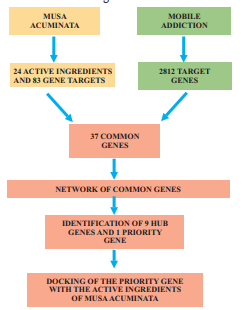
Mobile phone addiction is an emerging behavioural disorder characterized by compulsive and excessive smartphone usage, often linked to dopaminergic dysregulation in the brain’s reward circuitry, particularly involving the mesolimbic pathway. Dysfunctions in dopamine transmission specifically through D1 and D2 receptor signalling have been implicated in the reinforcement of addictive behaviours and impaired impulse control (Kuss & Griffiths, 2015; Montag et al., 2019). In this study, we employed a systems pharmacology approach integrating network pharmacology and molecular docking to decode the therapeutic potential of Musa acuminata (banana), a nutritionally rich plant known for its neuroactive phytochemicals, in modulating dopaminergic targets relevant to mobile addiction. Phytoconstituents of Musa acuminata were sourced from IMPPAT 2.0 and the Human Metabolome Database (HMDB), and their potential targets were predicted using STITCH. Mobile addiction-associated genes, particularly those related to dopamine regulation, were retrieved from GeneCards, yielding 1,872 disease related targets. A protein-protein interaction (PPI) network was constructed via the STRING database, and central hub genes were identified using the CytoHubba plugin in Cytoscape. Key targets such as DRD2, SLC6A3, and COMT were prioritized for molecular docking against top-scoring phytochemicals including dopamine precursors and flavonoids found in Musa acuminata. Molecular docking using DockThor revealed significant binding affinities between active compounds and dopaminergic receptors, suggesting potential modulation of neural pathways implicated in addiction. This integrative computational analysis highlights the prophylactic potential of Musa acuminata in rebalancing dopaminergic function and offers a promising phytotherapeutic direction for the management of mobile phone addiction
References
- 1. Newman DJ, Cragg GM. Natural products as sources of new drugs from 1981 to 2014. J Nat Prod. 2016;79(3):629–61.
- 2. Hopkins AL. Network pharmacology: the next paradigm in drug discovery. Nat Chem Biol. 2008;4(11):682–90.
- 3. Grant JE, Potenza MN. Behavioral addictions: a new challenge for psychiatric classification. Am J Psychiatry. 2006;163(11):1682–6.
- 4. King DL, Delfabbro PH. The cognitive psychology of Internet gaming disorder. Clin Psychol Rev. 2018;60:1–18.
- 5. Sarris J, Panossian A, Schweitzer I, Stough C, Scholey A. Herbal medicine for depression, anxiety and insomnia: a review. Phytother Res. 2011;25(6):919–34.
- 6. Howes MJ, Perry NS, Houghton PJ. Plants with traditional uses and activities, relevant to the management of Alzheimer’s disease and other cognitive disorders. Phytother Res. 2003;17(1):1–18.
- 7. Vivek-Ananth RP, Mohanraj K, Dhivya SM, et al. IMPPAT 2.0: an enhanced and expanded phytochemical atlas of Indian medicinal plants. ACS Omega. 2023;8(9):8827–45.
- 8. Williams RJ, Spencer JP. Flavonoids, cognition, and dementia: actions, mechanisms, and potential therapeutic utility for Alzheimer disease. Free Radic Biol Med. 2012;52(1):35–45.
- 9. Spencer JP. Flavonoids and brain health: multiple effects underpinned by common mechanisms. Nutrients. 2010;2(7):1103–21.
- 10. Mandel S, Youdim MBH. Catechin polyphenols: neurodegeneration and neuroprotection in neurodegenerative diseases. Trends Neurosci. 2004;27(7):339–45.
- 11. Chen B, Liu F, Ding S, Ying X, Wang L, Wen Y. Mobile phone addiction in adolescents: prevalence, predictors, and interventions. Child Youth Serv Rev. 2020;117:105348.
- 12. Kim J, Lee S, Park C, et al. Smartphone addiction in Korean adolescents: prevalence and consequences. J Pediatr. 2017;192:82–9.
- 13. Volkow ND, Fowler JS, Wang GJ. Dopamine in drug abuse and addiction: results from imaging studies and treatment implications. Drug Alcohol Depend. 2004;74(1):3–17.
- 14. Montag C, Walla P. Carriers at risk? Effects of mobile phone dependence. J Behav Addict. 2016;5(4):575–81.
- 15. Demirci K, Akgönül M, Akpinar A. Relationship of smartphone use severity with sleep quality, depression, and anxiety in university students. Comput Human Behav. 2015;31:343–50.
- 16. Grant JE, Chamberlain SR. Neural and behavioral mechanisms of compulsive behavior in addiction. Curr Addict Rep. 2019;6(4):343–52.
- 17. Grace AA. Phasic versus tonic dopamine release and the modulation of dopamine system responsivity: a hypothesis for the etiology of schizophrenia. Neuroscience. 1991;41(1):1–24.
- 18. Schultz W. Getting formal with dopamine and reward. Neuron. 2002;36(2):241–63.
- 19. Berridge KC, Robinson TE. What is the role of dopamine in reward: hedonic impact, reward learning, or incentive salience? Brain Res Brain Res Rev. 1998;28(3):309–69.
- 20. Koob GF, Volkow ND. Neurocircuitry of addiction. Neuropsychopharmacology. 2010; 35(1):217–38.
- 21. Noble EP. D2 dopamine receptor gene in psychiatric and neurologic disorders. Am J Med Genet B Neuropsychiatr Genet. 2003;116B(1):103–25.
- 22. Männistö PT, Kaakkola S. Catechol-Omethyltransferase (COMT): biochemistry, molecular biology, pharmacology, and clinical efficacy of the new selective COMT inhibitors. Pharmacol Rev. 1999;51(4):593–628. .
- 23. Brückl TM, et al. Association of COMT variant val158met with addiction behaviors. Addict Biol. 2011;16(3):476–82.
- 24. Kumar S, et al. Neuroprotective effects of Musa acuminata extract in Parkinson’s disease models. J Ethnopharmacol. 2015;169:234–42.
- 25. Balakrishnan M, et al. Phytochemical screening of Musa acuminata. Phytochemistry. 2013;89:18–24.
- 26. Acharya K, et al. Antioxidant activity of banana fruit peel extracts. Food Chem. 2010;123(3):715–20.
- 27. Shalini RR, et al. Anti-inflammatory and neuromodulatory effects of Musaderived polyphenols. Neurochem Res. 2018;43(12):2315–25.
- 28. Li S, Zhang B, Zhang N. Network pharmacology in traditional Chinese medicine. Evid Based Complement Alternat Med. 2014;2014:1–11.
- 29. Gfeller D, Grosdidier A, Wirth M, et al. SwissTargetPrediction: a web server for target prediction of bioactive small molecules. Nucleic Acids Res. 2014;42:W32–8.
- 30. Morris GM, Huey R, Lindstrom W, et al. AutoDockTools: automated docking with selective receptor flexibility. J Comput Chem. 2009;30(16):2785–91.
- 31. Sakkiah S, Baek A, Lee KW. Binding interaction studies of natural inhibitors with dopamineassociated proteins. J Mol Graph Model. 2012;36:17–25.
- 32. Mohanraj K, et al. IMPPAT: a curated database of Indian medicinal plants. Sci Rep. 2018;8(1):4329.
- 33. Zhao L, et al. NPASS: natural product activity and species source database. Nucleic Acids Res. 2019;47(D1):D1110–7.
- 34. Wishart DS, et al. HMDB: the human metabolome database. Nucleic Acids Res. 2018;46(D1):D608–17.
- 35. Kim S, et al. PubChem 2021 update. Nucleic Acids Res. 2021;49(D1):D1388–95.
- 36. Szklarczyk D, et al. STITCH 5: augmenting protein–chemical interaction networks. Nucleic Acids Res. 2016;44(D1):D380–4.
- 37. Davis AP, et al. Comparative Toxicogenomics Database (CTD): update. Nucleic Acids Res. 2021;49(D1):D1138–43.
- 38. Stelzer G, et al. GeneCards suite: from gene data mining to disease genome sequence analyses. Curr Protoc Bioinformatics. 2016;54:1–30.
- 39. Szklarczyk D, et al. STRING v11: protein– protein association networks. Nucleic Acids Res. 2019;47(D1):D607–13.
- 40. Shannon P, et al. Cytoscape: a software environment for integrated models. Genome Res. 2003;13(11):2498–504.
- 41. Guedes IPA, et al. DockThor-VS web server: virtual screening for SARS-CoV-2 therapeutic targets. Sci Rep. 2021;11:5543.
- 42. Santos KB, et al. Highly flexible ligand docking: benchmarking DockThor. J Chem Inf Model. 2020;60(2):583–95.
- 43. Pettersen EF, et al. UCSF Chimera—a visualization system. J Comput Chem. 2004;25(13):1605–12.
- 44. Dassault Systèmes BIOVIA. Discovery Studio Visualizer, version 2020.
- 45. De Silva FU, et al. Venny: comparing gene lists with Venn diagrams. Bioinformatics. 2017;33(10):1–2.
- 46. Berman HM, et al. The Protein Data Bank. Nucleic Acids Res. 2000;28(1):235–42.
- 47. Abraham MJ, et al. GROMACS: high performance molecular simulations. SoftwareX. 2015;1–2:19–25.
- 48. Pires DE, Blundell TL, Ascher DB. pkCSM: predicting pharmacokinetics and toxicity. J Med Chem. 2015;58(9):4066–72.
- 49. Daina A, Michielin O, Zoete V. SwissADME: evaluating pharmacokinetics and druglikeness. Sci Rep. 2017;7:42717.
- 50. Zhang Y, et al. In vivo validation of dopamine uptake inhibitors. Neuropsychopharmacology. 2014;39(5):1103–12.
- 51. Smith ML, et al. Behavioral paradigms for addiction-like phenotypes in rodents. Curr211 IJNNS / Volume 17, Number 3 / September - December 2025 Protoc Neurosci. 2018;82:e41.Pires DE, Ascher DB, Blundell TL. ADMET predictions with pkCSM and SwissADME. Brief Bioinform. 2018;19(6):1200–11.
- 52. Karplus M, McCammon JA. Molecular dynamics simulations of biomolecules. Nat Struct Biol. 2002;9(9):646–52.
- 53. Hasin Y, Seldin M, Lusis A. Multi-omics approaches to disease. Genome Biol. 2017;18:83.
- 54. Mishra A, et al. Integrative multi-omics for drug discovery in psychiatry. J Transl Med. 2020;18:296.
- 55. Volkow ND, Morales M. The brain on drugs: from reward to addiction. Cell. 2015; 162(4):712–25.
- 56. Kitchen DB, et al. Docking and scoring in virtual screening. Nat Rev Drug Discov. 2004;3(11):935–49.
- 57. Ferreira LG, dos Santos RN, Oliva G, Andricopulo AD. Virtual screening and docking: critical review. Curr Med Chem. 2015;22(23):2874–922.
- 58. Billieux J, et al. Is mobile phone addiction really an addiction? J Behav Addict. 2015; 4(2):127–34.
- 59. Huang Y, et al. Myricetin protects dopaminergic neurons: implications for Parkinson’s disease. J Neurol Sci. 2012;313(1–2):164–9.
- 60. Dajas F, et al. Quercetin as a neuroprotective agent. Free Radic Biol Med. 2015;89:598–609. 61. Volkow ND, et al. Dopamine imbalance in psychiatric disorders. Nat Rev Neurosci. 2017;18(3):142–57.
- 62. Sarris J, et al. Mind–body therapies and natural products in neurological disorders. BMC Complement Med Ther. 2021;21:121.
- 63. Pardridge WM. BBB drug delivery: promising approaches. Front Neurosci. 2020;14:401. 64. Lipinski CA, et al. Solubility and permeability in drug discovery. Adv Drug Deliv Rev. 2001;46(1–3):3–26
- 64. Lipinski CA, et al. Solubility and permeability in drug discovery. Adv Drug Deliv Rev. 2001;46(1–3):3–26
Data Sharing Statement
There are no additional data available. All raw data and code are available upon request.
Funding
This research received no funding.
Author Contributions
All authors contributed significantly to the work and approve its publication.
Ethics Declaration
This article does not involve any human or animal subjects, and therefore does not require ethics approval.
Acknowledgements
We would like to express our gratitude to the patients, their families, and all those who have contributed to this study.
Conflicts of Interest
No conflicts of interest in this work.
About this article

Cite this article
Priyanshi Srivastava, Shrijal Singh, Rekha Sharma et. al, Integrative computational analysis of dopaminergic pathways in Mobile Addiction and Decoding the Therapeutic efficacy of Musa acuminata. Int. J Neuro Neurosurgery. 2025; 17(3): 199-211.
Licence:
Attribution-Non-commercial 4.0 International (CC BY-NC 4.0)This license enables reusers to distribute, remix, adapt, and build upon the material in any medium or format for noncommercial purposes only, and only so long as attribution is given to the creator.
| Received | Accepted | Published |
|---|---|---|
| November 18, 2025 | December 25, 2025 | December 30, 2025 |
DOI: 10.21088/ijnns.0975.0223.17325.1
Keywords
Dopaminergic DysregulationMusa AcuminataMolecular DockingProteinProtein Interaction (PPI) NetworkSearch for Similar Articles
Similar Articles
- Intramedullary Capillary Hemangioma of Conus Medullaris: Case Report and Review...
- Atypical Miller Fisher Syndrome
- Therapeutic Potential of Passiflora incarnata in the Management of Neurological...
- Central or Axial Atlantoaxial Dislocation: Redefining Instability at the Craniov...
- Assessment of Neurocognitive Functions in Post-Acute Stroke Patients Undergoing...
Article Level Metrics
Last UpdatedFriday 23 October 2026, 06:59:19 (IST)
2558
Accesses
70
282
00
Citations
NA
NA
NA
Download citation
Article Keywords
Keyword Highlighting
Highlight selected keywords in the article text.
Timeline
| Received | November 18, 2025 |
| Accepted | December 25, 2025 |
| Published | December 30, 2025 |
licence
Attribution-Non-commercial 4.0 International (CC BY-NC 4.0)
This license enables reusers to distribute, remix, adapt, and build upon the material in any medium or format for noncommercial purposes only, and only so long as attribution is given to the creator.