Full Text (PDF)
Journal of Emergency and Trauma Nursing 5(1):p 07-12, Jan- June 2024. | DOI: n.a
Original Article
Impact of Structured Teaching Program on Knowledge and Level of Nomo-phobia among Adolescent Students in Selected Rural Community, Amritsar, Punjab
Author Information
Licence:
Attribution-Non-commercial 4.0 International (CC BY-NC 4.0)This license enables reusers to distribute, remix, adapt, and build upon the material in any medium or format for noncommercial purposes only, and only so long as attribution is given to the creator.
Journal of Emergency and Trauma Nursing 5(1):p 07-12, Jan- June 2024. | DOI: n.a
How Cite This Article:
Impact of Structured Teaching Program on Knowledge and Level of Nomo-phobia among Adolescent Students in Selected Rural Community, Amritsar, Punjab. J Emerg Trauma Nurs. 2024;5(1):7-12.Timeline
Received : April 02, 2024
Accepted : June 29, 2024
Published : June 30, 2024
Abstract
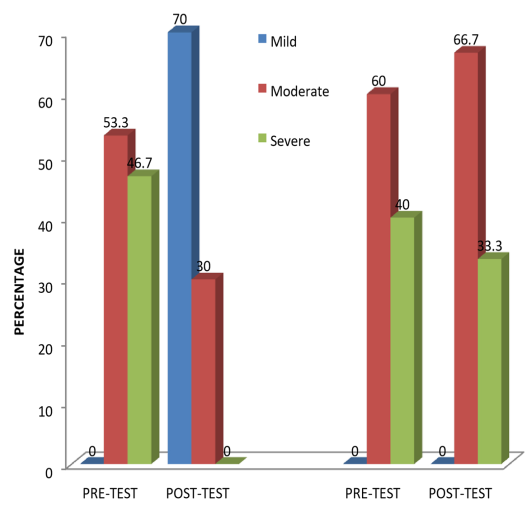
Context: Nomo-phobia or No- Mobile Phone Phobia is described as a psychological condition when people have a fear of being detached from mobile phone connectivity. The burden of this problem is now increasing globally. Aim: The aim of the study is to assess the level of knowledge and level of Nomo-phobia among adolescent students. Setting and Design: Research design for study was Quasi experimental-pre-test and post-test control group design. Methods and Material: The samples of 60 adolescent students were selected to collect data by convenient sampling technique. The tool for data collection were demographic variables, Nomo-Phobia rating scale and structured knowledge Questionnaire regarding Nomo-phobia. Statistical analysis used: The collected data were tabulated, analyzed and interpreted by using descriptive and inferential method. Results: The findings of the study have shown that in experimental group majority in pre-test 16(53.3%) had moderate Nomo-phobia where as in post-test majority 21(70%) had mild Nomo-phobia. Moreover, in control group findings showed that majority 18(6%) and 20(66.7%) had moderate Nomo-phobia in pre-test as well as in post-test respectively. About knowledge level, in experimental group during pre-test majority (66.7%) had average knowledge while in post-test majority (73.3%) had good knowledge regarding Nomo-phobia. Results in control group showed that during pre-test majority (56.7%) had average knowledge and in post-test majority (63.3%) had average knowledge regarding Nomo-phobia. Conclusion: Findings concluded that structured teaching program was very effective in reducing level of Nomo-phobia and improving knowledge regarding Nomo-phobia among adolescents.
References
- 1. https://www.cpdonline.co.uk
- 2. Sudip Bhattacharya, et al. Nomo-phobia. J Family Med Prim Care. 2019; 8(4):1297-1300.
- 3. Suresh K Sharma. Nursing Research and Statistics. 4th Ed. Elsevier; 2011. P. No-132 & 181.
- 4. Ismail Bulent Gurbuz, et al. What is your level of Nomo-phobia? An investigation of prevalence and level of Nomo-phobia among young people in Turkey. Community Ment Health J. 2020;56(5):814-822.
- 5. Nidhin Abraham, et al. A study to assess the knowledge and effect of Nomo-phobia among students of selected Degree colleges in Mysore. Asian J. Nur. Edu. And Research. 2014;4(4):421-428.
- 6. Nasrin Mohammadi Nasab, et al. The Effectiveness of Nomo-phobia Therapy on Self-esteem and Nomo-phobia Symptoms in High School Students. Iranian Journal of Psychiatry and Behavioral Sciences. 2021;15(1):109291.
- 7. Priyanka Thakur. A Quasi experimental study to assess the effect of structured teaching program on Knowledge regarding Nomo-phobia among students of selected colleges in Jalandhar, Punjab. International Journal of Nursing Education. 2016; 8(2);119
Data Sharing Statement
There are no additional data available. All raw data and code are available upon request.
Funding
This research received no funding.
Author Contributions
All authors contributed significantly to the work and approve its publication.
Ethics Declaration
This article does not involve any human or animal subjects, and therefore does not require ethics approval.
Acknowledgements
I would like to acknowledge the study participants for their cooperation and responses. My sincere thanks to all those who have helped me directly and indirectly for the successful completion of this study.
Conflicts of Interest
No conflicts of interest.
About this article

Cite this article
Impact of Structured Teaching Program on Knowledge and Level of Nomo-phobia among Adolescent Students in Selected Rural Community, Amritsar, Punjab. J Emerg Trauma Nurs. 2024;5(1):7-12.
Licence:
Attribution-Non-commercial 4.0 International (CC BY-NC 4.0)This license enables reusers to distribute, remix, adapt, and build upon the material in any medium or format for noncommercial purposes only, and only so long as attribution is given to the creator.
| Received | Accepted | Published |
|---|---|---|
| April 02, 2024 | June 29, 2024 | June 30, 2024 |
DOI: n.a
Keywords
KnowledgeNomo-phobia;Structured teaching programAdolescent students.Search for Similar Articles
Similar Articles
- Recent Advances in Surgical Nursing
- Trauma Nursing Management: A Comprehensive Approach to Patient Care in Acute and...
- Planned Teaching Strategy on Knowledge Regarding Prevention of Home and Miscella...
- A Study to assess the Knowledge Regarding Tracheostomy Care among Critical Care...
- Oxygen Administration and the Vital Role of Nurses: A Comprehensive Review
Article Level Metrics
Last UpdatedMonday 27 July 2026, 08:00:55 (IST)
538
Accesses
18
80
00
Citations
NA
NA
NA
Download citation
Article Keywords
Keyword Highlighting
Highlight selected keywords in the article text.
Timeline
| Received | April 02, 2024 |
| Accepted | June 29, 2024 |
| Published | June 30, 2024 |
licence
Attribution-Non-commercial 4.0 International (CC BY-NC 4.0)
This license enables reusers to distribute, remix, adapt, and build upon the material in any medium or format for noncommercial purposes only, and only so long as attribution is given to the creator.