Full Text (PDF)
Journal of ENT and Allied Sciences 8(1):p 9-12, January-June 2023. | DOI: N/A
Original Article
Hyperpara Thyroidism and its Management
Author Information
Licence:
Attribution-Non-commercial 4.0 International (CC BY-NC 4.0)This license enables reusers to distribute, remix, adapt, and build upon the material in any medium or format for noncommercial purposes only, and only so long as attribution is given to the creator
Journal of ENT and Allied Sciences 8(1):p 9-12, January-June 2023. | DOI: N/A
How Cite This Article:
Kaur S, Subashini SP, Jain P. Hyperparathyroidism and its management. RFP J ENT Allied Sci. 2023;8(1):9–12.Timeline
Received : April 24, 2023
Accepted : May 25, 2023
Published : June 30, 2023
Abstract
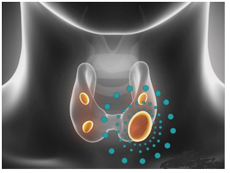
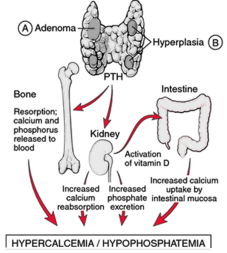
Hyperparathyroidism is an increase in parathyroid hormone (PTH) levels in the blood. This occurs from a disorder either within the parathyroid glands (primary hyperparathyroidism) or as response to external stimuli (secondary hyperparathyroidism). Symptoms of hyperparathyroidism are caused by inappropriately normal or elevated blood calcium leaving the bones and flowing into the blood stream in response to increased production of parathyroid hormone. In healthy people, when blood calcium levels are high, parathyroid hormone levels should be low. With long-standing hyperparathyroidism, the most common symptom is kidney stones. Other symptoms may include bone pain, weakness, depression, confusion, and increased urination. Both primary and secondary may result in osteoporosis (weakening of the bones). In 80% of cases, primary hyperparathyroidism is due to a single benign tumor known as a parathyroid adenoma. Most of the remainder are due to several of these adenomas. Very rarely it may be due to parathyroid cancer. Secondary hyperparathyroidism typically occurs due to vitamin D deficiency, chronic kidney disease, or other causes of low blood calcium. The diagnosis of primary hyperparathyroidism is made by finding elevated calcium and PTH in the blood.
References
- 1. https://rspmanguharjo.jatimprov.go.id /wpcontent /uploads /2020/02/11.-Handbook-for - Brunner - and - Suddarths - Textbook - of - Medical - Surgical - Nursing - 12th - Edition - Suzann.pdf
- 2. h t t p s : / / w w w . h y p e r p a r a t h y r o i d m d . c o m / hyperparathyroidism/
- 3. https://en.wikipedia.org/wiki/Hyperparathy roidism
- 4. https://www.endocrineweb.com / conditions / hyperparathyroidism / hyperparathyroidism
Data Sharing Statement
There are no additional data available
Funding
This research received no funding
Author Contributions
All authors contributed significantly to the work and approve its publication
Ethics Declaration
This article does not involve any human or animal subjects, and therefore does not require ethics approval
Acknowledgements
Information Not Provided
Conflicts of Interest
No conflicts of interest in this work.
About this article

Cite this article
Kaur S, Subashini SP, Jain P. Hyperparathyroidism and its management. RFP J ENT Allied Sci. 2023;8(1):9–12.
Licence:
Attribution-Non-commercial 4.0 International (CC BY-NC 4.0)This license enables reusers to distribute, remix, adapt, and build upon the material in any medium or format for noncommercial purposes only, and only so long as attribution is given to the creator
| Received | Accepted | Published |
|---|---|---|
| April 24, 2023 | May 25, 2023 | June 30, 2023 |
DOI: N/A
Keywords
Vitamin DOsteoporosisParathoromoneRenal RicketsSearch for Similar Articles
Similar Articles
- Concurrent Epidermal Inclusion Cyst and Lipoma of the Cervical Region: A Rare Co...
- Beyond the Lower Lip: Blandin–Nuhn Cyst—Clinicopathological Insights into a Rare...
- Histopathology in Disease Diagnosis: Interpreting Cellular Patterns
- Artificial Intelligence: An Aid in Diagnosis by Otoscopy
- Pseudomonas Aeruginosa in an Immunocompetent Individual with Acute Tonsillitis;...
Article Level Metrics
Last UpdatedMonday 07 September 2026, 23:17:21 (IST)
835
Accesses
14
117
00
Citations
NA
NA
NA
Download citation
Article Keywords
Keyword Highlighting
Highlight selected keywords in the article text.
Timeline
| Received | April 24, 2023 |
| Accepted | May 25, 2023 |
| Published | June 30, 2023 |
licence
Attribution-Non-commercial 4.0 International (CC BY-NC 4.0)
This license enables reusers to distribute, remix, adapt, and build upon the material in any medium or format for noncommercial purposes only, and only so long as attribution is given to the creator